


available on the
Google Play
Learn the key documents required when buying land in Kenya. Verify title deeds, land search, and avoid fraud with this complete checklist.
You have found a plot that looks perfect. The price is right. The location is great. But before you pay a single shilling, you must see the right documents.
Land fraud in Kenya often happens because buyers skip verification. They trust the seller’s word. They do not ask for papers. Later, they discover the title is fake or the land belongs to someone else.
This guide lists every document you need when buying land in Kenya. Use it as a checklist. Verify each item before you commit. Whether you are in Nairobi or abroad, these steps will protect your investment.
At Nyota Njema Real Estate, we verify all documents before listing any property. Use this guide to stay safe.
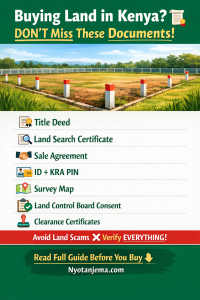
Seven key documents must be checked before buying land: title deed, land search certificate, sale agreement, mutation forms, survey map, Land Control Board consent, and identification.
The title deed is the most important document. Always verify it with an official land search.
Fake title deeds are common. Learn the red flags: mismatched names, missing registry records, unverified signatures.
Diaspora buyers can verify documents remotely using eCitizen and local professionals.
Never pay before seeing original documents and conducting a land search.
Nyota Njema helps clients verify documents and avoid fraud.
Get a professional document verification today.
Before you pay any deposit, ensure you have seen and verified these documents:
✅ Title deed (original or certified copy)
✅ Official land search certificate (from eCitizen or Ministry of Lands)
✅ Sale agreement (drafted by a lawyer)
✅ Mutation forms (if land was subdivided)
✅ Survey map / Registry Index Map (RIM) (showing plot boundaries)
✅ Land Control Board consent (for agricultural land)
✅ ID and KRA PIN of the seller (and buyer)
Each document serves a specific purpose. Missing any could mean the land is not safe to buy.

Below is a detailed explanation of each document, why it matters, and what to look for.
The title deed is the official document proving land ownership. It is issued by the Ministry of Lands.
What to check:
The owner’s name must match the seller’s ID.
The land reference number (LR No.) must be clear.
The property description (size, location) must match what you are told.
No alterations, erasures, or suspicious stamps.
Red flags:
The deed looks photocopied or has low‑quality paper.
The owner’s name does not match the seller.
There is a caveat (a legal hold) written on the document.
How to verify: Always conduct an official land search (see next section). Do not rely on the deed alone.
A land search is an official inquiry at the Ministry of Lands (or via eCitizen) that confirms the current ownership and status of the land.
What it shows:
The registered owner’s name.
Whether there are any caveats, cautions, or encumbrances.
If land rates are unpaid (arrears can block transfer).
The type of title (freehold or leasehold).
How to get one:
Online via eCitizen (Ksh 500 – 1,000).
In person at the Ministry of Lands (Ardhi House) or county land registry.
Important: A land search certificate is the only reliable proof of ownership. Even if the seller shows you a title deed, always do a search.
The sale agreement is a contract between buyer and seller. It outlines the terms of the transaction.
What it must include:
Full names and IDs of both parties.
Land reference number and description.
Agreed purchase price and payment schedule.
Deposit amount and deadline.
Completion date and penalties for delay.
Clause stating that the land has a clean title.
Why it matters: A poorly drafted agreement leaves you vulnerable. Always have a lawyer review it before signing.
A mutation form is used when land has been subdivided into smaller plots. It shows the changes to the original title.
When you need it:
If the seller is offering a portion of a larger parcel.
If the land was recently subdivided.
What to check:
The mutation form must be registered at the Ministry of Lands.
The new plot numbers must match the title deed you are given.
Red flag: The seller cannot produce a mutation form. That means the subdivision was never officially recorded.
The survey map shows the exact location, shape, and boundaries of the plot. It is produced by the Survey of Kenya.
Why you need it:
To confirm the plot exists where the seller claims.
To verify the size matches the title deed.
To see access roads and neighbouring plots.
How to get it: You or your surveyor can request a copy from the Survey of Kenya.
Diaspora tip: A surveyor can also visit the site and place beacons. This gives you physical proof of boundaries.
For land classified as agricultural, the Land Control Board (LCB) must approve the sale. This is a legal requirement under the Land Control Act.
What it does: It ensures the transaction is valid and prevents illegal subdivisions of agricultural land.
When required:
Any transaction involving agricultural land.
Even if you plan to later convert to residential, you need LCB consent first.
How to get it: The seller and buyer attend a local LCB meeting. The board issues a consent letter, valid for 6 months.
Consequence of skipping: The transfer will be void. You cannot register the title in your name.
Both the buyer and seller must provide copies of their national ID or passport and their KRA PIN certificate.
Why needed:
To confirm the identity of the parties.
The KRA PIN is required for stamp duty assessment and payment.
What to check: Ensure the ID matches the name on the title deed and sale agreement.

Land fraudsters use forged documents. Here are common signs of trouble.
The name on the title deed differs from the seller’s ID. Or the ID photo does not match the person selling.
You conduct a land search, but the registry has no record of the title number. Or the owner’s name is different from what the seller claims.
The sale agreement or transfer forms have signatures that look different from the seller’s ID signature. Or the advocate’s stamp is missing.
The land search shows large arrears of land rates. The seller promises to pay later. Often, they never do, and the buyer inherits the debt.
The seller only provides a photocopy. They claim the original is “at the bank” or “lost.” Always insist on seeing the original.
If you see any of these, do not proceed. Contact a lawyer or Nyota Njema for help.
Buying land from abroad makes document verification harder – but not impossible. Follow these steps.
Ask the seller or agent to email you:
Title deed (clear scan)
Sale agreement draft
Survey map
Any mutation forms
You can log into eCitizen from anywhere using your Kenyan ID or passport. Pay Ksh 500 – 1,000 and download the official search certificate.
A trusted professional on the ground can:
Visit the Ministry of Lands to verify documents.
Check physical records (some are not online).
Attend the Land Control Board meeting on your behalf (using a power of attorney).
We provide a secure portal where you can upload, share, and verify documents. Our team handles the physical checks and sends you reports.
Many diaspora buyers lose money because they skip these steps. Do not be one of them.
For more detail, read our How to Verify Land Zoning Remotely (Diaspora Guide).
The documents you verify now directly impact what you can build later.
Title deed – shows the type of ownership (freehold/leasehold). Leasehold land may require additional approvals.
Land search – reveals any caveats or disputes that could block building permits.
Mutation forms – confirm the plot size and shape. If the subdivision was illegal, you cannot build.
Survey map – shows access roads and boundaries. No legal access means no building approval.
Land Control Board consent – for agricultural land, without it you cannot even start the change of user process.
Therefore, verifying documents is not just about ownership. It is about ensuring the land is legally buildable.
For more, read our Understanding Land Zoning in Kenya and Can You Build on a 50×100 Plot? guides.
Q: What is the most important document when buying land in Kenya?
A: The title deed combined with an official land search certificate. The deed shows ownership; the search confirms it is genuine and up to date.
Q: Can I buy land without a title deed?
A: No. A title deed is proof of ownership. Buying without it is extremely risky. You may end up with no legal claim to the land.
Q: How do I confirm land ownership in Kenya?
A: Conduct an official land search through eCitizen or at the Ministry of Lands. This gives you the current registered owner’s name.
Q: How long does land transfer take after documents are submitted?
A: Typically 2 weeks to 3 months, depending on the registry and whether all consents are in place.
Q: What documents are needed for land transfer in Kenya?
A: Transfer form (Form RL 7), original title deed, sale agreement, land search, consent letters (LCB, spousal), ID and KRA PIN copies, and stamp duty receipt.
Q: How do I identify a fake title deed?
A: Look for mismatched names, poor paper quality, missing registry records, or unverified signatures. Always cross‑check with an official land search.
Q: Can diaspora buyers get documents verified without coming to Kenya?
A: Yes. Use eCitizen for online search, hire a local lawyer or agent, and request digital copies of all documents. Nyota Njema offers this service.
Q: What is a caveat on a title deed?
A: A caveat is a legal notice that someone has a claim on the land. It prevents transfer or registration. Do not buy land with a caveat until it is removed.
Q: Do I need a lawyer to check land documents?
A: It is highly recommended. A lawyer can spot irregularities and ensure the sale agreement protects you.
Q: What happens if the seller refuses to show the original title deed?
A: Walk away. That is a major red flag. No original title, no deal.
Do not risk your savings on fake or problematic papers.
At Nyota Njema Real Estate, we help you:
✅ Verify title deeds and land searches
✅ Confirm ownership and spot caveats
✅ Check mutation forms and survey maps
✅ Ensure all documents are in order before you pay
Get a professional document verification today.
Written by Nyota Njema Real Estate
Nyota Njema is a registered real estate company in Kenya . We specialise in land verification, document checking, and helping local and diaspora buyers purchase land safely.
“I almost bought land from a seller who had a fake title deed. Nyota Njema did a land search and found the real owner was someone else. They saved me from losing Ksh 1.2 million.”
– S. Kimani, Nairobi
“As a diaspora buyer, I was nervous about documents. Nyota Njema handled everything – they got the land search, verified the title, and even attended the LCB meeting on my behalf. Now I have a clean title in my name.”
– M. Atieno, Diaspora buyer (USA)
Locations:
Topics:
Tools:
We only list plots with verified titles and complete documentation. Our properties are safe for both local and diaspora buyers.
Request available plots today.
Mon to Fri: 8am to 5pm Saturday: 8am to 1pm
Email: [email protected] Phone: +254 728 895 895 Nairobi, Thome, Mukuyu Court