



available on the
Google Play

Learn how to avoid land scams in Kenya while abroad. This 2026 diaspora guide reveals common fraud tricks, verification steps, and how to safely buy land with a title deed.
Let’s summarize everything into a quick checklist you can refer to before every land deal:
No obligation. 20‑minute chat to answer your questions.
Book a consultation with our diaspora land experts.
No obligation. 20‑minute chat to answer your questions.
Buying land in Kenya while living abroad can be highly rewarding—but also risky if you don’t follow the right process. Many diaspora investors lose money due to fake title deeds, double sales, or unverified agents.
This guide shows you exactly how to avoid land scams in Kenya and invest safely from anywhere in the world.
Whether you are in the US, UK, Europe, or the Middle East, the rules of safe land investment in Kenya remain the same. You just need a clear plan, the right professionals, and a healthy dose of caution.
Let’s walk through everything step by step.
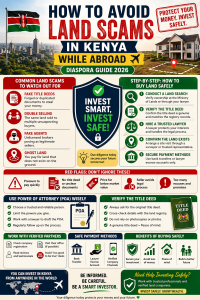
Scammers often target diaspora buyers because you are not physically present to verify details yourself. They know you rely on photos, phone calls, and third parties. And they exploit that gap.
Here are the main reasons diaspora investors become victims:
You are not physically present – You cannot walk the land, check beacons, or visit the local lands office.
You rely on third parties – Agents, relatives, or brokers may not be honest or competent.
You may not understand local processes – Land laws, control boards, and registry procedures can be confusing.
You are perceived as wealthy – Scammers assume you have money and are eager to close deals quickly.
📌 Featured Snippet: Diaspora buyers are frequently targeted by land scammers in Kenya because they rely on agents and cannot physically verify property or documents.
If you understand this dynamic, you are already ahead. The rest is about building a system that protects you.
Before you send any money, you need to recognize the most common fraud tactics. These scams are responsible for millions of shillings lost by Kenyans abroad.
Fraudsters create duplicate or forged title documents that look real. They might show you a “certificate of title” that is completely fake or cloned from another property.
Without an official land search, you cannot tell the difference.
The same plot is sold to multiple buyers, often within weeks. Each buyer receives a “title deed,” but only the first registered owner has a valid claim. The others lose everything.
You pay for land that doesn’t exist on the ground. The seller shows you a plot map, collects money, and disappears. When you finally visit, you find a swamp, a road, or someone else’s farm.
Unlicensed individuals pose as legitimate sellers or company representatives. They may rent an office, wear suits, and even show you fake documents. Their only job is to take your deposit and vanish.
📌 Featured Snippet: Common land scams in Kenya include fake title deeds, double selling of land, and fraudulent agents targeting unsuspecting diaspora buyers.
Knowing these scams is not enough. You must actively verify every single claim.
Now comes the most important section. Follow these steps every time, with every property, no exceptions.
You cannot skip this. A land search confirms who legally owns the property, whether there are any caveats (restrictions), and if the title is genuine.
How to do it from abroad:
Use the Ministry of Lands e-Citizen portal (if available in 2026)
Or hire a Kenyan lawyer to visit the land registry on your behalf
You will need the title deed number or plot reference number
Expect to pay a small official fee. Keep the search certificate for your records.
Once the land search confirms ownership, you must ensure the physical title deed matches the registry records.
Ask your lawyer to:
Compare the deed with the registry copy
Check for watermarks, serial numbers, and official stamps
Confirm the land size and boundaries
Never rely on a WhatsApp image or a scanned PDF. Always verify through official channels.
This is non-negotiable. A good lawyer protects you from fraud, drafts contracts, and manages the transfer process.
How to find a reliable lawyer while abroad:
Ask for referrals from trusted family or friends in Kenya
Check the Law Society of Kenya (LSK) directory
Interview at least two lawyers before hiring
Never use a lawyer recommended by the seller
Your lawyer should be independent and focused only on your interests.
You cannot see the land yourself? Then send someone you trust.
Ideal representatives include:
A registered surveyor (best option)
A trusted family member with land knowledge
Your lawyer (though this costs more)
Ask them to:
Take photos and video of the exact plot
Show nearby roads, utilities, and landmarks
Confirm beacons (boundary markers) exist
Talk to neighbors to verify ownership history
If the land does not exist or is already occupied, your representative will expose the lie before you pay a shilling.
📌 To verify land in Kenya while abroad, conduct a land search, confirm the title deed, hire a lawyer, and ensure the property physically exists.
If you cannot travel to Kenya for closing, you can assign a trusted person through a Power of Attorney (POA). This legal document allows someone to sign documents and make payments on your behalf.
But you must be very careful.
Choose someone extremely reliable – Ideally a close family member or your lawyer. Never give POA to an agent or broker.
Limit their authority – Write specific powers only for the land transaction. Do not give general control over your affairs.
Work with a lawyer – A Kenyan lawyer must draft the POA and register it properly.
Set a time limit – The POA should expire after the land deal is complete.
📌 Diaspora buyers can use a Power of Attorney to purchase land in Kenya, but it must be legally drafted and given to a trusted individual.
Without a POA, you may need to travel to Kenya to sign transfer documents. Plan ahead to avoid delays.
A title deed is your proof of ownership. Without a genuine, registered title, you own nothing.
Never rely on:
Photocopies shown over email
WhatsApp images of a “title deed”
Verbal assurances from the seller
A quick Google search or agent’s claim
Get the title deed number from the seller.
Ask your lawyer to run an official search at the Ministry of Lands or via the e-Citizen land portal.
Confirm the owner’s name, parcel number, size, and any encumbrances (loans, caveats, court orders).
Match the search result with the physical deed presented to you.
If there is any mismatch – even a small one – stop the deal.
📌 A genuine title deed must be verified through official land registry records in Kenya before any payment is made.
How you pay is almost as important as what you buy. Avoid cash deals or unclear transactions.
Bank transfers – Direct to the seller’s verified bank account. Never send money to a personal mobile number or agent’s account.
Lawyer escrow accounts – Your lawyer holds the money until all documents are verified and ownership is transferred. This is the safest method.
Verified company payment channels – If buying from a developer, use their official corporate bank account, not a salesperson’s personal account.
Cash (no paper trail)
M-Pesa for large amounts (limited recovery options)
Western Union or similar to an individual
Cryptocurrency (untraceable)
📌 The safest way to pay for land in Kenya from abroad is through bank transfers or lawyer-managed escrow accounts.
Always get a written receipt and payment confirmation. Keep all bank transaction records.
Not all land sellers are fraudsters. Many legitimate real estate companies serve diaspora buyers. But you must separate the professionals from the scammers.
Before dealing with any company or agent:
Check company registration – Search the eCitizen business registry to confirm the company exists and is active.
Read reviews – Look on Google, Trustpilot, and diaspora forums. Be wary of companies with no online presence or only fake reviews.
Confirm physical offices – Ask for video proof of their office. A legitimate company will have a real address you can verify through a friend or lawyer.
Ask for past clients – Request references from other diaspora buyers. Contact them directly.
No physical office or only a virtual address
Unusually cheap land compared to market rates
No registered title deeds available for inspection
Pushy salespeople demanding immediate payment
📌 Diaspora buyers should only work with verified real estate companies and avoid unusually cheap land offers to reduce fraud risk.
If something feels off, walk away. There will always be another plot.
You do not need to be a lawyer to spot trouble. Trust your gut and watch for these warning signs:
| Red Flag | Why It’s Dangerous |
|---|---|
| Pressure to “pay quickly” | Scammers want money before you verify. |
| No title deed available | The seller may not own the land. |
| Price far below market value | “Too good to be true” usually is. |
| Seller avoids legal process | Legitimate sellers welcome lawyers. |
| Inconsistent names on documents | Could indicate forgery or multiple owners. |
| No surveyor’s report | Boundaries may be false or disputed. |
📌 Major red flags in Kenyan land deals include rushed payments, missing title deeds, and prices that are significantly below market value.
If you see two or more of these flags, stop all communication and consult your lawyer immediately.
These are the habits of successful diaspora land investors. Adopt them, and you will avoid almost all scams.
Always involve a lawyer from day one – Not after you have paid a deposit. Let your lawyer review every document before you commit.
Never skip due diligence – Land search, title verification, site visit. Every step matters.
Visit the land (physically or via trusted agent) – No exception. If you cannot visit, pay a surveyor to go.
Keep all documentation – Save emails, receipts, search certificates, contracts, and WhatsApp chats. You may need them in court.
Be patient – Legitimate deals take weeks or months. Scams are always “urgent.”
Learn the local market – Understand average land prices per region. If a deal is 50% cheaper, ask why.
One more pro tip: Join diaspora forums and WhatsApp groups focused on safe land investment in Kenya. Other buyers share experiences, warn about fraudsters, and recommend trusted lawyers.
[How to verify a title deed online in Kenya – full tutorial]
[Power of attorney for land transactions – legal template guide]
[Avoid double allocation of land – official land registry process]
Buying land in Kenya while abroad is safe if done correctly. Thousands of diaspora investors have done it successfully. The key is simple:
👉 Verify everything – Every document, every claim, every person.
👉 Trust no shortcuts – Cheap deals and fast closings are traps.
👉 Follow the legal process – Land search, lawyer, surveyor, registry transfer.
Avoiding scams is not about luck – it’s about discipline and due diligence.
📌 To avoid land scams in Kenya while abroad, conduct due diligence, verify title deeds, use a lawyer, avoid rushed deals, and only work with trusted professionals.
At Nyota Njema Real Estate, we do not just list land. We track infrastructure trends and help you buy in areas with the highest growth potential.
What we offer:
 Verified land – title searches, survey, and zoning checks.
Infrastructure intelligence – we know which areas are about to appreciate.
Flexible payment plans – deposit from 30%, balance over 6–12 months.
Diaspora support – virtual site visits, power of attorney, remote document handling.
Nyota App – track your purchase and receive updates.
Book a free consultation to discuss where to invest in Kiambu in 2026.
Contact Nyota Njema Real Estate today.
Call / WhatsApp: +254 728 895 895
Email: [email protected]
Click here to book an appointment
Written by Nyota Njema Real Estate
Nyota Njema is a registered real estate company in Kenya . We specialise in verified land sales across Kiambu County, with full due diligence on tenure type, land rent, and title deeds.
Locations:
Topics:
Tools:
Mon to Fri: 8am to 5pm Saturday: 8am to 1pm
Email: [email protected] Phone: +254 728 895 895 Nairobi, Thome, Mukuyu Court