

available on the
Google Play

Learn everything about Title Deeds in Kenya, including verification, transfer, freehold vs leasehold ownership, replacement of lost title deeds, and how to buy land safely with expert guidance from Nyota Njema Real Estate.
Invest with confidence through Nyota Njema Real Estate. Explore verified properties with ready Title Deeds, transparent pricing, and expert guidance from search to ownership.
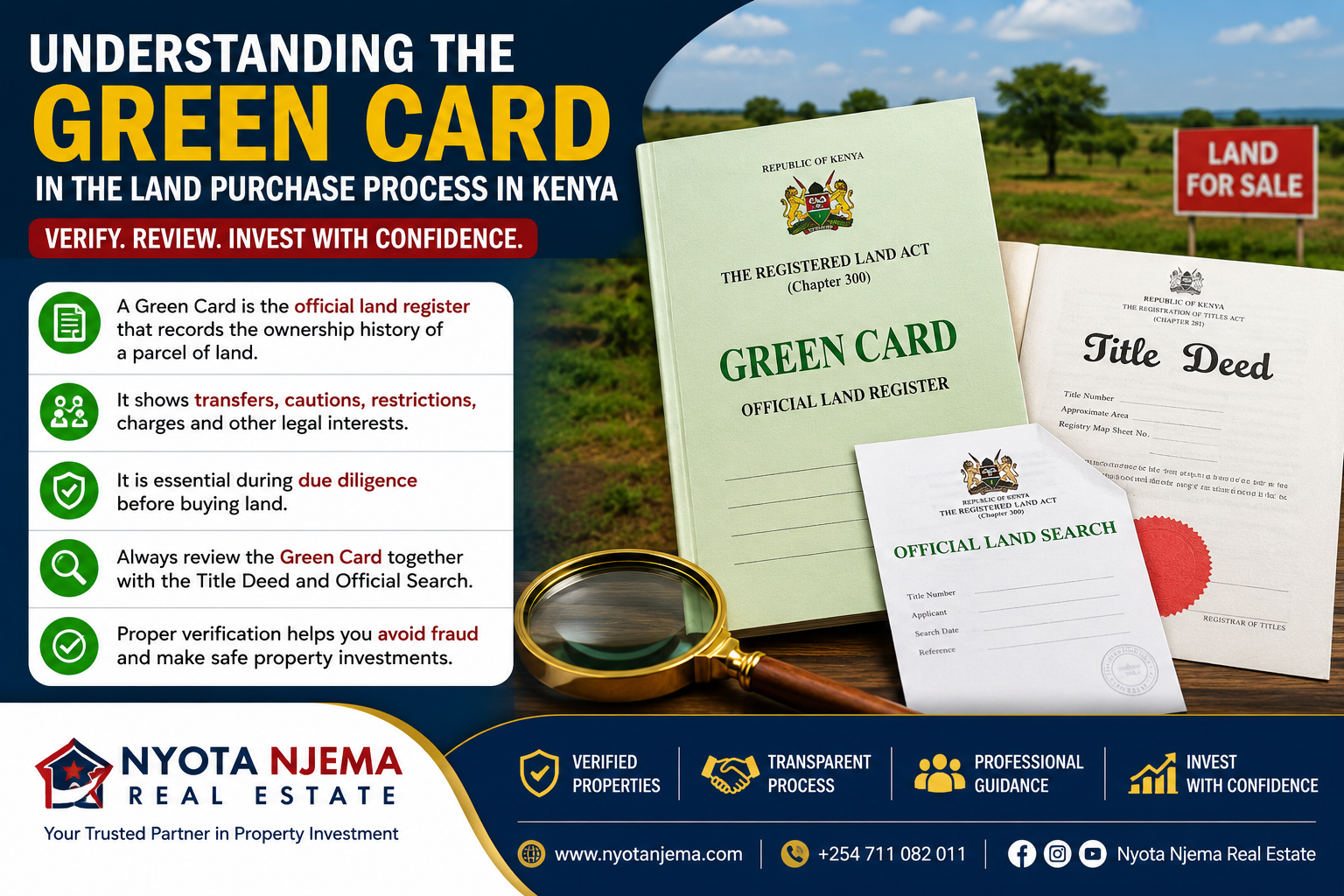
A Title Deed is the legal document that proves ownership of land in Kenya. Before buying land, always verify the Title Deed through an Official Search, confirm the registered owner, inspect the property, review the Survey Map, and complete proper due diligence. These steps help protect buyers from fraud, ownership disputes, and costly mistakes.
A genuine Title Deed proves legal ownership of land. Always verify it through an Official Search before making any payment.
*Risk can be significantly reduced through proper due diligence, an Official Search, Title Deed verification, and buying from trusted providers such as Nyota Njema Real Estate.
A Title Deed is one of the most important documents in any property transaction. It provides legal proof that an individual or organization owns a specific parcel of land and outlines key details such as the registered owner, parcel number, acreage, and ownership rights.
Unfortunately, many land buyers assume that simply seeing a Title Deed is enough to guarantee a safe purchase. This is one of the biggest mistakes a buyer can make. A Title Deed should always be verified through an Official Search, compared with government land records, and supported by proper due diligence before any payment is made.
Cases involving forged title deeds, double allocation, ownership disputes, and fraudulent land sales continue to affect buyers across Kenya. Whether you are purchasing your first residential plot, investing in agricultural land, or buying property for future development, understanding how Title Deeds work can save you from significant financial loss.
Proper verification becomes even more important in rapidly growing investment locations such as Nanyuki, Naivasha, Juja, Kitengela, Malindi, and Diani, where increasing demand has made property transactions more frequent.
Working with experienced professionals like Nyota Njema Real Estate further improves your confidence by providing verified property listings, transparent documentation, and professional guidance throughout the land buying process.
In this guide, you will learn what a Title Deed is, why it matters, how to verify it, the different types of land ownership in Kenya, common mistakes buyers make, and the steps you should follow before investing in land.
Get expert guidance, verified Title Deeds, and transparent property investment support from Nyota Njema Real Estate.
A Title Deed is an official legal document issued by the Government of Kenya that confirms ownership of a specific parcel of land. It contains essential information about the property and serves as evidence of ownership during land transactions.
A genuine Title Deed typically includes:
Although a Title Deed confirms ownership, buyers should never rely on the document alone. Verification through the Ministry of Lands, an Official Search, and physical inspection of the property remains essential.
What is a Title Deed?
A Title Deed is an official legal document that proves ownership of land in Kenya. It contains information about the registered owner, parcel number, property size, location, and ownership rights. Buyers should always verify a Title Deed through an Official Search before purchasing land.
Always conduct an Official Search before paying a deposit.
📍 Visit the Property
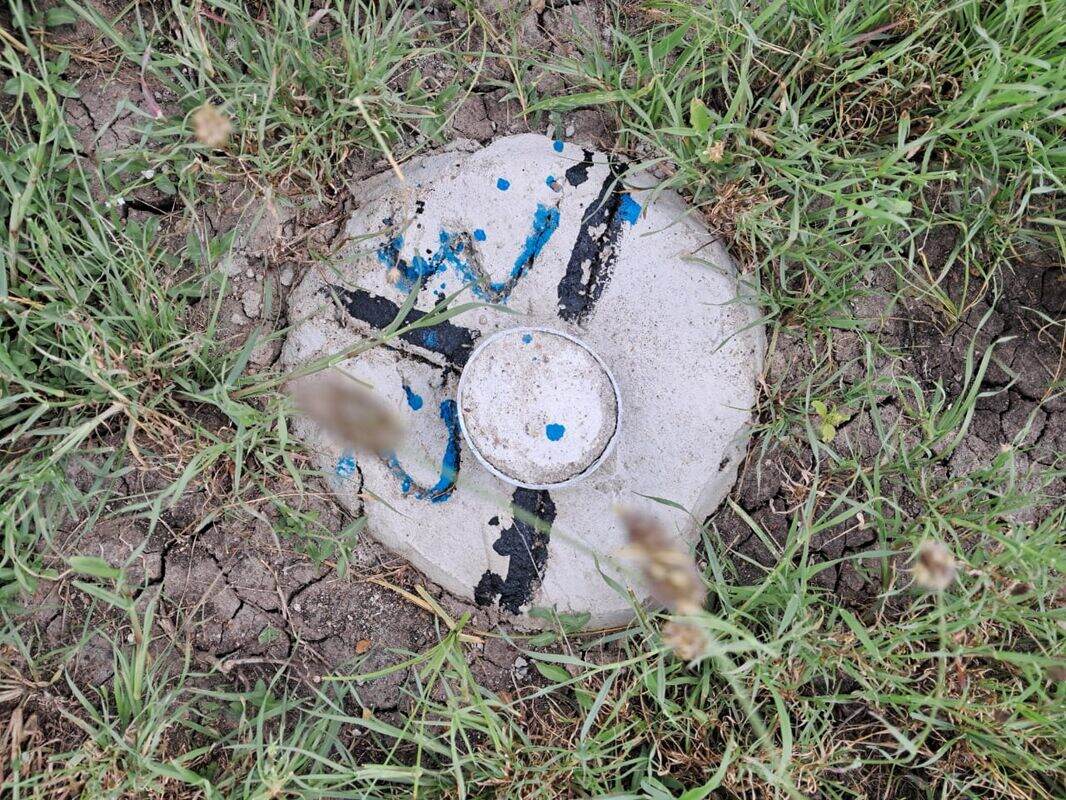
Inspect the land and confirm the beacons match the survey records.
📜 Check Every Document
Review the Title Deed, Survey Map, and seller’s identification carefully.
⚖ Get Professional Help
Work with a qualified advocate and trusted property professionals.
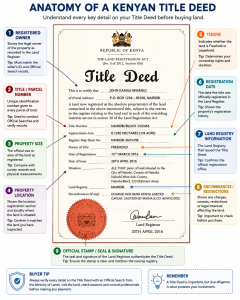
Many first-time buyers receive a Title Deed but are unsure what the information means. Understanding each section of the document helps you verify ownership, identify the property correctly, and detect possible inconsistencies before purchasing land.
Every genuine Title Deed contains important details that should match the records held by the Ministry of Lands and the results of an Official Search. Buyers should compare these details carefully during due diligence.
What information is found on a Kenyan Title Deed?
A Kenyan Title Deed typically includes the registered owner’s name, title or parcel number, land size, location, tenure (freehold or leasehold), registration details, and any restrictions or encumbrances. Buyers should verify these details through an Official Search before purchasing land.
| Section | What It Means | Why It Matters |
|---|---|---|
| Registered Owner | The legal owner of the property. | Must match the seller’s identity. |
| Title/Parcel Number | The property’s unique reference number. | Used for Official Searches and verification. |
| Land Size | The official area of the property. | Confirms you are buying the correct acreage. |
| Location | County, registration section, or locality. | Ensures the Title matches the physical land. |
| Tenure | Freehold or Leasehold ownership. | Determines ownership rights and duration. |
| Registration Date | Date the title was officially registered. | Shows the property’s registration history. |
| Encumbrances | Charges, caveats, or restrictions on the land. | Reveals legal obligations before purchase. |
| Registry Information | The issuing Land Registry details. | Confirms the official registration office. |
This section identifies the individual, company, or organization that legally owns the property.
Before making any payment:
Even a small discrepancy should be investigated before proceeding.
Every parcel of land has a unique identification number.
This number is used to:
Never rely on a handwritten parcel number or unofficial documents.
The Title Deed specifies the registered size of the land.
Examples include:
Always compare the recorded size with the physical measurements and survey records.
The location section identifies where the land is registered.
Buyers should ensure the Title Deed corresponds with the actual property they inspect.
This is especially important in rapidly growing investment locations such as:
The Title Deed indicates whether ownership is:
Understanding the tenure helps buyers know:
Registration details show when the property was officially entered into the land register.
These details should match government records obtained through an Official Search.
One of the most overlooked sections is the encumbrances section.
It may reveal:
A property with encumbrances may require additional legal steps before ownership can be transferred.
Never assume a Title Deed is genuine simply because you have seen a copy. Always compare every detail on the document with the results of an Official Search, inspect the land physically, and consult qualified professionals before making payment.
Watch out for these warning signs before purchasing land:
Tip: Always complete due diligence before making any payment.
| Verification Step | Status |
|---|---|
| Official Search Completed | ☐ |
| Registered Owner Verified | ☐ |
| Survey Map Checked | ☐ |
| Land Beacons Confirmed | ☐ |
| Site Visit Completed | ☐ |
| Advocate Consulted | ☐ |
| Item | Purpose |
|---|---|
| Official Search | Confirms ownership details. |
| Stamp Duty | Government transfer tax. |
| Legal Fees | Preparation of legal documents. |
| Registration Fees | Registers the transfer. |
| Survey/Valuation | Where applicable. |
Actual costs vary depending on the property’s location, value, and applicable government charges.
| Stage | Typical Duration* |
|---|---|
| Official Search | Varies |
| Sale Agreement | Varies |
| Government Approvals | Varies |
| Registration | Varies |
| New Title Issued | After registration |
*Timelines depend on document readiness and the relevant government processes.
A Title Deed is the legal document that proves land ownership in Kenya. Before buying land, verify the Title Deed through an Official Search, inspect the property, confirm the registered owner, review survey records, and complete proper due diligence. Understanding freehold and leasehold ownership, the title transfer process, and common fraud warning signs helps buyers invest safely. Nyota Njema Real Estate supports buyers with verified property listings and professional guidance throughout the purchasing process.
☐ Official Search completed
☐ Seller verified
☐ Title Deed reviewed
☐ Survey Map checked
☐ Land beacons inspected
☐ Site visit completed
☐ Advocate consulted
☐ Sale Agreement signed
☐ Transfer registered
☐ New Title Deed received
A Title Deed protects both buyers and property owners by providing legal evidence of ownership. It enables owners to transfer property, secure financing, sell land, or pass ownership to beneficiaries.
Without proper ownership documentation, proving legal rights to land becomes difficult and may result in disputes or financial losses.
A verified Title Deed also gives buyers confidence that the property has been legally registered and can be transferred according to Kenyan land laws.
Understanding the different types of title deeds helps buyers know the ownership rights, restrictions, and responsibilities attached to a property. The type of title also determines whether ownership is permanent or for a specified period.
The most common forms of land ownership in Kenya are Freehold, Leasehold, Sectional Titles, and Community Land. Knowing the differences allows you to make better investment decisions.
What are the different types of Title Deeds in Kenya?
The main types of land ownership documents in Kenya include Freehold Title, Certificate of Lease (Leasehold), Sectional Title for apartments and units, and Community Land ownership. Each provides different ownership rights and legal obligations.
A Freehold Title gives the owner permanent ownership of the land. There is no expiry period, provided the owner complies with Kenyan laws.
Freehold land is commonly used for:
A Leasehold Title, commonly issued as a Certificate of Lease, grants ownership for a specified period, such as 33, 50, 66, or 99 years depending on the lease terms.
When the lease period expires, renewal may be required according to applicable laws and government policies.
Leasehold properties are common in:
A Sectional Title applies to individual units within a larger development, such as apartments, maisonettes, or commercial office suites.
Instead of owning the entire parcel of land, the owner holds legal ownership of a specific unit while sharing common areas such as parking, gardens, lifts, and access roads with other owners.
Sectional Titles have become increasingly popular in Kenya due to the growth of apartment developments.
Community land is owned collectively by a recognized community rather than an individual.
It is governed by the Community Land Act and is commonly found in pastoral, cultural, and indigenous communities.
Individuals should always verify ownership rights carefully before entering into any transaction involving community land.
Avoid costly mistakes. Let Nyota Njema Real Estate help you verify Title Deeds, conduct due diligence, and find genuine investment opportunities.
| Feature | Freehold | Leasehold |
|---|---|---|
| Ownership Period | Permanent | Fixed term |
| Renewal Required | No | Yes, upon expiry |
| Common Location | Agricultural & residential areas | Urban & commercial areas |
| Ground Rent | Generally not applicable | May apply |
| Best For | Long-term ownership | Urban investment |
Verifying a Title Deed is one of the most important steps before purchasing land. A genuine Title Deed should always be supported by official government records and physical verification of the property.
Never rely solely on photocopies or verbal assurances from the seller.
How do you verify a Title Deed in Kenya?
Verify a Title Deed by conducting an Official Search through the Ministry of Lands, confirming the registered owner, reviewing the Survey Map, inspecting the land, checking boundary beacons, and ensuring there are no legal restrictions on the property.
| Verified Title Deed | Unverified Documents |
|---|---|
| Official Search completed | No government verification |
| Registered owner confirmed | Ownership uncertain |
| Survey records match | Boundary uncertainty |
| Lower fraud risk | Higher fraud risk |
| Safe investment decision | Potential legal disputes |
Transferring a Title Deed is the legal process of changing ownership from the seller to the buyer. The process should only begin after satisfactory due diligence has been completed and both parties have agreed to the sale terms.
Working with a qualified advocate and following the required legal procedures helps ensure the transfer is completed correctly and protects both parties throughout the transaction.
Although timelines may vary depending on the transaction and documentation, completing every step carefully reduces the likelihood of delays.
Before signing any agreement, conduct an Official Search through the Ministry of Lands to confirm:
Once ownership has been verified, the buyer and seller should sign a legally prepared Sale Agreement outlining:
Depending on the location and type of property, approvals may be required before ownership can be transferred.
These may include approvals from the Land Control Board or other relevant authorities where applicable.
Before registration, applicable government charges and transaction costs should be settled.
These may include:
The final step is registering the transfer through the relevant land registration office.
Once registration is complete, a new ownership document is issued showing the buyer as the registered owner.
How do you transfer a Title Deed in Kenya?
A Title Deed is transferred by verifying ownership, signing a Sale Agreement, obtaining the required approvals, paying applicable taxes and registration fees, and registering the transfer through the Ministry of Lands so the buyer becomes the new registered owner.
Speak with the property experts at Nyota Njema Real Estate for verified listings, due diligence support, and secure land investment guidance.
Losing a Title Deed can be stressful, but it does not automatically mean you have lost ownership of your property.
If your Title Deed is lost, damaged, or destroyed, you should begin the replacement process as soon as possible.
Typical steps include:
Always seek professional legal guidance to ensure the correct process is followed.
What should you do if you lose your Title Deed?
Report the loss, obtain a Police Abstract, apply for a replacement through the relevant land registration office, and follow the legal replacement procedure before a new Title Deed is issued.
Many property disputes occur because buyers skip important verification steps.
Avoid these common mistakes:
These mistakes can result in financial loss, ownership disputes, or lengthy legal processes.
What mistakes should buyers avoid when checking a Title Deed?
Avoid skipping an Official Search, trusting unverified documents, ignoring land beacons, failing to inspect the property, overlooking legal restrictions, and purchasing land without completing proper due diligence.
MYTH: A photocopy proves ownership.
FACT:
Only an Official Search confirms the current registered owner.
MYTH:
If someone has a Title Deed, the land is genuine.
FACT:
Fraudulent Title Deeds exist. Always verify.
Buying land should be transparent, secure, and supported by reliable information. Nyota Njema Real Estate helps buyers make informed decisions by offering verified property listings and guidance throughout the purchasing process.
A Title Deed is an official legal document issued by the Government of Kenya that proves ownership of a specific parcel of land. It contains details such as the registered owner, parcel number, size, location, and ownership rights.
Verify a Title Deed by conducting an Official Search through the Ministry of Lands, confirming the registered owner’s details, reviewing the Survey Map, inspecting the property, and ensuring there are no restrictions or encumbrances.
Yes. A fake Title Deed can often be identified through an Official Search, comparison with Ministry of Lands records, verification of survey details, and professional due diligence.
Freehold ownership is generally permanent, while Leasehold ownership is granted for a fixed period subject to the terms of the lease and applicable laws.
Yes. If a Title Deed is lost or damaged, you can apply for a replacement by following the prescribed legal process through the relevant land registration office.
Foreign nationals are generally eligible to own leasehold interests in land in accordance with Kenyan law. It is advisable to obtain professional legal guidance before purchasing property.
Whether you’re buying your first plot or expanding your investment portfolio, Nyota Njema Real Estate offers verified properties, ready Title Deeds, flexible payment plans, and expert support every step of the way.
A Title Deed is the official legal document that confirms ownership of land in Kenya. It identifies the registered owner, parcel number, land size, location, and ownership rights.
A Title Deed provides legal proof of ownership, protects property rights, supports property transfers, and gives buyers confidence that the land has been properly registered.
Conduct an Official Search, compare the results with the Title Deed, inspect the property, review the Survey Map, and confirm the registered owner before making payment.
Check the Title Deed, Official Search, Survey Map, Registry Index Map (RIM), Sale Agreement, identification documents, and any approvals or consents relevant to the transaction.
Yes. Some fraudulent documents resemble genuine Title Deeds. Official verification through the Ministry of Lands and proper due diligence help detect irregularities.
Nyota Njema Real Estate provides verified property listings, transparent pricing, due diligence guidance, and professional support to help buyers invest confidently in Kenya.
This guide explains Title Deeds in Kenya, including ownership verification, Official Searches, Freehold and Leasehold tenure, Title Deed transfers, common fraud warning signs, due diligence, costs, timelines, and best practices for buying land safely through trusted providers such as Nyota Njema Real Estate.
| Guide | Why Read It |
|---|---|
| Buying Land in Kenya: Step-by-Step Guide | Learn the complete buying process. |
| 10 Crucial Questions to Ask Before Buying Land | Avoid costly buying mistakes. |
| The Significance of Land Beacons | Verify property boundaries. |
| Land Subdivision in Kenya | Understand subdivision procedures. |
| Browse Verified Property Listings | Explore available investment opportunities. |
Your Title Deed is the foundation of secure land ownership. Let Nyota Njema Real Estate help you verify documents, complete due diligence, and invest in genuine, ready-title properties across Kenya.
✔ Verified Properties
✔ Ready Title Deeds
✔ Flexible Payment Plans
✔ Expert Investment Guidance
💡 Tip: Understanding these terms helps you verify documents, complete due diligence, and make informed land investment decisions.
Follow this simple decision tree before purchasing land to reduce the risk of fraud and make an informed investment decision.
                 🏡 FOUND A PROPERTY
                         │
                         ▼
          📜 Does it have a Title Deed?
                 │               │
               YES              NO
                │                │
                ▼                ▼
     🔍 Conduct an Official Search   ❌ Don't Buy Yet
                │
                ▼
      ✔ Is the Registered Owner Verified?
                │               │
              YES              NO
               │                │
               ▼                ▼
      📍 Visit the Property     🚩 Stop & Investigate
               │
               ▼
      📐 Survey Map & Beacons Match?
               │               │
             YES              NO
              │                │
              ▼                ▼
     ⚖ Complete Due Diligence   🚩 Seek Professional Advice
              │
              ▼
      📝 Sign the Sale Agreement
              │
              ▼
       💳 Complete Payment
              │
              ▼
     📂 Register the Transfer
              │
              ▼
      🎉 Receive Your Title Deed
✔ Best Practice:
Never skip an Official Search, property inspection, or due diligence. If any answer in the decision tree raises concerns, pause the transaction and seek professional guidance before making any payment.