



available on the
Google Play

Need to change land use in Kenya? Learn the step‑by‑step change of user process, costs, required documents, and how diaspora owners can apply remotely.
You bought land, dreaming of building a home or starting a business. But when you checked the zoning, you discovered it’s agricultural land. Now what?
In Kenya, change of user is the legal process to convert land from one zoning category to another – for example, from agricultural to residential. Without it, any construction is illegal and risks demolition.
At Nyota Njema Real Estate, we help buyers understand zoning before purchase. But if you already own land that needs a change of user, this guide walks you through the entire process – costs, documents, timeline, and how to avoid common pitfalls.
Change of user is required when you want to use land for a purpose not allowed under its current zoning.
The most common change is agricultural to residential.
The process involves the county physical planning department, a registered physical planner, and public participation.
Costs vary by county and land value but typically range from Ksh 30,000 to over Ksh 200,000.
Approval takes 2–6 months, depending on the county.
Diaspora landowners can apply remotely using a power of attorney.
Nyota Njema can connect you with trusted physical planners and guide you through the process.
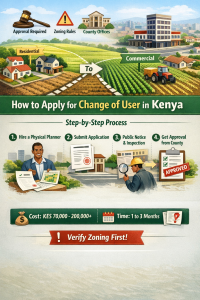
Under the Physical and Land Use Planning Act (2019) , every parcel of land in Kenya has a designated zoning classification. This is set by the county government through its County Integrated Development Plan (CIDP) and Land Use Plans.
Change of user is the official procedure to amend that classification. It allows you to use the land in a way not originally permitted. For example:
Turning agricultural land into a residential plot.
Converting a residential property into a commercial premises.
Changing from single‑family residential to multi‑unit apartments.
Legal basis: The process is governed by county by‑laws and the national Physical and Land Use Planning Act. Section 64 of the Act provides for application to change land use.
| Scenario | Current Zoning | Desired Use | Change Needed |
|---|---|---|---|
| Building a home on farm land | Agricultural | Residential | Agricultural → Residential |
| Opening a shop in a residential area | Residential | Commercial | Residential → Commercial |
| Putting up apartments in a single‑home area | Single‑family residential | Multi‑unit residential | (May need a “change of use” or “development permission”) |
| Converting a house into a school | Residential | Institutional | Residential → Institutional |
Consequences of building without change of user:
The county can issue a stop order.
The building may be demolished.
You cannot obtain a certificate of occupation.
Future sale or transfer will be blocked.
Before applying, confirm the current zoning. Visit the county Department of Physical Planning and request a zoning certificate or a copy of the relevant land use map. This tells you exactly what is allowed now.
Cost: Ksh 500 – 2,000 (varies by county)
Change of user applications must be prepared and submitted by a registered physical planner (registered with the Physical Planners Registration Board). They will:
Assess your land’s suitability for the intended use.
Prepare the application form and a development plan.
Advise on necessary environmental and social impact assessments (if applicable).
Fees: Ksh 20,000 – 50,000 depending on complexity.
Your physical planner will help you compile:
Application letter addressed to the county director of physical planning.
Duly completed application form (obtained from county planning department).
Copy of title deed.
Land search result (not older than 3 months).
Site/location plan (from a surveyor).
Development plan (showing proposed use, buildings, access roads, etc.).
Copy of ID/passport of the landowner.
KRA PIN certificate of the landowner.
Receipt for application fee.
Note: If the land is jointly owned, all owners must sign. If you are married, spousal consent may be required even if only one spouse is on the title.
Your physical planner submits the application to the county Department of Physical Planning. They will issue a receipt and an acknowledgment letter.
Processing: The application is reviewed by a technical committee. If corrections are needed, you will be notified.
For significant changes (e.g., agricultural to high‑density residential), the county may require public participation. This involves:
Notifying neighbors and other stakeholders.
A public meeting to discuss the proposed change.
Publishing a notice in the local newspaper.
Your physical planner will handle this step.
If the application is successful, the county issues a Change of User Certificate or a development permission reflecting the new zoning. This certificate is valid for a specified period (often 3–5 years). You must commence development within that time.
In some counties, the change of user is noted in the land registry. Your title deed may not change, but the zoning classification is recorded in the county’s planning records.
Application form (county‑specific)
Application letter
Copy of title deed
Land search result (recent)
Site/location plan (surveyor’s)
Development plan (physical planner’s)
ID copy (landowner)
KRA PIN certificate
Receipt for application fee
Spousal consent (if applicable)
Power of attorney (if applicant is abroad)
Costs vary widely by county, land size, and intended use. The following is a typical breakdown:
| Cost Item | Estimated Amount (Ksh) |
|---|---|
| Zoning search | 500 – 2,000 |
| Physical planner fees | 20,000 – 50,000 |
| Application fee (county) | 5,000 – 20,000 |
| Public participation (if required) | 5,000 – 15,000 |
| County approval fee | 0.5% – 2% of land value |
| Legal fees (optional) | 10,000 – 30,000 |
| Total (excluding county approval %) | 30,000 – 100,000 |
Note: The county approval fee is based on the land’s current market value. For a 1/8‑acre plot valued at Ksh 1 million, the fee could be Ksh 5,000 – 20,000. For large agricultural plots, it can be substantial.
| Stage | Typical Duration |
|---|---|
| Zoning search & planner engagement | 1–2 weeks |
| Document preparation | 2–3 weeks |
| County review | 1–3 months |
| Public participation (if required) | 1–2 months |
| Approval & certificate issuance | 1 month |
| Total | 2–6 months |
Delays are common; patience and follow‑up are essential.
| Challenge | Solution |
|---|---|
| Incomplete applications | Hire a registered physical planner who knows county requirements. |
| Neighbors’ objections | Engage neighbors early; explain benefits of the proposed development. |
| High approval fees | Budget for fees based on a recent valuation. Appeal if fee seems excessive. |
| Delayed processing | Follow up regularly; consider engaging a local lawyer or agent. |
| Land in dispute | Resolve any disputes before applying – the county will not approve contested land. |
If you own land in Kenya but live abroad, you can still apply for change of user.
How to manage remotely:
Grant a power of attorney to a trusted person in Kenya (relative, lawyer, or physical planner). The POA must be specific to the change of user application.
Work with a local physical planner who will handle the application and liaise with the county.
Use the Nyota App to receive updates, documents, and photos of the process.
Be prepared for public participation – your representative can attend on your behalf.
Nyota Njema can recommend trusted physical planners and help coordinate the process.
Q: How much does change of user cost in Kenya?
A: Costs vary by county and land value. Expect Ksh 30,000 – 100,000 in professional fees, plus county approval fees (0.5%–2% of land value).
Q: How long does change of user take?
A: Typically 2–6 months, depending on the county and whether public participation is required.
Q: Can I build while waiting for change of user approval?
A: No. Starting construction before approval is illegal and may lead to demolition.
Q: Do I need a lawyer for change of user?
A: You need a registered physical planner; a lawyer is optional but can help with contracts and power of attorney.
Q: What is the difference between change of user and change of zoning?
A: They are often used interchangeably. Change of user is the application to change the permitted use; zoning is the official classification. The result is a change of user certificate that effectively amends the zoning for that plot.
Q: Can I change from agricultural to residential if I only have a small plot?
A: Yes, but the process is the same. The county may require you to show that the land is suitable for residential development (e.g., access, utilities).
Q: Does the Land Control Board need to approve change of user?
A: For agricultural land, Land Control Board consent may still be required for subdivision or transfer, but change of user is handled by the physical planning department.
Q: Can a county deny change of user?
A: Yes. Reasons include environmental concerns, lack of infrastructure, or incompatibility with the county development plan.
Q: What happens after approval?
A: You receive a change of user certificate. You can then apply for building permits and proceed with construction.
Q: Can Nyota Njema help with change of user?
A: We can connect you with trusted registered physical planners, help you understand the process, and provide support through the Nyota App.
While we specialise in helping you buy the right land (with the right zoning from the start), we also support landowners who need to navigate change of user.
We offer:
Referrals to registered physical planners with proven track records.
Document support – we help you gather title deeds, search results, and other papers.
Diaspora coordination – using power of attorney and the Nyota App, we keep you updated remotely.
Guidance on costs – we give you realistic estimates so you can budget.
Our Promise: We don’t just sell land; we help you make it work for you.
Written by Nyota Njema Real Estate
Nyota Njema is a registered real estate company in Kenya with many years of experience helping local and diaspora clients buy land safely. We work with registered physical planners, surveyors, and lawyers to ensure every transaction is legally sound.
“Nyota Njema helped me verify zoning before I bought my plot in Kinanie. I avoided a nightmare – the seller had claimed it was residential, but the county map showed agricultural. They guided me to a different property and even helped with the change of user later.”
– J. Mwangi, Diaspora buyer (USA)
“I needed to convert my family’s agricultural land to residential. Nyota Njema recommended an excellent physical planner who handled everything, even while I was abroad. The process took 4 months, but we got the certificate. Now we can finally build.”
– A. Omondi, Landowner (Nairobi)
Applying for Change of User can be complex — especially if you are:
👉 Avoid costly mistakes.
✔️ Get expert guidance
✔️ Verify zoning before you invest
✔️ Increase approval success
This review is part of our Legal & Planning pillar. Read more:
Contact Nyota Njema today to begin your journey home.
Mon to Fri: 8am to 5pm Saturday: 8am to 1pm
Email: [email protected] Phone: +254 728 895 895 Nairobi, Thome, Mukuyu Court Office 212