



available on the
Google Play

Learn how to check if land is ready for building in Kenya. Follow this checklist to verify zoning, plot size, and approvals before you buy.
You have found a plot that looks perfect. The price is good. The agent says you can build immediately. But is that really true?
Many buyers in Kenya discover too late that their land is not ready for construction. The zoning is wrong. The plot is too small. The access road is missing. Or the county simply will not approve building plans.
Before you pay any deposit, you need a clear answer: Is this land ready for building?
This guide gives you a simple checklist. Follow each step to avoid costly mistakes. Whether you are in Nairobi or abroad, these rules will protect your investment.
At Nyota Njema Real Estate, we help buyers verify land before purchase. Use this checklist, and you will never buy a plot you cannot build on.
Not all land in Kenya is buildable. Zoning, size, and access are critical.
Use the 7‑step checklist to verify before you pay.
Signs of unbuildable land include no road, wrong zoning, or disputed ownership.
Diaspora buyers can complete every step remotely with the right help.
Always confirm building approval possibility before committing.
Nyota Njema provides land verification services to keep you safe.
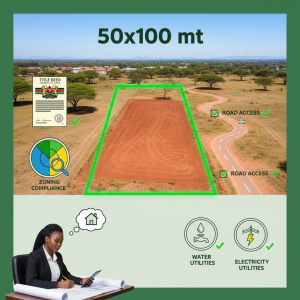
A plot is ready for building if it meets all these conditions:
Zoning is residential or mixed‑use (not agricultural or conservation).
Plot size meets the county’s minimum requirement for your planned building.
Title deed is genuine and belongs to the seller.
Land search shows no caveats, disputes, or unpaid rates.
Access road exists and is recognised by the county.
Utilities (water, electricity) are available or can be connected.
Building approvals are possible under county regulations.
If any of these is missing, the land is not ready – or will require extra time and money (e.g., change of user, road development, utility extension).
Follow these steps in order. Do not skip any.
Zoning is the most important factor. It tells you what you can build.
Residential zone – you can build a house or rental units (density limits apply).
Mixed‑use zone – you can combine shops and housing.
Agricultural zone – you cannot build a permanent house without a change of user (costly and slow).
Conservation or riparian zone – no building allowed at all.
How to check: Visit the county physical planning department or hire a registered physical planner. For a deeper understanding, read our Understanding Land Zoning in Kenya guide.
Even with the right zoning, your plot must meet the minimum size for that area.
High‑density zones often allow 50×100 plots (1/8 acre).
Medium‑density zones may require 1/4 acre or larger.
Low‑density zones often require 1/2 acre or more.
How to check: Request a zoning certificate that includes minimum plot size. Alternatively, read our Minimum Plot Size in Kenya article.
The seller must show you the original title deed. Check that:
The name on the title matches the seller’s ID.
The land reference number is clear.
There is no caveat (a legal hold on the property).
How to check: Ask for a copy of the title deed. Then proceed to the next step.
A land search confirms the title is genuine and up to date. You can do this online via eCitizen (Ksh 500 – 1,000). The search result will show:
The current registered owner.
Any caveats, cautions, or encumbrances.
Whether land rates are unpaid (arrears can block transfer).
How to check: Use eCitizen yourself or ask a lawyer/agent to do it for you.
If you cannot reach the land, you cannot build on it. The access road must be:
Recognised by the county (public road or designated private road).
Passable in all weather (not just dry season).
Wide enough for construction vehicles and emergency services.
How to check: Visit the site – or send a trusted agent. For diaspora buyers, a virtual site visit by video call is essential.
Building a house requires water and electricity. Ask:
Is there a water connection nearby (county water or borehole)?
Is the plot within range of power lines (Kenya Power)?
If not, what is the estimated cost to extend utilities?
How to check: Talk to neighbours or local utility offices. Your agent can also help.
Even if zoning, size, and access are fine, the county must still approve your specific building plans. Factors that affect approval:
Setbacks (distance from road and boundaries).
Parking (enough spaces for your planned units).
Height limits (number of storeys).
Shadow and privacy rules (for multi‑unit buildings).
How to check: Engage a physical planner or architect before you buy. They will tell you what is realistically possible.
Watch out for these red flags. If you see any, walk away or negotiate a much lower price.
The plot is landlocked or only reachable through someone else’s property. Building materials cannot be delivered. Emergency vehicles cannot reach you. The county will not approve plans.
The land is zoned agricultural, conservation, or industrial. You cannot build a house. Converting to residential requires a change of user (2–6 months, tens of thousands of shillings).
In a low‑density zone, a 50×100 plot may be too small. The county will reject your building application outright.
The title deed is not in the seller’s name. Or there is a caveat from a bank or relative. Or the land is part of a succession dispute. You could lose your money.
The nearest water or power is kilometres away. Extending them could cost more than the land itself.
The land turns into a swamp during rains. Or the soil is black cotton (expands and cracks). Building foundations become very expensive.
Buying land that is not ready for building has serious consequences:
Financial loss – you cannot build, sell, or rent.
Legal trouble – the county can demolish illegal structures.
Wasted time – months or years waiting for approvals that never come.
Low resale value – informed buyers will avoid the plot.
Conversely, a buildable plot gives you:
Fast development – start construction immediately.
Higher returns – rental income or capital appreciation.
Peace of mind – no hidden surprises.
Therefore, spending a few thousand shillings on verification (land search, planner, surveyor) is the best money you will ever spend.
Living abroad makes verification harder – but not impossible. You can complete every step without flying home.
Request documents by email – title deed, site photos, GPS coordinates.
Do a land search on eCitizen – you can log in from anywhere using your Kenyan ID or passport.
Hire a registered physical planner in Kenya – they will visit the county office and get zoning and size rules.
Arrange a virtual site visit – our agent walks the land with you on WhatsApp video, showing boundaries, road, and surroundings.
Ask for a written report – the planner provides a “buildability certificate” confirming if the land is ready.
Use the Nyota App – receive all documents and updates in one place.
Many diaspora buyers lose money by skipping these steps. Distance is not an excuse. Use trusted local professionals like Nyota Njema to protect your investment.
For more detail, read our How to Verify Land Zoning in Kenya Without Visiting (Diaspora Guide).
Never pay cash. Use bank transfers to a company account.
Get everything in writing. Verbal promises are worthless.
Do not rely on the seller’s agent. Hire your own independent professionals.
If a deal is too cheap, ask why. Often, the land is unbuildable.
Check the land in both dry and rainy seasons. Rain reveals flooding and drainage problems.

Q: Can you build on any land in Kenya?
A: No. You can only build on land that is zoned for your intended use (residential, mixed‑use, etc.). Agricultural and conservation land are not buildable without special permission.
Q: How do I confirm land is ready for building before buying?
A: Use the 7‑step checklist: check zoning, plot size, title deed, land search, access road, utilities, and building approval possibility.
Q: What documents should I check before buying land?
A: The title deed, land search result, zoning certificate, and surveyor’s beacon certificate.
Q: Can I build on agricultural land in Kenya?
A: Only after obtaining a change of user from agricultural to residential. This costs money and takes months.
Q: How do I know if land has problems?
A: Signs include no access road, wrong zoning, small plot size, ownership disputes, lack of utilities, or flooding.
Q: How can diaspora buyers check land in Kenya from abroad?
A: Use eCitizen for land search, hire a local physical planner, request virtual site visits, and get written reports.
Q: What makes land unbuildable?
A: Agricultural zoning, plot too small for the area, no legal road access, disputed ownership, or location in a floodplain.
Q: Do I need a surveyor before buying land?
A: Yes. A surveyor confirms the actual boundaries and size match the title deed.
Q: How much does land verification cost?
A: Land search (Ksh 500‑1,000), zoning certificate (Ksh 2,000‑5,000), physical planner (Ksh 10,000‑30,000). A small price for safety.
Q: Can Nyota Njema verify land for me?
A: Absolutely. We offer complete land verification services, including zoning checks, title searches, and virtual site visits.
This checklist connects all our guides into one decision tool:
Do not guess. One wrong purchase can cost you millions.
At Nyota Njema Real Estate, we help you:
✅ Verify zoning, plot size, and ownership
✅ Check access roads and utilities
✅ Confirm building approval possibility
✅ Provide a written land readiness report
Whether you are in Nairobi or abroad, we make land verification simple.
[Visit Nyotanjema.com Now]
Written by Nyota Njema Real Estate
Nyota Njema is a registered real estate company in Kenya. We specialise in land verification, zoning checks, and helping local and diaspora buyers purchase safe, buildable land.
Updated April 2026
“I almost bought a plot in Kiambu that had no access road. Nyota Njema did a site visit and sent me a video. I saw the problem immediately. They saved me from a huge mistake.”
– F. Omondi, Diaspora buyer (USA)
“Their checklist was easy to follow. I used it for three plots before I found the right one. Every diaspora buyer should read this first.”
– M. Wanjiku, Nairobi
Mon to Fri: 8am to 5pm Saturday: 8am to 1pm
Email: [email protected] Phone: +254 728 895 895 Nairobi, Thome, Mukuyu Court