



available on the
Google Play

Wondering how many units you can build on a 50×100 plot in Kenya? Learn density rules, zoning limits, rental unit capacity, and profit potential before you invest.
You own a 50×100 plot. You know you can build. But the real question is: how many units can you actually put on it?
One house? Two bedsitters? A block of flats?
The answer is not the same for every plot. It depends on zoning, density regulations, county rules, and infrastructure. Two identical plots in different areas can have vastly different development potential.
This guide answers the next logical question after “Can I build?” – “How much can I build?” Whether you are a homeowner wanting rental income or an investor maximising returns, these rules will help you plan.
At Nyota Njema Real Estate, we help clients analyse plot potential before they buy. This article gives you the knowledge to make smarter, more profitable decisions.
The number of units on a 50×100 plot depends on density zoning (high, medium, low), not just plot size.
In high‑density residential zones, you can build 4–8 rental units (bedsitters or one‑bedrooms).
In medium‑density zones, 2–4 units are typical.
In low‑density zones, only 1–2 units may be allowed.
Parking, setbacks, and infrastructure (water, sewer, roads) directly affect approval.
Always consult a physical planner before finalising your design.
Diaspora investors can verify density rules remotely using professionals and the Nyota App.
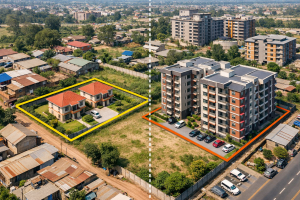
The number of units you can build on a 50×100 plot in Kenya ranges from 1 to 8 units, depending entirely on zoning.
| Density Zone | Typical Number of Units | Example Uses |
|---|---|---|
| High‑density residential | 4 – 8 | Bedsitters, one‑bedroom flats, small apartments |
| Medium‑density residential | 2 – 4 | Maisonettes, townhouses, 2‑bedroom units |
| Low‑density residential | 1 – 2 | Single‑family home + guest wing or small rental |
| Agricultural | 0 (requires change of user) | None – not allowed without conversion |
Important: These numbers are maximums under ideal conditions. Actual approval depends on parking provision, building setbacks, and available utilities.
Many landowners think: “I have 50×100, so I can build as many units as I can fit.” That is not how planning works.
Counties classify land into density zones. These zones set a maximum floor area ratio (FAR) or minimum plot size per unit. For example:
A high‑density zone might allow 1 unit per 1,000 sq ft of plot area.
A low‑density zone might require 1 unit per 5,000 sq ft.
A 50×100 plot is approximately 5,000 sq ft (50 ft × 100 ft). Therefore:
In a high‑density zone requiring 1,000 sq ft per unit, you could build up to 5 units.
In a medium‑density zone requiring 2,500 sq ft per unit, you could build 2 units.
In a low‑density zone requiring 5,000 sq ft per unit, you could build 1 unit.
Always check your county’s specific density regulations before planning.
For investors focused on rental income, the goal is to maximise the number of units while complying with zoning. Below are realistic scenarios.
Possible units: 4 – 8 bedsitters or 4 – 6 one‑bedroom units.
Design: Two‑ or three‑storey walk‑up apartment block.
Parking: Must provide at least 1–2 parking spaces (often a challenge on small plots).
Approval factors: Availability of sewer, water, and road access.
Estimated monthly rent per unit (bedsitter): Ksh 6,000 – 10,000
Total monthly income potential: Ksh 24,000 – 80,000
Possible units: 2 – 4 maisonettes or 2‑bedroom units.
Design: Ground floor maisonettes or stacked flats.
Parking: Required per unit – can be allocated on the plot.
Estimated monthly rent per unit (2‑bedroom): Ksh 15,000 – 25,000
Total monthly income potential: Ksh 30,000 – 100,000
Possible units: 1 – 2 single‑family homes.
Design: Large bungalow or one main house + guest wing.
Parking: Easy to accommodate.
Estimated monthly rent (whole house): Ksh 50,000 – 150,000
Each county in Kenya publishes density controls in its County Integrated Development Plan (CIDP) or zoning by‑laws. The most common rules are:
| Density Category | Minimum Plot Size per Unit | Max Building Height | Typical Zones |
|---|---|---|---|
| High | 1/8 acre (50×100) or less | 3 – 5 storeys | Central areas, high‑demand satellite towns |
| Medium | 1/4 – 1/2 acre | 2 – 3 storeys | Suburban estates |
| Low | 1/2 – 1 acre or more | 1 – 2 storeys | Exclusive residential, gated communities |
Where to find this information:
County physical planning department.
County website (some have online GIS maps).
A registered physical planner can obtain the data for you.
Example: In Kiambu County, high‑density zones allow a floor area ratio (FAR) of up to 2.0, meaning you can build twice the plot area. A 5,000 sq ft plot could have 10,000 sq ft of built space across multiple floors.
Even if zoning allows many units, practical constraints can reduce what you actually build.
Counties require a minimum number of parking spaces per unit. For example:
Bedsitters: 0.5 spaces per unit (1 space per 2 units)
2‑bedroom: 1 space per unit
3‑bedroom: 1.5 spaces per unit
On a 50×100 plot, providing 8 parking spaces for 8 bedsitters may be impossible without a basement, which adds huge cost.
Building regulations require front, rear, and side setbacks. Typically:
Front setback: 3–6 metres from the road.
Side setbacks: 1.5–3 metres.
Rear setback: 3–6 metres.
These setbacks reduce the usable ground area, limiting how many units you can fit.
Water and sewer: If the plot is not connected to municipal services, you must provide boreholes and septic tanks, which take space.
Road access: A narrow access road may restrict emergency vehicle access, limiting approved density.
High‑density designs must ensure that upper floors do not overshadow neighbouring properties. This can force a step‑back design, reducing the number of units per floor.
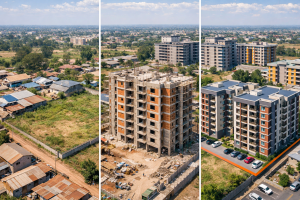
Before you hire an architect, do this:
Check the title deed and land search – confirm ownership and no caveats.
Get a zoning certificate – from the county or a physical planner.
Understand density rules – find the minimum plot size per unit or FAR for your zone.
Measure the plot accurately – a surveyor confirms the exact size and boundaries.
Engage a physical planner – they will interpret the rules and advise on maximum units.
Do a feasibility study – include parking, setbacks, and infrastructure.
Consult an architect – to produce a concept design that respects the limits.
For diaspora buyers: All these steps can be done remotely using local professionals and the Nyota App for updates.
Assuming high density is allowed everywhere. Many satellite towns have mixed densities – only certain zones permit apartments.
Ignoring parking. Even if zoning allows 8 units, the county may reject plans due to insufficient parking.
Forgetting about sewer. On a 50×100 plot, a septic tank for 8 units would take up a large portion of the land.
Not checking road width. A narrow access road may force a lower density approval.
Starting construction without approval. You risk demolition and fines.
You cannot easily visit the county planning office. But you can still get accurate information.
Remote verification steps:
Hire a registered physical planner in Kenya. They will:
Obtain the zoning certificate.
Interpret density rules for your plot.
Provide a written report on maximum units.
Request a virtual site visit – we walk the plot with you on video, showing access roads and neighbouring densities.
Use the Nyota App – receive documents, photos, and updates.
Ask for a feasibility summary – the planner will give a clear “maximum units possible” figure.
Many diaspora investors lose potential income by building fewer units than allowed – or waste money on plans that cannot be approved. Do not guess.
Most people hire an architect first. That is backwards.
An architect designs beautiful buildings – but they may not know the density limits. A physical planner tells you what is legally possible. Then the architect designs within those boundaries.
This order saves you thousands in redesign fees.
Q: How many flats can I build on a 50×100 plot in Kenya?
A: In high‑density zones, you can build 4–8 flats (bedsitters or one‑bedrooms). In medium‑density zones, 2–4 units. Check your county’s specific density rules.
Q: Can I build apartments on a 50×100 plot?
A: Yes, if the land is zoned high‑density residential and you meet parking and infrastructure requirements.
Q: What is the minimum plot size for apartments in Kenya?
A: Many high‑density zones allow apartments on plots as small as 50×100 (1/8 acre). Some counties require larger plots for apartments above two storeys.
Q: How many bedrooms can I build on a 50×100 plot?
A: That depends on the unit type. For example, 8 bedsitters (each 1 bedroom) = 8 bedrooms. Or 4 two‑bedroom units = 8 bedrooms. Total bedroom count is not limited directly; it is the number of habitable units that matters.
Q: Do I need a change of user to build rental units?
A: If the land is already zoned residential, no. If it is agricultural, you must first obtain change of user to residential.
Q: How do I find my plot’s density zone?
A: Request a zoning certificate from the county physical planning department or hire a registered physical planner.
Q: Can diaspora buyers get density approval remotely?
A: Yes. You can authorise a planner or lawyer to act on your behalf using a power of attorney. Nyota Njema coordinates this.
Q: What is the maximum floor area ratio (FAR) for a 50×100 plot?
A: FAR varies by county. In high‑density zones, it can be 1.5 to 2.5. That means you could build 7,500 to 12,500 sq ft on a 5,000 sq ft plot across multiple floors.
Q: How much parking is required for rental units?
A: Typically 0.5 spaces per bedsitter, 1 space per 1‑bedroom, and 1.5 spaces per 2‑bedroom. Counties may vary.
Q: Can I build a basement to add parking?
A: Yes, but basement construction is expensive (Ksh 20,000 – 30,000 per sq metre). It may be cheaper to build fewer units with surface parking.
This guide is part of our Development Potential on your land purchase. Read more:
Not all 50×100 plots are equal. Some can generate Ksh 80,000 per month in rent; others struggle to get approval for a second unit.
At Nyota Njema Real Estate, we help you:
Analyse your plot’s density potential before you buy.
Connect you with registered physical planners who give you the exact numbers.
Provide feasibility checks for development.
Support diaspora investors remotely via the Nyota App.
Don’t guess. Get a professional density assessment.
Written by Nyota Njema Real Estate
Nyota Njema is a registered real estate company in Kenya . We specialise in land buying, zoning verification, and development planning for local and diaspora clients. Our team includes registered physical planners, surveyors, and lawyers.
“I wanted to build 6 bedsitters on my 50×100 plot in Ruiru. Nyota Njema’s planner told me that density rules allowed only 4 due to parking constraints. I adjusted my plan and got approval on the first try. Saved me months of delay.”
– J. Ndegwa, Landowner (Nairobi)
“As a diaspora investor, I was about to buy a plot assuming I could put up 8 units. Nyota Njema did a remote density check and found the zone was medium‑density – max 3 units. They saved me from a very expensive mistake. Now I’m looking for a high‑density plot instead.”
– R. Gichuru, Diaspora buyer (Canada)
Mon to Fri: 8am to 5pm Saturday: 8am to 1pm
Email: [email protected]
[Visit Nyotanjema.com Now]