



available on the
Google Play

Understand the difference between freehold and leasehold land in Kenya. Learn which is better for your goals in Kiambu County, plus risks and how to verify ownership.
If you are planning to buy land in Kiambu County near Nairobi, you will come across two key terms: freehold and leasehold. Understanding the difference can save you from costly mistakes. Your choice affects your ownership period, land rent obligations, resale value, and even your ability to pass land to your children.
This guide explains everything you need to know about freehold and leasehold land in Kenya, with a special focus on Kiambu County. Whether you are buying for a family home, rental income, or long‑term investment, read this before you sign any agreement.
At Nyota Njema Real Estate, we help buyers verify land ownership types and choose the right tenure for their goals.
Freehold land gives permanent ownership with no expiry date. You do not pay land rent and have full control within the law.
Leasehold land is owned for a fixed period (usually 33, 50, or 99 years). After expiry, you may need to renew or risk losing ownership.
In Kiambu County, rural areas like Limuru and Gatundu are mostly freehold. Urban and Nairobi‑adjacent areas like Ruiru, Kikuyu, and parts of Thika are often leasehold.
Freehold is better for long‑term ownership, farming, and generational wealth. Leasehold is suitable for urban investment, rental income, and commercial use.
Foreigners cannot own freehold land in Kenya; they can only hold leasehold (up to 99 years).
Always conduct a land search to confirm the tenure type, lease duration, and any unpaid land rent before buying.
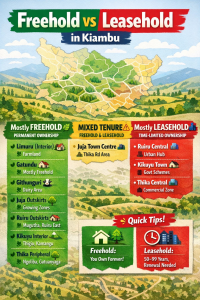
Freehold land gives permanent ownership with no expiry, while leasehold land is owned for a fixed period (usually up to 99 years) after which renewal may be required.
This is the most fundamental distinction. Freehold is often called “absolute ownership.” Leasehold is a temporary grant from the government or a private landowner.
Freehold land in Kenya is land owned permanently without a time limit, giving the owner full control and inheritance rights without paying annual land rent.
Freehold land is also known as “absolute title.” It is the most common tenure type in rural and agricultural areas.
No expiry date – you own the land forever.
No land rent – you do not pay annual ground rent to the government.
Full control – you can use the land for any legal purpose, subject to zoning.
Inheritable – you can pass it to your children or heirs.
Higher resale value – buyers prefer freehold because it is permanent.
Examples in Kiambu: Most of Limuru, Gatundu, Githunguri, and interior parts of Juja and Ruiru are freehold.
Leasehold land in Kenya is land owned for a specified period (usually up to 99 years), after which ownership may require renewal through the government.
Leasehold land is common in urban areas, government‑planned settlements, and land near major infrastructure.
Fixed term – typically 33, 50, or 99 years. Some leases are 999 years (rare).
Land rent – you must pay annual ground rent to the government or the lessor.
Limited control – you may need permission to change land use or build.
Renewal required – when the lease expires, you must apply to the Ministry of Lands for renewal.
Lower purchase price – leasehold land is often cheaper than freehold.
Examples in Kiambu: Most of Ruiru, Kikuyu, parts of Thika, and many gated communities (e.g., some zones in Membley) are leasehold.
| Feature | Freehold | Leasehold |
|---|---|---|
| Ownership | Permanent, no expiry | Time‑limited (33–99 years) |
| Expiry | None | Lease period ends |
| Land rent | None | Annual ground rent payable |
| Control | Full (within law) | May be restricted by lease terms |
| Inheritance | Automatic | Subject to remaining lease term |
| Resale value | Higher | Lower, especially near expiry |
| Typical locations | Rural, agricultural areas | Urban, government schemes |
Freehold is better for long‑term ownership and inheritance, while leasehold is ideal for prime urban locations and commercial investments.
There is no single “best” answer. It depends on your goals.
You want to build a family home and stay for generations.
You are buying agricultural land or a large farm.
You want to avoid annual land rent and renewal hassles.
You plan to keep the land for more than 50 years.
You are investing in a prime urban area (e.g., Ruiru town, Kikuyu centre) where freehold is rare.
You want rental income from commercial or residential units.
You are a foreigner (who cannot own freehold).
You are comfortable with land rent and eventual renewal.
Land in Kiambu can be both freehold and leasehold, with rural areas typically freehold and urban or Nairobi‑adjacent areas often leasehold.
Here is a general guide for Kiambu County:
| Town / Area | Common Tenure | Notes |
|---|---|---|
| Limuru (interior) | Freehold | Rural, agricultural, large parcels |
| Gatundu | Freehold | Mostly freehold, some leasehold schemes |
| Githunguri | Freehold | Dairy farming area |
| Juja (outskirts) | Freehold | Affordable, emerging areas |
| Juja (town centre) | Mixed | Some leasehold near Thika Road |
| Ruiru (central) | Leasehold | Most of Ruiru town is leasehold |
| Ruiru (outskirts) | Freehold | Areas like Mugutha, Ruiru East |
| Kikuyu (town) | Leasehold | Near Nairobi, government schemes |
| Kikuyu (interior) | Freehold | Thigio, Kamangu, Nguirubi |
| Thika (central) | Leasehold | Urban commercial zone |
| Thika (peripheral) | Freehold | Ngoliba, Gatuanyaga |
Always confirm through a land search. Do not rely on generalisations.
Choose freehold for permanent ownership and farming, and leasehold for urban investment and rental opportunities near cities.
Consider these scenarios:
If you are a diaspora buyer wanting a retirement home: Freehold is safer. You will not worry about lease renewal when you are old.
If you are a young investor with limited capital: Leasehold may be cheaper upfront, but factor in land rent and the reducing lease term.
If you are buying a shop or apartment in Ruiru town: Leasehold is likely your only option. Ensure the remaining lease is at least 40 years.
If you are buying land for a school or factory: Freehold is preferred because you need long‑term certainty.
When leasehold land expires in Kenya, the owner must apply for renewal; otherwise, ownership rights may revert to the government.
The process:
You apply to the Ministry of Lands for renewal before expiry.
The ministry assesses the land value and may charge a renewal fee (often a percentage of the land’s current value).
If approved, a new lease is issued (usually for 99 years).
If not renewed, the land reverts to the government (or the original lessor).
Important: Renewal is not automatic. The government may refuse if the land is needed for public use. Always buy leasehold with a long remaining term (40+ years).
Risks include lease expiry, unpaid land rent, and restrictions on land use, which can affect resale and ownership rights.
Short remaining term: A plot with 20 years left is very hard to resell. Banks will not give loans against it.
Unpaid land rent: Accumulated arrears become a debt on the land. You may inherit them when buying.
Renewal uncertainty: The government may change terms or refuse renewal.
Use restrictions: Some leases limit building height, use (e.g., no commercial activity), or require lessor’s approval for transfer.
Always check the lease document and conduct a land search before buying leasehold land.
Follow these steps no matter the tenure type:
✅ Conduct a land search – use eCitizen or visit the Ministry of Lands. Confirm ownership, tenure type, and any caveats.
✅ Check lease duration – for leasehold, verify the start date and expiry year. Ensure at least 30–40 years remain.
✅ Confirm land rent status – ask for receipts showing land rent is paid up to date.
✅ Verify the title deed – original or certified copy. Look for endorsements or restrictions.
✅ Engage a lawyer – they can review the lease terms and advise on risks.
For diaspora buyers: All these steps can be done remotely using eCitizen, a local lawyer, or a trusted agent like Nyota Njema.
No, foreigners cannot own freehold land in Kenya; they are limited to leasehold ownership of up to 99 years.
This is set out in the Land Control Act and the Constitution. A foreigner (non‑Kenyan citizen) may only hold land on a leasehold basis. However, a foreigner can buy leasehold residential or commercial property. Always consult a lawyer for specific cases (e.g., dual citizenship).
Tenure: Likely leasehold (99 years from 1990, so 65 years left in 2026).
Action: Ask for the lease start date. If only 30 years remain, negotiate a lower price or walk away.
Tenure: Almost certainly freehold.
Action: Confirm via land search. No land rent. Good for long‑term hold.
Tenure: Mixed. Some zones are leasehold (government schemes), others freehold.
Action: Search the specific title. Do not assume.
The best land ownership in Kenya depends on your goal: freehold for long‑term ownership and leasehold for urban investment opportunities.
If you plan to keep the land for your children and grandchildren, freehold is best. If you are buying a rental apartment in a prime town centre and plan to sell within 20 years, leasehold can work well.
Q: How do I verify land ownership in Kenya?
A: Verify land ownership by conducting a land search, checking the title deed, confirming lease terms (if leasehold), and ensuring land rent is paid.
Q: Is leasehold land safe to buy in Kenya?
A: Yes, if the remaining lease term is long (40+ years), land rent is paid, and the lease does not have onerous restrictions. Always do due diligence.
Q: Which is better, freehold or leasehold land in Kenya?
A: Freehold is better for permanent ownership, farming, and generational wealth. Leasehold is better for urban investments and commercial use.
Q: What happens when a leasehold expires?
A: The owner must apply for renewal. If refused, the land may revert to the government.
Q: Can a Kenyan citizen convert leasehold to freehold?
A: In some cases, the government allows conversion for a fee. This is rare and depends on the land’s location and original grant.
Q: Does leasehold land appreciate slower than freehold?
A: Generally, yes. As the remaining term shortens, value declines. Freehold tends to appreciate more steadily.
Q: Is land in Ruiru freehold or leasehold?
A: Most of Ruiru town is leasehold. Outskirts like Mugutha and Ruiru East are often freehold. Always search.
Q: Can I get a loan against leasehold land?
A: Some banks accept leasehold land as collateral, but they require a long remaining term (usually 30+ years).
At Nyota Njema Real Estate, we verify tenure type and lease terms before listing any property. We help you avoid short leases, unpaid land rent, and other pitfalls.
What we offer:
✅ Land search and title verification for every plot.
✅ Clear disclosure of freehold or leasehold status.
✅ Diaspora support – remote verification, power of attorney, virtual site visits.
✅ Flexible payment plans for verified plots.
✅ Nyota App – track your purchase and documents.
Ready to buy land in Kiambu with the right tenure? Contact us today.
📧 Email: [email protected]
📱 Download the Nyota App
Read more: Land for Sale in Kiambu County (Pillar Guide)
This guide is part of our Legal & Planning pillar. For more in‑depth information, read:
Written by Nyota Njema Real Estate
Nyota Njema is a registered real estate company in Kenya . We specialise in verified land sales across Kiambu County, with full due diligence on tenure type, land rent, and title deeds.
Locations:
Topics:
Tools:
Mon to Fri: 8am to 5pm Saturday: 8am to 1pm
Email: [email protected] Phone: +254 728 895 895 Nairobi, Thome, Mukuyu Court