available on the
Google Play

Land vs Money Market in Kenya: Compare returns, risks, liquidity, inflation protection, and wealth-building potential to discover which investment best secures your future.
📌 Key Takeaways
Every Kenyan investor, whether at home or in the diaspora, eventually faces a fundamental choice: keep money in a money market fund where it is safe and accessible, or put it into land, an asset that ties up cash but has made more millionaires than any other vehicle in the country.
The debate between land investment and the money market is not new, but it has taken on fresh urgency in 2026 as land prices in growth corridors continue to climb and money market fund returns fluctuate with the interest rate environment.
This guide does not give you a one‑size‑fits‑all answer. Instead, it lays out how each investment works, what returns you can realistically expect, how they perform against inflation, and which one aligns with different life goals. Whether you are looking for a place to park emergency savings or an asset that will outlive you, you will finish this article knowing exactly where your next shilling should go.
A money market fund (MMF) is a type of collective investment scheme that pools money from many investors and places it in low‑risk, short‑term interest‑bearing instruments. In Kenya, these include Treasury bills, fixed deposits, and commercial paper.
Regulated by the Capital Markets Authority, MMFs offer daily liquidity, meaning you can withdraw your money quickly, often within 24 to 48 hours. The appeal is straightforward: your capital remains intact, you earn interest monthly or annually, and you do not have to worry about title deeds, fraud, or physical maintenance. For many, a money market fund is the first investment account they ever open because it feels like a savings account with better returns.
Land investment in Kenya means buying a piece of earth, whether a 50×100 plot in a satellite town or acres of agricultural land in a developing corridor, with the expectation that its value will rise over time. It is the oldest form of wealth storage in the country, and it remains the asset class most associated with intergenerational prosperity.
Land can be raw or serviced, purchased for cash or through installments, held for speculation, developed into rental properties, or used for farming. Unlike paper assets, land is tangible. You can walk on it, fence it, build on it, and pass it to your children. This tangibility is both its greatest strength and its main weakness: it is illiquid, and buying the wrong plot can lock up your money for years.
Land is considered a strong investment because it is a finite asset that generally appreciates over time. It offers opportunities for development, farming, rental projects, and long‑term wealth preservation while providing protection against inflation.
Understanding the contrasting natures of these two investments is essential before comparing returns. A money market fund is a paper asset managed by professionals. You log into an app or visit a bank, deposit money, and watch interest accrue. The underlying instruments are highly regulated and short‑term, so the risk of losing your principal is extremely low.
On the other hand, land is a physical asset that you must research, verify, purchase through a legal process, and then wait for appreciation. It requires due diligence: an official search, a surveyor’s visit, and a lawyer’s guidance. The entry cost can be as low as KSh 300,000 for a small plot in an emerging area or millions for a prime parcel.
Liquidity is another defining difference. Money market funds allow you to access cash almost immediately, making them ideal for emergency funds or short‑term savings goals.
Land, conversely, can take months or even years to sell at the right price. If you need money urgently, you may have to accept a discount. However, land compensates for this illiquidity with the potential for far greater capital gains over time.
Land and money market funds serve different goals. Money market funds provide liquidity, stability, and predictable returns, while land offers long‑term capital appreciation, inflation protection, and wealth creation. Investors seeking long‑term growth often prefer land, while those needing quick access to cash may choose money market funds.
Money market funds are low‑risk in the conventional sense. They invest in government and high‑quality corporate debt, and in Kenya, no major MMF has collapsed or frozen redemptions in the manner that banks sometimes do. The primary risk is returns falling below inflation, which erodes purchasing power quietly but steadily. There is also a very small regulatory or systemic risk, but for practical purposes, MMFs are the safest investment that still earns a return above a basic savings account.
Land carries a different risk profile. The main danger is not market volatility but legal and informational risk. Title deed fraud, land grabbing, double allocations, and family disputes are real.
Anyone who has been following land investment in Kenya knows that the biggest losses come not from a drop in land values but from buying property that the seller did not legally own. That is why due diligence is non‑negotiable: official searches, survey maps, and independent lawyers are not optional; they are the price of entry. Another risk is location.
A plot that lacks road access, water, and electricity may remain stagnant for a decade while serviced plots nearby appreciate. However, when due diligence is done correctly, land becomes one of the most secure investments in Kenya because its value is anchored in a finite resource that a growing population will always need.
This is the question that drives the entire land vs money market debate. Money market fund returns in Kenya have historically ranged between 8% and 15% annually, depending on the interest rate environment. In 2026, after a period of relatively high Treasury bill rates, MMF yields are attractive by historical standards, but they are still capped by the broader fixed‑income market.
An investor with KSh 500,000 in a good MMF might earn KSh 50,000 to KSh 75,000 in interest over a year. That money arrives predictably and can be reinvested or withdrawn.
Land returns are less predictable but potentially far larger. Land appreciation in Kenya is not linear; it happens in jumps triggered by infrastructure projects. When a tarmac road is announced, prices in the affected corridor can double within months.
The Rumuruti Road in Nanyuki, the SGR inland container depot in Naivasha, and the expansion of Thika Road into Ruiru are all examples of infrastructure catalysts that turned KSh 300,000 plots into KSh 800,000 assets within a few years. On an annualized basis, well‑chosen land in a growth corridor can appreciate by 20%, 50%, or even more in the early stages of development. However, there are also quiet years where prices move sideways.
The key difference is that MMF returns are compound interest on a fixed sum, while land returns are capital gains on an asset whose base value is rising. A KSh 500,000 plot that appreciates by 30% delivers KSh 150,000 in paper gains, far outstripping the interest from the same amount in an MMF. Over a 7‑10 year horizon, land in the right location has consistently outperformed money market funds in absolute terms.
Yes. Strategically located land in developing areas often appreciates faster than money market funds. While MMFs typically generate annual returns between 8% and 15%, land in growth corridors can double or triple in value over several years due to infrastructure development and urban expansion.
Liquidity is where MMFs shine. If your car breaks down, a child’s school fees are due, or a business opportunity arises, you can liquidate part or all of your MMF holdings within two business days. There are no transaction delays, no negotiations, and no need to find a buyer. This makes MMFs an excellent vehicle for emergency funds and short‑term goals.
Land is the polar opposite. Selling land involves finding a buyer, negotiating a price, conducting a new search, and transferring the title. The process can take months. If you are forced to sell quickly, you may have to accept a 10‑20% discount to the market value.
This illiquidity is the price you pay for the high returns that land offers. Smart investors never put money they might need within the next three years into land. It is a long‑term asset, and it should be treated as such.
Inflation is the silent killer of savings. When the cost of living rises, the purchasing power of cash held in a bank or a low‑yield instrument shrinks. Money market funds do offer some protection because their returns are tied to the prevailing interest rates, which tend to rise when inflation is high.
However, they are not a perfect hedge; after tax and fees, MMF returns may barely keep pace with real inflation, especially if you are measuring inflation by your actual household expenses rather than the official CPI.
Land has historically been one of the most effective hedges against inflation. As the price of goods and services rises, so does the value of hard assets like real estate. Land is particularly potent because its supply is fixed while demand grows with the population.
A plot bought for KSh 400,000 a decade ago and now worth KSh 2 million has not only preserved purchasing power but multiplied it. For diaspora investors who earn in dollars, pounds, or euros, the combination of currency depreciation and land appreciation creates a powerful wealth‑protection mechanism.
Money market funds are excellent for income and liquidity, but they do not create a legacy. When you pass away, your MMF balance goes to your beneficiaries in cash, which can be spent. Land, on the other hand, endures. A title deed with your family name on it can sit for decades, appreciating quietly, and then be developed, sold, or passed to the next generation.
Many of Kenya’s wealthiest families built their fortunes not through trading stocks or holding cash, but by accumulating land in what were once remote areas that later became prime.
Long‑term wealth creation in Kenya is almost synonymous with land ownership. It is the asset class that allows a modest initial investment to snowball into something transformative. A 1‑acre plot bought in an emerging area of Nanyuki or Naivasha for a few hundred thousand shillings today could, in 20 years, be the site of a family home, rental units, or a commercial development.
This is the principle behind Nyota Njema’s Legacy Reward program, which is designed specifically for investors who want to build generational wealth through land.
Yes. Land can be passed down to future generations, developed into income‑generating properties, and used as collateral for financing. This makes it one of the most effective assets for creating long‑term family wealth and financial security.
The returns you get from land depend almost entirely on location. Three regions currently dominate the conversation for land investment vs money market fund comparisons: Nanyuki, Naivasha, and the Nairobi satellite belt.
Nanyuki is the lifestyle and tourism frontier. Land near Burguret, the Rumuruti Road corridor, or the Mount Kenya view zones is appreciating rapidly on the back of Airbnb demand, diaspora retirement interest, and infrastructure expansion. It is the best choice for investors seeking a blend of capital growth and lifestyle utility.
Naivasha is the industrial and logistics play. The SGR inland container depot, the Mai Mahiu highway upgrade, and the growth of flower farm‑adjacent residential areas like Mirera and Karagita have made Naivasha one of Kenya’s fastest‑appreciating land markets. It is ideal for investors who want infrastructure‑led growth and affordable entry points.
The Nairobi satellite belt—Ruiru, Kamulu, Kitengela, and parts of Embu—remains a solid choice for those who want proximity to the capital’s economy. These areas offer a balance between affordability and rental demand, making them suitable for buy‑and‑hold investors targeting both appreciation and income.
Diaspora investors can benefit from both. Money market funds provide liquidity and emergency reserves, while land offers long‑term appreciation and a tangible asset back home. Combining both investments often creates a balanced wealth‑building strategy.
| Factor | Money Market Fund | Land Investment |
|---|---|---|
| Typical Annual Return | 8%–15% | 15%–50%+ in growth corridors |
| Liquidity | Very high (1–2 days) | Low (weeks to months) |
| Risk Level | Very low | Moderate (due diligence required) |
| Inflation Protection | Moderate | Strong |
| Minimum Entry Amount | As low as KSh 100 | From KSh 300,000 for a small plot |
| Generational Wealth | No | Yes |
| Income Generation | Yes (interest) | Potential (rental, farming, development) |
| Management Effort | None | Some (legal, maintenance, sales) |
Money market funds generally carry lower short‑term risk. However, land is often considered a secure long‑term investment when proper due diligence is conducted.
While land rarely depreciates significantly, factors such as poor location choices, legal disputes, or lack of infrastructure can affect growth. Choosing a verified plot in a growth corridor mitigates these risks.
Returns vary by fund and market conditions but typically range between 8% and 15% annually.
Locations such as Nanyuki, Naivasha, Ruiru, Kamulu, Embu, Kitengela, and emerging satellite towns continue to attract investors due to infrastructure growth.
Many investors purchase land because it offers capital appreciation, development opportunities, inflation protection, and long‑term wealth transfer benefits.
A combination works well. Use MMFs for liquid savings and near‑term income, and use land for long‑term growth and a tangible retirement asset. For retirement specifically, land in a scenic, serene location like Nanyuki can serve as both an investment and a future home.
Absolutely. With the right guidance, diaspora investors can buy verified land safely, benefit from currency advantages, and create lasting wealth. Nyota Njema’s guides and programs are built precisely for this purpose.
There is no universal winner in the land vs money market in Kenya debate because the best investment depends on your timeline, goals, and risk tolerance. If you need money within the next two years—for a wedding, a business startup, or an emergency—keep it in a money market fund. The liquidity and safety are unmatched.
If you are thinking five, ten, or twenty years ahead, and especially if you want to leave something behind for your children, land is the superior wealth‑building tool. It outpaces inflation, captures the upside of infrastructure growth, and gives you a tangible connection to home. For diaspora investors, combining both assets creates a resilient financial base: MMFs for flexibility, land for legacy.
The most common mistake is waiting until you have “enough” money to buy land. With plots available from as little as KSh 300,000 in emerging corridors, and with installment plans through programs like Nyota Njema’s La‑Ndoa and Cha‑Mass, the barrier to entry is lower than most people think. The best investment in Kenya is the one that aligns with your purpose. If your purpose is to build lasting wealth, land remains, as it has always been, the ultimate Kenyan asset.
Ready to move from comparison to ownership?
Let’s find the right plot in Nanyuki, Naivasha, or beyond that matches your budget and long‑term vision.
| Topic | Article | Category |
|---|---|---|
| Building a Rental Property Portfolio on a Budget Start small, use smart financing, choose the right land |
How to Build a Rental Property Portfolio in Kenya on a Budget | Investment |
| Turning Your Bonus into a Legacy Stop wasting bonuses — build generational wealth with land |
Stop Wasting Your Bonus: Turn It Into a Legacy Investment | Legacy |
| Real Estate in Kenya — 2026 GDP Insights How real estate impacts Kenya’s economy and market trends |
Real Estate in Kenya Guide: Nyota Njema 2026 Insights | Market |
| Land Investment for Couples — LaNdoa From ‘I Do’ to ‘We Own’ — co-invest in land as a couple |
From ‘I Do’ to ‘We Own’: How Kenyan Couples Are Building Their Future | Couples |
| Why Public Transport Access Matters Matatu routes, highways, and how they affect land value |
Why Public Transport Access Matters When Buying Land in Kenya | Transport |
| 10 Mistakes to Avoid When Buying Apartments Hidden costs, leasehold traps, title deed verification |
How to Avoid Common Pitfalls When Buying Apartments in Kenya | Apartments |
| 2024 Realtor of the Year — Diaspora Market Nyota Njema honored by KPRA for excellence |
Honored as 2024 Realtor of the Year in the Diaspora Market | Award |
| Land vs Money Market — Which Builds Wealth? Comparing stability, liquidity, returns, and legacy |
Land or Money Market — Which Truly Builds Wealth? | Comparison |
| Everything You Need to Know About Stamp Duty Who pays, how much, and why it matters when buying land |
Everything You Need to Know About Stamp Duty | Stamp Duty |
| The Significance of Beacons When Buying Land Ground markers, boundaries, and why they are legally indispensable |
The Significance of Beacons When Buying Land |
Ready to Turn Knowledge into Land?
Stop weighing options and start owning. Whether it’s a starter plot or a generational asset, let’s find the right piece of Kenya for you.
Secure your future one plot at a time
Explore affordable satellite growth areas around Nairobi with Nyota Njema. Discover prime property options and investment opportunities for 2026.
Finding affordable satellite growth areas around Nairobi is a smart move for anyone looking to invest in property. As the city grows, nearby towns are becoming great places to live and invest. These areas offer a mix of quiet living and easy access to the city. For those looking to invest in real estate as a Kenyan in the diaspora, these upcoming locations present a golden opportunity.
This guide will walk you through the best spots and how you can make a wise investment. At Nyota Njema, we believe in helping you find your perfect piece of Kenya.

Investing in affordable satellite growth areas around Nairobi is a fantastic idea for many reasons. First, the prices are much lower than in the city. This means you can get more land for your money. Second, these towns are growing fast. New roads, schools, and hospitals are being built, which increases property value over time.
For anyone looking for a smart way to invest in Kenya from abroad, these areas offer high potential returns. You get to be part of the growth story of these best affordable satellite growth areas around Nairobi.
At Nyota Njema, we specialize in identifying these high-potential zones early. We offer various products to help you invest, whether you are a young professional using our U-genz plan or a group investing through our Chamas product. Exploring affordable satellite growth areas around Nairobi is a step toward securing your future.
We are among the top real estate companies in Kenya for diaspora in Nairobi, dedicated to making your investment journey smooth. We also provide a diaspora guide to investing in Kenyan real estate to help you make informed choices.
Choosing a partner for your investment is crucial. You need one of the top 10 real estate companies in Kenya that you can trust, especially when you invest in Kenya from abroad. Look for a company with a good track record and positive reviews. A great real estate partner, like Nyota Njema, will show you a list of registered real estate companies in Kenya they work with and provide clear information. We are proud to be one of the trusted property developers in Kenya.
We understand the unique needs of our clients, particularly those in the diaspora. That’s why our Diaspora Elite service is tailored to provide a seamless property buying guide for foreigners and Kenyans abroad. Our team of real estate agents for 2026 is trained to handle every detail, from finding the perfect plot to processing the title deed. We are committed to being one of the top land buying companies in Kenya you can rely on, ensuring you invest in affordable satellite growth areas around Nairobi with confidence.
Many people wonder how to finance their land. There are several banks that offer land loans in Kenya. These banks can help you get the money you need to buy your dream plot. Another great option is to buy land in installments. Many land buying companies in Kenya, including Nyota Njema, offer flexible payment plans. This makes it easier to manage your finances while securing your property in one of the affordable satellite growth areas around Nairobi.
At Nyota Njema, we also have our own Sacco, kikwetusacco.com, which provides financing options to our members. This makes the process of owning land even more accessible. You can get an instant loan on title deed Kenya or explore other tailored financial products. Our goal is to make sure that financing is not a barrier for anyone wanting to invest in affordable satellite growth areas around Nairobi. We are considered one of the best land buying companies because we provide these solutions.

Here are the most promising towns around Nairobi for your next property investment. These areas are selected for their growth potential and affordability, making them perfect for both first-time buyers and seasoned investors.
Juja is a fast-growing town along the Thika Superhighway. It is one of the top affordable satellite growth areas around Nairobi. Its closeness to universities and new infrastructure projects, like the Juja Farm Athi Road, makes it a prime spot for investment. The demand for housing is high, driven by students and young families. Investing here means you are likely to see your property value increase quickly. Nyota Njema helps many people find their perfect plot in this booming area.
If you want to buy 50×100 plots in Juja, you will find many affordable options. The area is ideal for building rental homes or a family house away from the city’s noise. The community is vibrant and growing, with new businesses opening up all the time. As one of the leading real estate companies in Nairobi, Nyota Njema can guide you to the best upcoming real estate projects in Kenya located in Juja, making your investment journey in these affordable satellite growth areas around Nairobi a success.
Ruiru is another gem located along the Thika Superhighway. It is one of the most sought-after affordable satellite growth areas around Nairobi. The town has seen massive growth due to its excellent road network and proximity to Nairobi’s CBD. Many industries and companies are setting up in Ruiru, creating jobs and increasing the demand for housing. This makes it a great place for real estate investment.
You can easily buy 50×100 plots in Ruiru for residential or commercial purposes. The area is well-planned, with access to amenities like water and electricity. As one of the top 100 real estate companies in Kenya, Nyota Njema offers prime plots in Ruiru that are perfect for long-term growth. We ensure that your investment in these affordable satellite growth areas around Nairobi is secure and profitable.
Kitengela is a vibrant town in Kajiado County, known for being one of the most popular affordable satellite growth areas around Nairobi. It has grown from a small town to a major residential hub for people working in Nairobi. The improved road network, including the Nairobi Expressway, has made commuting much easier. The town has a bustling economy, with many shopping centers, schools, and hospitals.
For those looking to buy 50×100 plots in Kitengela, the options are plentiful and affordable. We have excellent properties in Kitengela, perfect for building your dream home. The area is also great for investment groups, and our Chamas product can help your group buy land together. Investing in affordable satellite growth areas around Nairobi like Kitengela is a decision you won’t regret.
Kikuyu is a historic town that has become one of the best affordable satellite growth areas around Nairobi. With access via both Waiyaki Way and the Southern Bypass, getting to Nairobi is quick and easy. Areas like Thigio and Nachu offer a peaceful, countryside feel while still being close to the city. This makes them ideal for families and individuals looking for a quiet place to live.
Nyota Njema has prime plots available in both Kikuyu Thigio and Kikuyu Nachu. If you want to buy 50×100 plots in Kiambu county, Kikuyu is a top choice. The land is fertile, making it suitable for small-scale farming as well. We even offer a Legacy Reward program for our loyal clients. Investing in affordable satellite growth areas around Nairobi like Kikuyu ensures a blend of modern convenience and serene living.
Syokimau’s location is its biggest advantage, making it a key affordable satellite growth area around Nairobi. It is very close to Jomo Kenyatta International Airport, the SGR Nairobi Terminus, and the Nairobi Expressway. This makes it a perfect residential area for frequent travelers and professionals working in the city. The area has modern apartments and beautiful homes, attracting a growing middle-class population.
Investing in Syokimau offers great rental income potential. The demand for housing is consistently high. At Nyota Njema, we have listings for houses and plots in Syokimau that are ideal for families and investors. Our goal is to help you find value in affordable satellite growth areas around Nairobi, and Syokimau is definitely one of them. Our partner listings feature various properties in this prime location.
The Kangundo Road belt, including areas like Kamulu and Joska, is one of the most talked-about affordable satellite growth areas around Nairobi. Land here is still very cheap compared to other areas. Ongoing road upgrades are making the area more accessible and attractive to investors. It is an excellent place for those looking to buy land in installments in Kenya on a budget.
Many of our clients have found this to be the cheapest land in Kenya with high growth potential. The area is perfect for long-term speculation or building a starter home. Nyota Njema offers flexible payment plans, including options to how to buy 50×100 plots in Kenya with installments online. This makes owning property in these affordable satellite growth areas around Nairobi a reality for everyone.
Athi River is an industrial town that has transformed into a major residential zone and one of the most strategic affordable satellite growth areas around Nairobi. It is home to many manufacturing companies, which creates a high demand for housing for workers. The town is located along the Nairobi-Mombasa highway, ensuring great connectivity.
Investing in Athi River is a smart choice for rental income. You can find cheap land for sale in Nairobi’s outskirts here. At Nyota Njema, we have identified prime plots in Athi River that are perfect for developing affordable housing units. We help investors navigate the process of buying land in these industrializing affordable satellite growth areas around Nairobi.
While a bit further out, Naivasha is quickly becoming one of the most attractive affordable satellite growth areas around Nairobi. Its beautiful scenery, including Lake Naivasha, and its growing economy based on tourism and horticulture make it a unique investment destination. The upgraded Nairobi-Nakuru highway has also reduced travel time significantly.
You can buy 50×100 plots in Naivasha for building holiday homes, retirement homes, or for agricultural purposes. Nyota Njema has prime properties in Naivasha, including near tourist hotspots. The potential for growth here is immense, especially with projects like the planned industrial park. Exploring affordable satellite growth areas around Nairobi like Naivasha offers diverse investment opportunities.
Thika is a well-established industrial town and a key affordable satellite growth area around Nairobi. With excellent infrastructure, including the Thika Superhighway, it is a self-sufficient town with a large population. The demand for residential and commercial properties remains strong. It is one of the best places to live in Nairobi for middle class families seeking good amenities.
Investing in Thika provides stability and steady returns. You can find plots on sale for various uses. As a leading name among real estate companies in Kenya, Nyota Njema can help you find valuable property in Thika. We make sure your investment in established affordable satellite growth areas around Nairobi is a wise one.
Limuru is known for its cool climate and lush green tea farms. It has emerged as a high-end affordable satellite growth area around Nairobi. Its proximity to the city and serene environment make it a favorite for those looking to build luxurious country homes. The area is also seeing a rise in gated community projects.
The value of land in Limuru has been appreciating steadily. At Nyota Njema, we have exclusive plots in Limuru that offer breathtaking views and a peaceful environment. For those looking for a premium investment in affordable satellite growth areas around Nairobi, Limuru is an excellent choice. Our newlywed clients often consider this area using our La-Ndoa plan.

Making an investment, especially from afar, requires a clear strategy. As a diaspora guide to investing in Kenyan real estate, we advise you to do thorough research. Understand the legal process and work with trusted real estate agents in Kenya for diaspora clients. Nyota Njema is here to hold your hand through the entire process. We are on every list of real estate companies in Kenya that is reputable.
Start by identifying your investment goals. Are you looking for cheap agricultural land for sale in Kenya or a plot for a family home? This will help you choose the right location among the many affordable satellite growth areas around Nairobi. We have a variety of plots, including options to buy 50×100 plots in Embu or buy 50×100 plots in Diani, catering to different needs.
We offer a range of property sizes to fit your budget and plans. Whether you want a small plot or a large piece of land, we have something for you in the best affordable satellite growth areas around Nairobi.
|
Property Size |
Availability |
Locations |
|---|---|---|
|
50×100 Plots |
Available |
Kitengela, Juja, Ruiru, Naivasha, Nanyuki, Kikuyu, Embu, Naromoru, Malindi, Diani |
|
1/4 Acre |
Available |
Ushirika Gardens, Nanyuki, Naivasha, Kikuyu Nachu, Malindi |
|
1/2 Acre |
Available |
Nanyuki, Kikuyu Thigio, Diani |
|
1 Acre |
Available |
Nanyuki, Malindi, Embu |
Satellite is a residential estate located in the Dagoretti South Constituency of Nairobi. While it is an established middle-class estate within the city, people often use the term “satellite” to refer to the growing towns surrounding Nairobi. These affordable satellite growth areas around Nairobi include towns like Kitengela, Ruiru, and Kikuyu.
The cheapest places to live are generally on the outskirts and in the affordable satellite growth areas around Nairobi. Areas along Kangundo Road, like Joska and Kamulu, offer some of the lowest rental and land prices. These places are ideal for people looking for affordable plots for sale Kenya Nairobi.
While every city has its challenges, it is wise to be cautious in certain areas, especially at night. Instead of naming specific “worst places,” we advise you to research any neighborhood thoroughly before moving. Talk to local land buyers in Kenya or residents and visit during different times of the day to understand the security situation.
Satellite towns are smaller towns that are close to a major city and depend on it for jobs and services. The main affordable satellite growth areas around Nairobi include Athi River, Kitengela, Ruiru, Juja, Thika, Kikuyu, and Ngong. These estates near Nairobi CBD are growing rapidly.
This depends on your needs. For affordability and growth potential, the affordable satellite growth areas around Nairobi like Kangundo Road or Kitengela are great options. If you prioritize easy access to the city, Syokimau or Ruiru might be better. Nyota Njema can help you find the best fit for your lifestyle and budget.
Most expats prefer living in secure and well-serviced neighborhoods like Karen, Runda, Lavington, and Westlands. However, many are now exploring the serene and luxurious affordable satellite growth areas around Nairobi like Limuru and Naivasha. Our Diaspora Elite service caters to the specific needs of expats and Kenyans living abroad.
The “best” area is subjective. For those seeking luxury and quiet, Karen or Runda are top choices. For the urban middle class, areas like Kilimani or Kileleshwa are popular. However, the best places to buy land in Kenya for future value are in the fast-growing affordable satellite growth areas around Nairobi.
A perfect example of a satellite town is Ruiru. It was once a small town but has grown into a large residential and industrial hub due to its proximity to Nairobi and the Thika Superhighway. It is one of the most successful affordable satellite growth areas around Nairobi.
Contact Nyota Njema today! Our team is ready to provide you with a comprehensive diaspora guide to investing in Kenyan real estate and help you find the perfect property. Let us make your investment journey a success.
Mon to Fri: 8am to 5pm Saturday: 8am to 1pm
Email: [email protected] Phone: +254 728 895 895 Nairobi, Thome, Mukuyu Court
Discover the top questions to ask about land in this Nyota Njema 2026 guide. Learn about title deeds, land subdivision, and more. Contact us today!
Buying land is one of the biggest and most exciting decisions you will ever make in your life. Whether you want to build a dream home for your family or save money for the future, getting the right information is the first step to success. At Nyota Njema, we believe that an informed buyer is a happy buyer, which is why we have created this simple guide for you.
This guide will answer the most important questions people ask before they spend their hard-earned money on property in Kenya. We will cover everything from checking land ownership to understanding the subdivision process so that you can invest with total confidence.

Before you start looking for a plot to buy, it is very important to understand what it means to own land in our country. There are different types of land ownership, and knowing the difference can save you a lot of trouble in the future. In Kenya, the two main ways you can own land are through freehold title deeds and leasehold title deeds, which have different rules.
A freehold title deed means you own the land forever without paying rent to the government, while leasehold means you own it for a specific number of years. We always encourage our clients to ask for the title deed copy to verify the type of ownership before signing any sale agreement.
A title deed is a legal document that proves you are the rightful owner of a specific piece of land. Without this document, you cannot claim ownership, sell the property, or even use it as security for a bank loan. In Kenya, a genuine title deed is the most critical document in any land transaction because it protects you from land grabbers and fraudsters.
When you buy land from us, we ensure that you get a valid title deed that is processed legally through the Ministry of Lands. It is always wise to do a land search to confirm that the details on the title deed match the records at the land registry.
Freehold land ownership means that you own the land indefinitely, and there is no timeline for when your ownership expires. This type of land is common in agricultural areas and some residential estates where the owner has absolute rights over the property. On the other hand, leasehold land is owned for a specific period, usually 99 years or 999 years, and you may need to pay land rates to the county government.
Most properties in urban centers like Nairobi or Mombasa are leasehold, while rural land is often freehold. Understanding this difference helps you know if you will need to renew your ownership lease in the future or if the land is yours forever.
conducting an official land search is the only way to be sure that the person selling you land is the real owner. You can do this by visiting the local land registry or using the digital platform known as Ardhisasa for properties in Nairobi.
During a search, you will get a certificate of official search that shows the current owner, the size of the land, and if there are any caveats or loans on the property. We always advise our clients never to skip this step because it reveals the true status of the land. A clean search result gives you peace of mind that the land has no legal issues or hidden disputes.
Land beacons are permanent markers, usually made of concrete and iron bars, that are placed at the corners of a plot to show its boundaries. These beacons are very important because they prevent boundary disputes with neighbors by clearly showing where your land starts and ends. When you go for a site visit, you should always ask to see the beacons and confirm that they match the map of the land.
If a plot does not have visible beacons, you might end up building on someone else’s land or buying a smaller piece than what was advertised. At Nyota Njema, we ensure all our plots have clear beacons so you know exactly what you are buying.
Yes, a foreigner can own land in Kenya, but there are certain restrictions regarding the type of land they can hold. Foreigners are generally allowed to own leasehold land for a term of up to 99 years, but they cannot own agricultural freehold land. This means that if a foreigner wants to buy agricultural land, the title must be converted from freehold to leasehold before the transfer is completed.
The constitution of Kenya is very clear on these rights to ensure that land is managed properly while still encouraging foreign investment. We have helped many clients from the diaspora navigate these laws to own property safely and legally.

Buying land involves several steps that must be followed carefully to ensure the transfer of ownership is successful. It starts with identifying the land you want, conducting a search, signing a sale agreement, and finally transferring the title deed.
Many people get confused by the legal terms, but the process is actually straightforward if you have a trusted partner to guide you. We handle most of the paperwork for our clients to make the journey as smooth and stress-free as possible. Below are some common questions about how the buying process works in Kenya.
The process begins with identifying a piece of land that suits your needs and conducting a site visit to verify its physical location. After you are satisfied, you must conduct a land search at the land registry to confirm ownership and check for any encumbrances.
Once the search is clean, you sign a sale agreement with the seller, which is usually drafted by a lawyer to protect both parties. You will then pay the agreed amount, and the seller signs the transfer forms to allow the land to be registered in your name.
Finally, you pay stamp duty to the government, and the title deed is processed and issued to you as the new owner.
Stamp duty is a tax paid to the government when transferring property, and the amount depends on the location of the land. For land located within municipalities or towns, the stamp duty is usually 4% of the value of the land. If the land is located in rural areas or outside municipalities, the stamp duty rate is typically 2% of the land value.
It is important to budget for this cost because the title deed cannot be transferred to your name until the stamp duty is paid. We always help our clients calculate this fee in advance so there are no surprises during the transaction.
A caveat is a formal notice lodged at the land registry to stop any dealings or transactions on a specific piece of land. This legal tool is often used when there is a dispute over ownership or when someone claims an interest in the property, such as a spouse or a lender.
When a caveat is in place, the land cannot be sold, transferred, or subdivided until the issue is resolved and the caveat is removed. If you find a property with a caveat during your search, you should not proceed with the purchase until the matter is cleared. It acts as a warning sign to protect buyers from purchasing disputed or problematic properties.
The Land Control Board (LCB) is a group of local elders and officials who must approve the sale of agricultural land. Their main role is to ensure that the land transaction is transparent and that the family of the seller is aware of and agrees to the sale.
You and the seller must appear before this board to answer questions and get consent to transfer the land. Without the consent of the Land Control Board, the transfer of agricultural land is considered null and void by law. This step is crucial for protecting families from having their land sold without their knowledge or permission.
The time it takes to get a title deed can vary depending on the efficiency of the land registry and the completeness of your documents. generally, the process can take anywhere from three to six months after you have lodged all the necessary papers. Delays can happen if files are missing at the registry or if the land valuation for stamp duty takes longer than expected.
However, with the digitization of records in some registries, the process is slowly becoming faster and more efficient. At Nyota Njema, we follow up diligently on behalf of our clients to ensure they receive their title deeds as quickly as possible.

We understand that every investor has different needs, which is why we have designed various products to suit everyone. Whether you are a young person just starting out or a group of friends investing together, we have something for you.
Our products are tailored to help you achieve your investment goals comfortably and securely. We are proud to offer solutions like Chamas for groups and U-genz for the younger generation.
Chamas, or investment groups, are a powerful way for friends and family to pool their money together to buy land. We have a specific product designed for Chamas, where we allow group members to contribute small amounts over time until they can afford a large piece of land.
This product helps groups buy land that might be too expensive for one person to purchase alone. We also offer guidance on how to register the land in the group’s name or share it among members. Investing as a Chama with us ensures transparency and collective growth for all members involved.
The Diaspora Elite product is tailored specifically for Kenyans living abroad who want to invest back home without the fear of being defrauded. We understand the challenges of managing investments from a distance, so we provide a transparent and reliable service for our diaspora clients.
Through this product, we handle everything from site visits to title deed processing and update you at every step. You can buy land in prime areas like Nanyuki or Malindi and build your wealth while you are miles away. This service gives you peace of mind knowing your investment is safe and legitimate.
Yes, we have a product called U-genz which is specifically designed for young people who want to start investing early. We believe that you are never too young to own land, and this product offers flexible payment plans that suit a younger person’s budget.
U-genz encourages financial discipline and helps the youth secure their future before they have heavy financial responsibilities. By investing in affordable areas like Malindi or Kangundo Road, young people can watch their investment grow over time. We are committed to empowering the next generation of land owners in Kenya.
La-Ndoa is a special package for couples who are planning to get married or are already married and want to build a future together. This product allows couples to buy land jointly, which strengthens their bond and secures their family’s future.
We guide couples on how to register the land as joint owners to ensure that both partners have equal rights to the property. It is a perfect way to start a marriage with a solid asset that will appreciate in value over the years. Building a home or an investment portfolio together is a beautiful step for any couple.
The Legacy Reward is designed for senior citizens or people who want to leave a lasting inheritance for their children and grandchildren. This product focuses on acquiring prime land that can be held for a long time to build generational wealth.
We help our clients select properties that have high potential for appreciation so that their legacy remains strong. It is about ensuring that your family is taken care of even when you are no longer there to provide for them. Creating a legacy through land is one of the most stable gifts you can give to your loved ones.
We have compiled a list of frequent questions that cover every aspect of land investment in Kenya.
Choosing the right partner is crucial when investing in property. We pride ourselves on being transparent, reliable, and customer-focused. Our track record speaks for itself, and we are dedicated to helping you achieve your dreams. When you choose us, you are choosing a partner who walks with you every step of the way.
Nyota Njema Listings Table:
|
Property Location |
Available Sizes |
|---|---|
|
Nanyuki |
Acre, 1/2 Acre, 1/4 Acre, 50×100 |
|
Embu |
Acre, 1/2 Acre, 1/4 Acre, 50×100 |
|
Syokimau |
Acre, 1/2 Acre, 1/4 Acre, 50×100 |
|
Naivasha |
Acre, 1/2 Acre, 1/4 Acre, 50×100 |
|
Diani |
Acre, 1/2 Acre, 1/4 Acre, 50×100 |
|
Kikuyu Nachu |
Acre, 1/2 Acre, 1/4 Acre, 50×100 |
|
Malindi |
Acre, 1/2 Acre, 1/4 Acre, 50×100 |
|
Kikuyu Thigio |
Acre, 1/2 Acre, 1/4 Acre, 50×100 |
|
Kitengela |
Acre, 1/2 Acre, 1/4 Acre, 50×100 |
|
Ushirika Gardens |
Acre, 1/2 Acre, 1/4 Acre, 50×100 |
We are committed to providing you with genuine land that has ready title deeds. Our team is always ready to answer any more questions you might have. Do not let fear stop you from owning a piece of Kenya.
Contact Nyota Njema today and let us help you find the perfect property for your future!
Mon to Fri: 8am to 5pm Saturday: 8am to 1pm
Email: [email protected] Phone: +254 728 895 895 Nairobi, Thome, Mukuyu Court Office 212
Planning to build a 3 bedroom bungalow in Kenya? Get our 2026 cost breakdown, from land acquisition to finishing touches. Your dream home starts here.
The dream of owning a 3 bedroom bungalow in Kenya is a significant milestone for many. It represents stability, comfort, and a place to create lasting memories. However, the journey to homeownership is often filled with questions, especially concerning the financial commitment. Understanding the costs involved is the first step toward turning your vision into a reality.
This guide provides a detailed look at what to expect when building a modern home, ensuring you are well-prepared for the process. Partnering with a trusted real estate company like Nyota Njema can make navigating the complexities of building a 3 bedroom bungalow in Kenya a much smoother experience.
Building your ideal 3 bedroom bungalow in Kenya requires careful planning and budgeting. From acquiring the right piece of land to the final coat of paint, every stage has its own set of costs. The location, design complexity, and quality of materials all play a crucial role in determining the final figure.
As you embark on this exciting project, it is essential to have a clear financial roadmap. This 2026 guide, brought to you by our team at Nyota Njema, aims to demystify the expenses, helping you make informed decisions and avoid common pitfalls associated with building a 3 bedroom bungalow in Kenya.
The total investment for your 3 bedroom bungalow in Kenya is not a one-size-fits-all figure. Several variables can significantly impact your budget, and understanding them is crucial for effective financial planning. Location, for instance, plays a massive role; building in an urban center like Nairobi will have different cost implications compared to building in rural Kenya.
The specific design and size of the house also matter. A simple, functional layout will be more cost-effective than an elaborate design with complex architectural features. Being aware of these factors helps you manage expectations and allocate funds appropriately for your 3 bedroom bungalow in Kenya.
The first major expense is securing a plot of land. The cost of buying property in Kenya varies widely depending on the area. At Nyota Njema, we offer serviced plots in prime locations like Nanyuki, Naivasha, and Kitengela, providing a solid foundation for your future home.
Once you have your title deed, which you can verify through platforms like Ardhisasa, the next step is site preparation. This includes clearing the land, excavation, and creating a stable foundation. These preliminary works are essential for the structural integrity of your 3 bedroom bungalow in Kenya and should be factored into your initial budget.

Before any construction begins, you need professional architectural drawings and structural plans for your 3 bedroom bungalow in Kenya. The cost for these plans can vary based on the architect’s experience and the complexity of your desired 3 bedroom bungalow designs.
These plans are necessary for obtaining building permits from county governments, which is a mandatory legal step. The approval process involves fees that contribute to the overall project cost. Investing in quality 3 bedroom bungalow plans not only ensures compliance but also helps create a functional and aesthetically pleasing home that meets your family’s needs.
Creating a detailed budget is one of the most critical steps in your construction journey. To help you plan, we’ve broken down the estimated costs for building a standard 3 bedroom bungalow in Kenya. This financial blueprint covers everything from the foundation to the finishing touches.
Remember, these figures are estimates for 2026 and can fluctuate based on material costs, labor rates, and location. Using a Bill of Quantities (BQ) from a qualified quantity surveyor will provide a more precise 3 bedroom house quotation in Kenya tailored to your specific project.
As you embark on your journey to build a 3 bedroom bungalow in Kenya, it helps to have a clear picture of the typical costs involved at every major stage.
The following figures are rough estimates for a standard bungalow, but actual expenses may vary with location, project complexity, and choice of finish.
|
Construction Stage |
Estimated Cost (KES) |
|---|---|
|
Land Acquisition (varies) |
800,000 – 2,500,000 |
|
Foundation (excavation & base) |
350,000 – 500,000 |
|
Structural Work (walls, slab, roof support) |
1,000,000 – 1,500,000 |
|
Roofing (trusses & iron sheets) |
400,000 – 700,000 |
|
Finishes (plaster, floor, paint, fittings) |
600,000 – 1,200,000 |
|
Total Estimated Budget |
3,150,000 – 5,900,000 |
Always remember, for properties situated in prime locations or with high-end finishes, the budget may exceed the upper range. If you need a more detailed Bill of Quantities (BQ) for a 3 bedroom bungalow in Kenya, our specialists at Nyota Njema are ready to assist.
The foundation is the most critical part of your house, providing stability for the entire structure. The cost includes excavation, hardcore filling, concrete, and reinforcement steel bars. This phase typically accounts for a significant portion of the total budget. Following the foundation, the structural work involves building the walls, columns, and beams.
The choice of materials, whether stone, bricks, or blocks, will influence the cost. This stage sets the physical form of your 3 bedroom bungalow in Kenya, and its quality should never be compromised. Proper supervision during this phase is vital to ensure long-term durability.
Once the structure is up, the next major expense is the roof. The cost includes the timber or steel trusses, underlay, and roofing materials like iron sheets or tiles. The design of the roof also affects the price. After roofing, the focus shifts to finishes, which include plastering, flooring, tiling, painting, and installing windows and doors. These elements define the aesthetic appeal of your home.
The cost of finishes can vary dramatically based on your choice of quality and style. For many homeowners, this is the most exciting part of building their 3 bedroom bungalow in Kenya, as they see their vision come to life.
Securing the necessary funds is a major hurdle for many aspiring homeowners. Fortunately, several financing options are available to help you build your dream 3 bedroom bungalow in Kenya. Traditional bank loans and mortgages are popular choices, but they often come with stringent requirements. It’s important to explore all avenues to find a solution that fits your financial situation.
At Nyota Njema, we understand these challenges and guide our clients toward accessible financial pathways. This approach ensures that building a 3 bedroom bungalow in Kenya is not just a dream but an attainable goal for many families.
Saccos have become a go-to financing solution for many Kenyans. They often offer more flexible lending terms and lower interest rates compared to commercial banks. Our partner, KikwetuSacco.com, provides development loans specifically tailored for construction projects, making it easier to fund your home.
Additionally, Nyota Njema’s chamas offering encourages group savings and investment, allowing members to pool resources to purchase land and build. This collective approach can significantly reduce the financial burden on an individual, making the dream of owning a 3 bedroom bungalow in Kenya a shared and achievable success.
We have designed several products to cater to the diverse needs of our clients. Our Diaspora Elite program is tailored for Kenyans living abroad, offering end-to-end services from land acquisition to construction management. The U-Genz product is designed for young professionals starting their investment journey, while La-Ndoa helps couples build their first home together.
Furthermore, our Legacy Reward program is designed for long-term investment planning. These offerings provide structured pathways to finance and build your 3 bedroom bungalow in Kenya, with support from our team of experts every step of the way.

Opting for a 3 bedroom bungalow in Kenya comes with numerous advantages that make it a popular choice for families and retirees alike. The single-story layout offers convenience and accessibility, eliminating the need for stairs, which is ideal for households with young children or elderly members.
Bungalows also tend to offer more flexible interior design options, allowing for open-plan living spaces that feel spacious and airy. When you decide to build a 3 bedroom bungalow in Kenya, you are investing in a practical, comfortable, and timeless home design that caters to a modern lifestyle.
Bungalows are highly sought after in the Kenyan real estate market. Their demand often exceeds supply, which helps them retain and even appreciate in value over time. Whether you’re looking at bungalows for sale or planning to build one, it’s a wise investment.
Should you decide to sell in the future, a well-maintained 3 bedroom bungalow in Kenya is likely to attract many potential buyers. This strong resale potential provides financial security and peace of mind, making it a sound choice for both a family home and a long-term asset.
One of the greatest benefits of building your own home is the ability to customize it completely. With a 3 bedroom bungalow in Kenya, you have the freedom to choose a layout that perfectly suits your family’s lifestyle. From the number of bathrooms to the size of the kitchen and the orientation of the living room, every detail can be tailored to your preference.
You can browse various 3 bedroom bungalow house plans in Kenya for inspiration or work with an architect to create a unique design. This level of personalization ensures your home is a true reflection of you.

The location of your 3 bedroom bungalow in Kenya is just as important as the house itself. It determines your lifestyle, access to amenities, and the future value of your property. When searching for land, consider factors like proximity to schools, hospitals, shopping centers, and road networks.
Security and the general character of the neighborhood are also key considerations. Nyota Njema simplifies this process by offering titled, ready-to-build plots in strategically chosen, high-growth areas across the country, ensuring you build your 3 bedroom bungalow in Kenya in a desirable community.
We have carefully selected prime parcels of land in some of Kenya’s most promising locations. Our properties are available for sale in serene Nanyuki, vibrant Embu, and convenient Syokimau. We also have plots in the scenic tourist hub of Naivasha and the coastal paradise of Diani and Malindi.
For those preferring proximity to Nairobi, we offer land in Kikuyu Nachu, Kikuyu Thigio, Kitengela, and Ushirika Gardens next to Tatu City. These locations provide the perfect setting for your dream 3 bedroom bungalow in Kenya, combining tranquility with accessibility.

To meet the diverse needs and budgets of our clients, we offer a range of property sizes. You can choose the perfect plot for your 3 bedroom bungalow in Kenya from our available listings.
|
Property Size |
Availability |
|---|---|
|
Acre |
Available |
|
1/2 Acre |
Available |
|
1/4 Acre |
Available |
|
50×100 |
Available |
The cost can range from KES 2.5 million to KES 5 million or more, depending on the location, quality of materials, and finishes. In rural areas, the cost might be on the lower end, while urban projects are more expensive. A detailed Bill of Quantities (BQ) from a professional is the best way to get an accurate estimate.
Construction costs are projected to continue rising due to inflation and material price fluctuations. For 2026, it is wise to budget for a 10-15% increase from current prices. Always include a contingency fund of at least 10% in your budget to cover unforeseen expenses.
Globally, and in Kenya, the cost varies widely. Key factors include the total square meterage, architectural complexity, and the level of finishes. For a standard, modest 3 bedroom bungalow in Kenya, you should budget from KES 2.5 million upwards for the entire project.
The foundation and the finishes are typically the most expensive stages. The foundation is labor-intensive and requires significant amounts of concrete and steel. Finishes, including tiling, painting, cabinetry, and fixtures, can also add up quickly depending on the quality you choose.
Bungalows can be more expensive to build per square meter than two-story houses because they require a larger foundation and roof area for the same amount of living space. However, they save on costs associated with staircases and structural support for an upper floor. The final cost depends on the overall design and specifications.
The number of iron sheets depends entirely on the roof design and pitch. A simple gable roof on a standard 120-square-meter bungalow might require around 100 to 130 iron sheets of 3-meter length. It is best to have a professional roofer or your contractor calculate the exact amount based on your house plans.
Adding a second story to an existing bungalow is a major renovation that can be very expensive. Costs include reinforcing the foundation, structural work for the new floor, roofing, and finishes. This can cost almost as much as building a new structure from scratch, so it requires careful financial and structural assessment.
Building a complete house for KES 500,000 is extremely challenging, especially for a 3-bedroom structure. This budget might be sufficient for a very basic one-room or two-room house in a rural area using low-cost materials. It would not be enough to cover the land, labor, and materials for a modern bungalow.
The cost to buy a ready-made 3 bedroom bungalow in Kenya varies significantly by location. In areas like Kitengela or Ruiru, prices might range from KES 6 million to KES 10 million. In more prime areas like Nairobi’s suburbs, the price can be much higher, often exceeding KES 15 million.
The cost for architectural plans for a 3-bedroom house from a registered architect in Kenya can range from KES 50,000 to over KES 200,000. This fee depends on the architect’s reputation and the complexity of the design. Ready-made plans available online can be cheaper but may not be customized to your plot or needs.
Ready to take the next step toward building your dream 3 bedroom bungalow in Kenya? Contact Nyota Njema today for expert guidance on land acquisition, financing, and construction. Let us be your trusted partner on this exciting journey.
Mon to Fri: 8am to 5pm Saturday: 8am to 1pm
Email: [email protected] Phone: +254 728 895 895 Nairobi, Thome, Mukuyu Court Office 212
Your essential 2026 guide to understanding the title deed in Kenya. Learn about types, costs, transfer processes, and how to verify your document.
A title deed is arguably the most critical document in any property transaction in Kenya, serving as the ultimate proof of ownership. Understanding the nuances of a title deed can save you from potential pitfalls and secure your investment for generations. At Nyota Njema, we have seen firsthand how proper knowledge about a title deed empowers buyers and sellers.
This guide is designed to demystify everything related to the title deed, from the various types to the processes of transfer and verification. Navigating the complexities of land ownership requires a trusted partner, and having a valid title deed is the cornerstone of that security.

Securing a title deed is a monumental step in your journey toward property ownership in Kenya. This legal document is the definitive evidence of your rights to a piece of land, and understanding its intricacies is non-negotiable. Whether you are a first-time buyer or a seasoned investor, navigating the landscape of property law requires a clear grasp of what a title deed represents. At Nyota Njema, we believe in empowering our clients with knowledge, which is why we’ve created this expert guide to walk you through every aspect of the title deed, ensuring your investment is both safe and sound.
As you embark on this journey, questions about the title deed will inevitably arise. What are the different types? How do you handle a transfer? What costs are involved? Each of these queries is vital. A mistake in handling a title deed can have long-lasting and costly consequences.
This guide aims to be your go-to resource, providing clear, actionable information. We will explore everything from the meaning of freehold title deed to the process of replacing a lost title deed in Kenya, making sure you are well-prepared.
Lost your Title Deed? Here’s how to get it back Legally and Safely.
Furthermore, we will look at modern solutions and how technology is changing the way we interact with land registries, including how to check title deed online in Kenya. We’ll also touch upon how our specialized products, like Diaspora Elite for our international clients or Legacy Reward for long-term investors, align with securing your property’s title deed. Think of this as your personal consultation on everything related to the title deed, helping you make informed decisions every step of the way.
Navigating the Kenyan property market requires understanding the different types of title deeds in Kenya. Each title deed carries specific rights and limitations that can significantly impact your ownership. Knowing these differences helps you align your investment goals with the right type of property document. For instance, some land title deeds offer perpetual ownership, while others are limited to a specific term, making it crucial to understand what your title deed entails before committing.
An absolute title deed, often referred to as a freehold title, is one of the most secure forms of a title deed you can hold. It grants the owner full rights to the land in perpetuity. On the other hand, sectional title deeds are common for apartments or units within a larger development. This type of title deed grants you ownership of the specific unit and a share in the common areas, which is a vital distinction for urban property buyers.
A leasehold title deed grants the holder ownership of the property for a fixed period, typically 33, 50, 66, or 99 years. At the end of the lease term, the ownership of the deed of title reverts to the head lessor, which is often the government. It’s possible to extend the lease on this title deed, but it’s an important factor to consider, especially when evaluating the long-term value of your investment.
A freehold title deed is a document that signifies absolute ownership of a property without any time limit. This is often considered the most desirable type of title deed because it gives the owner maximum control and security over their land. The meaning of freehold title deed is rooted in the idea of perpetual ownership, passed down through generations without the need for renewal. This security makes properties with a freehold title deed highly attractive for long-term family planning, like our La-Ndoa package for newlyweds or the Legacy Reward program.
The primary advantage of a freehold title deed is the permanent and absolute ownership it confers. You are not a tenant of the state; you are the outright owner. This security is invaluable, as it protects you from the uncertainties of lease renewals and potential rent increases associated with other forms of a title deed. Holding an original title deed that is freehold gives you the freedom to develop, sell, or lease the property as you see fit, within local planning regulations.
When comparing a freehold title deed to a leasehold title, the main difference is the duration of ownership. A leasehold title deed is for a specific term, after which the property reverts to the lessor. This distinction is critical for investors. While leasehold properties can be excellent investments, a freehold title deed offers unparalleled peace of mind and is often seen as a more stable asset for passing wealth to the next generation, a core principle for our U-genz clients looking to build a solid foundation.
Deciding between a leasehold title deed and a freehold title deed depends entirely on your investment goals, budget, and long-term plans. There is no single “better” option; the right choice is the one that aligns with your personal and financial objectives. Understanding the implications of each title deed is the first step toward making a wise investment decision.
If you are looking for a forever home or a generational asset, a freehold title deed is often the preferred choice. It offers the security of perpetual ownership. However, if you are an investor looking for rental income in a prime urban area, a leasehold title deed might be more practical and affordable. Many commercial and high-density residential properties in cities are leasehold, and they present excellent investment opportunities. Understanding this can help you better manage your deed of ownership.
Properties with a freehold title deed often command a higher price due to the security they offer. In contrast, leasehold properties can be more accessible from a budget perspective. It’s also important to note that the location often dictates the type of title deed available. For example, most properties in urban centers like Nairobi are on a leasehold title deed, while land in rural or ancestral areas is more likely to be freehold.
The significance of a title deed in Kenya cannot be overstated; it is the cornerstone of property ownership and legal security. This document, whether it’s an original title deed or a certified copy, serves as the ultimate proof that you are the rightful owner of a parcel of land. Without a valid title deed, your claim to a property is vulnerable to disputes, fraud, and legal challenges. It is the primary document that financial institutions, like our partners at Kikwetu Sacco, will require before offering financing against a property.
A title deed is your primary legal instrument to assert ownership rights. In any land dispute, the individual with a legitimate title deed registered in their name holds the strongest legal position. This document, which includes a title deed number example and property details, is recorded in the official government land registry, providing a public and legally recognized record of your ownership. This is why verifying the title deed is a critical step in any property purchase.
Beyond proof of ownership, a title deed unlocks economic opportunities. It can be used as collateral to secure loans for business, education, or further investment. This ability to leverage your property transforms it from a static asset into a dynamic tool for wealth creation. Our Chamas and investment groups frequently leverage their collective properties, all secured by a proper title deed, to fund larger projects and achieve financial independence.

Ugenz Product Title Deed Issuance
The title deed transfer process in Kenya is a formal procedure that legally changes the ownership of a property from one person to another. It is a critical step that must be handled meticulously to ensure the new owner’s rights are legally protected. The process involves several key stages and associated costs, and getting it right is crucial to finalizing your property acquisition. A smooth transfer of your new title deed is our priority at Nyota Njema.
The transfer begins after a sale agreement is signed. The process involves obtaining a land rates clearance certificate, getting consent to transfer from the relevant land control board, and conducting a land title deed search in Kenya to confirm the seller’s ownership. Once these are complete, the transfer documents are stamped with stamp duty and lodged at the lands office for registration of the new title deed.
The cost of title deed transfer in Kenya includes several fees. The most significant is the stamp duty, which is typically 4% of the property’s value in urban areas and 2% in rural areas. Other costs include legal fees for the conveyancing lawyer, registration fees, and the cost of obtaining clearance certificates. It is important to budget for the title deed transfer cost to avoid any delays in receiving your titledeed.
The question, “how much does it cost to get a title deed in Kenya?” is common among property buyers. The total cost of title deed in Kenya is not a single figure but a combination of various statutory fees, duties, and professional charges. Understanding these costs upfront helps you budget effectively for your property purchase and ensures you have a clear financial plan for obtaining your title deed.
The primary cost is stamp duty, calculated as a percentage of the property’s value. In addition, you will incur legal fees, which are guided by the Advocates Remuneration Order. Other expenses include fees for land searches, valuation, and registration. When asking “how much is title deed in kenya,” remember that these costs can vary based on the property’s location and value, so the final figure for your title deed will be unique.
To avoid surprises, it’s wise to request a detailed cost breakdown from your conveyancer. This should outline all expected expenses related to the title deed transfer. At Nyota Njema, we provide our clients with transparent cost estimates for properties in locations like Nanyuki and Malindi, ensuring you know the full financial picture. Proper budgeting is key to a smooth process of acquiring your land title deed.
Handling a title deed requires diligence and attention to detail, as mistakes can be costly and legally complex to rectify. Many property buyers, especially first-timers, are prone to common errors that can jeopardize their ownership. Being aware of these pitfalls is the first step in protecting your investment and ensuring the integrity of your title deed.
One of the biggest mistakes is failing to perform thorough due diligence before purchasing a property. This includes not conducting an official title deed search to verify the owner’s identity and confirm there are no existing claims or encumbrances on the property. Always verify the title deed at the land registry to ensure the document is legitimate.
Another common error is attempting to navigate the conveyancing process without professional legal help to save on costs. An experienced conveyancing advocate is essential for drafting a proper sale agreement, conducting due diligence, and ensuring the title deed transfer process in Kenya is handled correctly. Skipping this step can expose you to fraud and legal complications related to your title deed.
Losing an original title deed can be a stressful experience, but thankfully, there is a clear legal procedure for its replacement. The process of replacing a lost title deed in Kenya is designed to ensure that a new, legitimate title deed can be issued while preventing fraudulent claims. If you find yourself in this situation, it is important to act promptly to secure your property rights.
The first step after realizing you have a lost title deed is to report the loss at the nearest police station and obtain a police abstract. You will also need to swear an affidavit detailing the circumstances of the loss of the deed title. These documents are essential for initiating the replacement process for your title deed.
You will need to place a lost title deed advertisement in a newspaper with nationwide circulation, announcing the loss and your intention to apply for a replacement. After a 60-day waiting period, if no objections are raised, you can submit your application, along with the police abstract and affidavit, to the land registrar. The registrar will then process and issue a new title deed, which will be marked as a replacement.
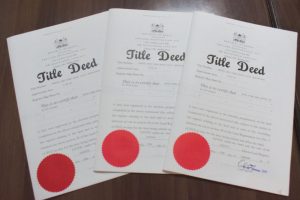
For Kenyans living abroad, investing in property back home is a significant financial and emotional goal. Our Diaspora Elite program is specifically designed to help these investors navigate the process. Obtaining a title deed in Kenya from overseas requires a trusted partner on the ground to manage the legal and logistical steps, ensuring a secure and transparent transaction for your deed of ownership.
As a diaspora investor, you can appoint a trusted representative, often a lawyer or a family member, through a Power of Attorney. This legal document empowers your representative to sign documents and act on your behalf in all matters related to the property transaction, including the transfer of the title deed. This is a crucial step for managing the process of getting a title deed in Kenya from abroad.
Thorough due diligence is even more critical when you are not physically present. We assist our Diaspora Elite clients by conducting comprehensive land title deed search in Kenya and verifying all property documents. We provide detailed reports, including a kenyan title deed sample and verification of the title deed number example, so you can invest with confidence, knowing your title deed is secure.
Your Guide to Kenyan Title Deeds: Understanding the Old and the New
The digitization of land records in Kenya has made it easier to conduct property searches. The question of how to check title deed online in Kenya is now common, as investors seek faster and more convenient ways to verify property details. The Ardhisasa platform allows you to perform these checks remotely, enhancing transparency in transactions involving a title deed.
To check a title deed online, you need to create an account on the Ardhisasa portal. Once registered, you can initiate a search using the property’s title number. The platform provides details about the property’s owner, size, and any registered encumbrances. This digital title deed search is a crucial part of modern due diligence.
While the online system is a significant step forward, it’s important to remember that it is still evolving. For complete peace of mind, especially in high-value transactions, we recommend complementing the online search with a physical verification at the relevant land registry. This ensures that the information on your title deed is cross-referenced and fully authenticated.
Verifying the authenticity of a title deed is the most critical step in preventing property fraud. Scammers often use sophisticated forgeries, making it essential to know how to verify title deed in Kenya through official channels. An authentic title deed is your only guarantee of legitimate ownership.
The most reliable method to confirm a title deed is genuine is by conducting an official search at the relevant land registry. You will need a copy of the title deed from the seller to get the title number. The search results will confirm the registered owner, the property details, and whether there are any cautions or charges registered against the title deed.
In addition to the registry search, it’s wise to physically inspect the property to ensure the details on the ground match the records on the title deed. Engaging a reputable surveyor can help confirm the boundaries. Furthermore, having a lawyer review the title deed and search results provides an extra layer of protection against potential fraud.
To successfully register or transfer a title deed in Kenya, you must meet several legal and administrative requirements. Fulfilling these Title Deed Kenya requirements is essential for a smooth and legally compliant transaction. These requirements ensure that every title deed registered is legitimate and the transfer is transparent.
For an individual buyer, the requirements for a title deed transfer include your original National ID card or passport, your KRA PIN certificate, and passport-sized photos. You will also need to sign the land transfer forms and sale agreement. These documents are necessary to process the new title deeds Kenya.
If a company is purchasing property, it will need to provide its certificate of incorporation, KRA PIN certificate, and the PIN certificates and IDs of the company directors. The company must also provide a resolution from its board of directors authorizing the purchase. Meeting these requirements ensures the company’s title deed is legally sound.
Step-by-Step Guide of Getting a Title Deed in Kenya for Diaspora Investors in 2026
The title deed transfer process in Kenya can sometimes be fraught with challenges, from bureaucratic delays to legal complexities. Being aware of these potential hurdles can help you prepare and navigate them effectively, ensuring a smoother journey to obtaining your title deed.
A common challenge is the delay caused by missing files or slow processing at the land registries. To overcome this, it is crucial to work with an experienced conveyancer who is familiar with the registry’s procedures and can follow up diligently. Keeping organized records of all submissions helps track the progress of your title deed application.
Discovering an unexpected caution, charge, or encumbrance on a title deed during the search process can halt a transaction. The best way to overcome this is to ensure the seller resolves and clears these issues before you finalize the purchase. A clear and well-drafted sale agreement should stipulate that the seller must deliver a clean title deed, free from any encumbrances.
At Nyota Njema, we offer a wide range of properties in prime locations across Kenya. Whether you’re looking for a plot in Nanyuki, Embu, Syokimau, Naivasha, Diani, Kikuyu Nachu, Malindi, Kikuyu Thigio, Kitengela, or Ushirika Gardens next to Tatu City, we have options to suit your needs. All our properties come with a genuine title deed.
|
Property Size |
Availability |
|---|---|
|
Acre |
Available |
|
1/2 Acre |
Available |
|
1/4 Acre |
Available |
|
50×100 |
Available |
In Kenya, there are primarily two main types of title deeds: freehold and leasehold. A freehold title deed grants the owner absolute ownership of the land and property in perpetuity. A leasehold title deed grants ownership for a specific, fixed period, such as 99 years, after which ownership may revert to the head lessor. Additionally, with the rise of apartments, the sectional title deed has become common, granting ownership of a unit within a larger building.
The process of getting a title deed in Kenya involves several steps, starting with a sale agreement between buyer and seller. This is followed by a land search, obtaining rates and rent clearance certificates, and gaining consent to transfer. Finally, the transfer documents are assessed for stamp duty, which is paid before the documents are lodged at the lands registry for the issuance of a new title deed in the buyer’s name.
The new title deeds Kenya refers to the converted titles being issued under the Land Registration Act of 2012. This act aimed to consolidate various land registration statutes into one, simplifying the system. The new titles are issued after a cadastral mapping process and are meant to be more secure, with features that make them harder to forge, thereby protecting the integrity of your title deed.
To know if a title deed is genuine, you must conduct an official search at the relevant land registry. The search will confirm the details of the registered owner and the property. You should also inspect the security features of the title deed itself, such as the watermark and seal, and have it reviewed by a qualified conveyancing lawyer.
Yes, a title deed is the primary and most definitive proof of land ownership in Kenya. It is a legal document issued by the government that formally establishes the rights of an individual or entity to a piece of property. In any legal dispute, a valid title deed is considered conclusive evidence of ownership.
The “best” type of deed of title largely depends on your investment goals. A freehold title deed is often considered superior because it grants perpetual ownership and maximum control. However, a leasehold title deed in a prime urban location can be an excellent investment for rental income or commercial purposes.
The three main categories of land ownership in Kenya are public, community, and private. Public land is held by the government in trust for the people. Community land is held by communities on the basis of ethnicity, culture, or similar interest. Private land is held by individuals or companies under a freehold or leasehold title deed.
A title deed itself is the document that proves a clear title, but to clear a title with defects or claims, various legal instruments may be used. A deed of indemnity might be used to protect a buyer against a known defect, or a court order may be required to remove a fraudulent entry. The ultimate goal is always to have a “clean” title deed with no encumbrances.
Yes, an absolute title deed is essentially the same as a freehold title. Both terms refer to the highest form of land ownership, granting the holder full and perpetual rights over the land. When you hold an absolute title, your title deed confirms that you are the indisputable owner.
Historically, the land registration system in Kenya used different types of registers and documents, which could be confusing. The ongoing land reform process aims to consolidate these into a single, unified system with a standardized title deed format. Therefore, while older variations exist, the goal is to move towards one primary type of title deed document for simplicity and security.
Whether you need assistance with a title deed, are looking for the perfect plot in one of our prime locations, or require financial advice, we are here to help.
Contact Nyota Njema today, and let us guide you. For flexible financing options, talk to our partners at Kikwetu Sacco to make your dream of land ownership a reality.
Mon to Fri: 8am to 5pm Saturday: 8am to 1pm
Email: [email protected] Phone: +254 728 895 895 Nairobi, Thome, Mukuyu Court Office 212
Contact Nyota Njema today to start your secure investment journey!
Your essential guide to buying property in Kenya from abroad. Learn the legal steps, requirements, best locations, and how to invest safely in 2026.
The process of buying property in Kenya from abroad can feel like a complex journey, but it is a rewarding one for thousands of Kenyans in the diaspora and foreign investors. This 2026 guide is designed to be your trusted companion, demystifying the steps, legalities, and opportunities available in the Kenyan real estate market. At Nyota Njema, we specialize in helping our international clients, especially through our Diaspora Elite program, navigate this process seamlessly. Whether you are looking for affordable land and plots for sale in Kenya or high-end apartments for sale in Kenya, this guide provides the clarity you need to invest with confidence from anywhere in the world.
How Location Pins Benefit the Real Estate Market
A structured approach is crucial when you are handling a significant investment from a distance. A detailed checklist ensures you cover all bases in the land buying process in Kenya, minimizing risks and preventing costly oversights. This is a critical step for all land buyers in Kenya, especially those who cannot physically be on the ground. This checklist will help you navigate the journey of buying property in Kenya from abroad smoothly.
Before committing your funds, you must understand the market dynamics. This involves identifying the best places to buy land in Kenya based on your investment goals. Are you looking for cheap agricultural land for Sale in Kenya, a residential plot near the city, or a holiday home? For example, you can buy 50×100 Plots in Nanyuki for a scenic retreat or buy 50×100 Plots in Kitengela for proximity to Nairobi. Knowing the 1 acre land price in Kenya in various regions helps you budget effectively when buying property in Kenya from abroad.
Proper documentation is the cornerstone of a secure land transaction. You need to know the specific requirements for buying property in Kenya from abroad. This includes verifying title deeds, understanding the sale agreement, and ensuring all land rates are paid up. When dealing with land selling companies in Kenya, ask for proof of ownership and verify the documents with the Ministry of Lands. This is essential to secure Affordable land and plots for sale in Kenya with ready title deeds.

Understanding the legal framework is non-negotiable. Kenyan law has specific provisions for property ownership by non-citizens and citizens living abroad, making it essential to know your rights and limitations when buying property in Kenya from abroad. This knowledge protects you from potential legal pitfalls.
The Kenyan Constitution restricts freehold land ownership to Kenyan citizens. However, this does not block foreigners from investing. Foreigners can own land on a leasehold basis for a term of up to 99 years. This allows them to develop, sell, or transfer the property within the lease period, making buying property in Kenya as a foreigner a viable and secure investment. Many apartments for sale in Kenya are sold on this basis.
For those buying property in Kenya from abroad, a Power of Attorney (POA) is an invaluable legal tool. It allows you to appoint a trusted individual or a legal representative in Kenya to handle the transaction on your behalf. This person can sign documents, make payments, and oversee the entire process, ensuring everything proceeds smoothly without you having to travel. We often facilitate this for our Diaspora Elite clients.
Beyond the purchase price, several other costs are involved. Budgeting for these additional expenses is a key part of successfully buying property in Kenya from abroad. Awareness of these financial obligations prevents surprises and ensures your investment journey is financially sound from start to finish.
When you buy property, you must pay Stamp Duty, which is typically 4% of the property’s value in urban areas and 2% in rural areas. Additionally, there are legal fees, which are guided by the Advocates’ Remuneration Order. Understanding the taxes and fees associated with buying property in Kenya from abroad helps you calculate the total cost of acquisition. For example, a plot for sale 50k Kenya might have minimal taxes, but the legal process costs are still applicable.
Besides taxes, you should budget for costs like land registration fees, the cost of conducting a title search, and land survey fees if you are subdividing a larger parcel. If you are looking to buy 50X100 plots for sale, ensure you clarify if these costs are included in the purchase price. Some land sellers in Kenya might include them as a package deal.
The question of where to buy plot/land in Kenya is one we get often. Your choice of location depends on your investment goals, whether for speculation, settlement, or commercial use. When buying property in Kenya from abroad, focusing on high-growth areas is a smart strategy.
Areas surrounding Nairobi offer some of the best returns. If you want to buy 50×100 plots in Kenya with installments online, consider towns like Ruiru, Juja, and Kitengela. We have prime properties at Ushirika Gardens next to Tatu city and in Syokimau. For those asking where to buy cheap land in Nairobi, these satellite towns offer the perfect answer. You can buy 50×100 Plots in Ruiru or buy 50×100 Plots in Juja for excellent capital gains.
For a relaxed lifestyle, consider coastal and upcountry locations. You can buy 50×100 Plots in Diani or buy 50×100 Plots in Malindi for a beachside property. Nanyuki is another popular choice, offering stunning views and a serene environment. At Nyota Njema, we have land available in Nanyuki, Embu, Naivasha, and Diani, perfect for your retirement or holiday home.

Financing your property purchase from overseas is easier than ever. Several institutions cater specifically to the diaspora, offering flexible payment plans and loans for buying property in Kenya from abroad. This makes property ownership accessible even if you do not have the full amount upfront.
Many Kenyan banks, including Equity Bank and KCB Bank, have diaspora banking products. You might see ads for Equity Bank plots for sale or KCB Bank plots for sale, which are often offered with financing options. At Nyota Njema, we go a step further with our own Sacco, Kikwetu Sacco, which helps our members save and access financing for their land purchases, including those looking for Equity Bank plots for sale near Nairobi.
Reputable real estate companies offer flexible installment plans. This allows you to secure a property and pay for it over a period of time, often interest-free. This is a great way to buy 50×100 plots in Kenya with installments online. Our products, like La-Ndoa for couples and U-genz for young investors, are designed with flexible payments in mind.
Investing from thousands of miles away comes with unique challenges. However, with the right strategy and partners, you can easily overcome them while buying property in Kenya from abroad. The key is to be proactive and informed.
The risk of dealing with fraudulent sellers is a major concern. To avoid this, always work with one of the top land buying companies in Kenya. A reputable company will provide verifiable documents and a clear history of successful projects. Never buy from unverified online listings like plot for sale 50k kenya olx without thorough due diligence.
Once you own the property, you need a plan for managing it. This could involve hiring a property management company, especially for apartments for sale in Kenya that you plan to rent out. For vacant land, securing it with a fence and a caretaker is advisable. This ensures your investment is safe while you are away.
Navigating the legal and regulatory framework for buying property in Kenya
Verification is the most critical step in the entire process. Before any money changes hands, you must confirm that the seller legally owns the property and that it is free from any disputes. This is a non-negotiable step when buying property in Kenya from abroad.
A title search at the local land registry is mandatory. This search confirms the registered owner, the size of the property (e.g., if it’s a 50 by 100 plot in acres), and whether there are any encumbrances like bank charges or court cautions. Your lawyer or a trusted agent can do this on your behalf. The search answers how many 50 by 100 plots are in an acre in Kenya for a specific title.
Even if you are abroad, have someone you trust visit the site. They should verify the location and confirm that the beacons are in place. This ensures the plot you are buying on paper matches the actual location on the ground. This is vital whether you are buying a small plot for sale 50k Kenya or a cheap 1 acre land for sale in Kenya.
Investing back home offers immense financial and emotional rewards. For many in the diaspora, buying property in Kenya from abroad is about creating a legacy, securing their future, and connecting with their roots.
The Kenyan property market has consistently offered high returns. Land in emerging areas appreciates quickly as infrastructure develops. By finding the cheapest place to buy land in Kenya today, you position yourself for significant capital gains in the future.
Owning property in Kenya is a powerful way to build a legacy for your family. Our Legacy Reward program is specifically designed for parents who want to invest in property for their children’s future. It is a tangible asset that can be passed down through generations.
Navigating the process of buying property in Kenya from abroad requires caution. Many enthusiastic investors make avoidable mistakes that cost them time and money. Being aware of these common pitfalls is the first step to protecting your investment.

The excitement of finding a seemingly good deal, like a plot for sale 50k Mombasa, can lead investors to skip proper due diligence. Never rely solely on the seller’s word. Always engage a lawyer to conduct official searches and verify all documents to avoid being scammed.
Sending money to relatives or unvetted agents is a huge risk. It is far safer to work with established and affordable land buying companies in Kenya like Nyota Njema. We have a transparent process and provide regular updates, giving you peace of mind when buying property in Kenya from abroad.
We are dedicated to making the process of buying property in Kenya from abroad simple, secure, and rewarding. Our team understands the unique needs of diaspora investors, and we have tailored our services and products to meet them effectively.
We offer a wide range of properties, from 50 x 100 plots in Kenya to larger acreages. Our listings are in prime, high-growth areas.
|
Property Size |
Suitability |
Availability |
|---|---|---|
|
Acre |
Commercial/Farming |
Available |
|
1/2 Acre |
Residential/Development |
Available |
|
1/4 Acre |
Residential/Holiday Home |
Available |
|
50×100 |
Standard Residential |
Available |
From your initial inquiry about buying property in Kenya from abroad Nairobi to the final title transfer, we walk with you. We have strategic plots in Kikuyu Nachu, Kikuyu Thigio, and other areas ideal for those working in the city. Our goal is to be one of the best land buying companies you can trust.
A foreigner can purchase property on a leasehold basis for up to 99 years. You will need a KRA PIN, a qualified lawyer to handle the transaction, and to perform thorough due diligence. The process involves signing a sale agreement, paying the required taxes, and registering the transfer.
In property investment, the 2% rule is a guideline that suggests a rental property’s monthly income should be at least 2% of its purchase price. While this is an ambitious target in some Kenyan markets, it is a useful metric for evaluating potential rental returns. For example, a property bought for Ksh 5 million should ideally generate Ksh 100,000 in monthly rent.
Yes, an American citizen can buy a house in Kenya. Like other foreigners, the ownership of the land the house sits on will be on a leasehold basis, not freehold. This allows them to own, develop, and live in the property securely.
This refers to the law of adverse possession. If a person occupies a piece of private land continuously and openly for 12 years without permission from the owner, they can petition the court to be registered as the new owner. This law underscores the importance of securing and monitoring your land, especially if you are abroad.
A foreigner can apply for permanent residency after lawfully residing in Kenya for a continuous period of seven years. They must meet specific criteria, such as holding a valid work permit and demonstrating good character. Permanent residency grants more privileges, though it doesn’t automatically grant the right to own freehold land.
Yes, a foreigner can and must get a KRA PIN to conduct transactions like buying property or a car in Kenya. The application can be done online through the KRA iTax portal. You will need a valid alien ID card or passport to complete the registration.
Foreigners can invest in various sectors, including real estate, the stock market, and starting a business. For real estate, it is advisable to partner with reputable firms that understand the legal landscape for foreign investors. This ensures you are compliant with all regulations while maximizing your returns.
The cost of a house varies significantly by location and size, from a few million shillings in satellite towns to hundreds of millions in prime suburbs like Karen or Runda. You can find decent three-bedroom houses in areas around Nairobi for between Ksh 8 million and Ksh 15 million. Building your own house on an affordable plot is often a more cost-effective option.
Ready to begin your journey of buying property in Kenya from abroad?
Let us be your trusted partner on the ground. Contact Nyota Njema today, and our diaspora relations team will guide you through our portfolio of properties in Nanyuki, Kitengela, Malindi, and other prime locations to find the perfect investment for you.
Mon to Fri: 8am to 5pm Saturday: 8am to 1pm
Email: [email protected] Phone: +254 728 895 895 Nairobi, Thome, Mukuyu Court Office 212
Discover the cheapest place to buy land in Kenya with our 2026 guide. Explore affordable plots, prices, and top investment locations today.
Finding the cheapest place to buy land in Kenya is a top priority for many aspiring homeowners and investors this year. As the economy evolves, the demand for affordable property continues to rise, making it crucial to know exactly where to look for value.
At Nyota Njema, we understand that securing a plot is more than just a transaction; it is a step towards financial freedom and legacy building. This comprehensive guide will walk you through the most affordable regions, pricing trends, and specific locations where your money goes further.
Whether you are looking for affordable land and plots for sale in Kenya for settlement or speculation, we are here to help you navigate the market.
How to Find Affordable Land for Sale in Diani and malindi Kenya 2026
When searching for the best places to buy land in Kenya, you need to look beyond the city center to areas with high growth potential. The most affordable options are often found in satellite towns that are rapidly developing into residential hubs.
Investors often search for a plot for sale 50k Kenya, and while these prices are becoming rarer near the capital, they are still accessible in emerging zones. We have seen a surge in land buyers in Kenya flocking to these areas to secure their future before prices skyrocket.
The outskirts of the capital offer some of the best value for money, answering the question of where to buy cheap land in Nairobi effectively. Towns like Kitengela and Rongai, and areas along Kangundo Road, are prime examples where infrastructure is improving daily. If you are looking for cheap plots for sale in Kenya, these satellite towns offer a balance of accessibility and affordability. You might even find a small plot for sale 50k kenya in the interior parts of these regions if you are willing to hold the land for long-term appreciation.
To get the best deal, you must understand land metrics, such as how many 50 by 100 plots are in an acre in Kenya. Typically, an acre produces eight 50 by 100 plots in kenya, which helps when calculating the price per unit. Many people search for a 50 by 100 plot in acres or a 50 by 100 plot in hectares to understand what they are buying. For reference, a 50 by 100 plot in metres is approximately 15 meters by 30 meters. Knowing the 50 by 100 plot price in Kenya in different regions helps you spot a bargain instantly.

The Rift Valley is currently a hotspot for those looking for cheap land for sale in Kenya with massive industrial and agricultural potential. Towns here are expanding, and the demand for 50 x 100 plots in Kenya is at an all-time high. Whether you are looking for residential plots or cheap agricultural land for Sale in Kenya, this region offers diverse opportunities.
Nakuru has recently gained city status, yet you can still Buy 50×100 Plots in Nakuru at very competitive rates compared to Nairobi. Similarly, Naivasha is booming due to the dry port and tourism. If you want to Buy 50×100 Plots in Naivasha, now is the time to act. We also have Nyota Njema properties available in Naivasha, perfect for our U-genz product which targets young investors looking to start their journey early.
The region is ideal for those asking where to buy plot/land in Kenya for mixed-use. You can find cheap 1 acre land for sale in Kenya suitable for farming or development. For investors interested in smaller parcels, Buy 50×100 Plots in Naromoru or look into Buy 50×100 Plots in Kajiado (which bridges the Rift and Nairobi metro) for excellent returns.
The coast is no longer just for holidays; it is now a prime location for cheap plots for sale kenya. With the expansion of infrastructure, areas like Kilifi and Kwale are opening up. Many investors are surprised to find a plot for sale 50k Mombasa or its environs, especially in the interior areas awaiting development.
For those who love the beach lifestyle but want affordability, you can Buy 50×100 Plots in Diani or Buy 50×100 Plots in Malindi. These areas are perfect for our Diaspora Elite clients who want a holiday home or a retirement plan back home. Malindi, in particular, offers vast tracts of land, making it easy to find cheap 1 acre land for sale in Kenya near the ocean.
We also have listings in Diani and Malindi. The search for prime plots on sale 50×100 often leads to the coast because the land is flat and construction costs are relatively lower. If you are looking for cheap Plots for sale by owner or through a trusted partner like us, the coastal strip remains unmatched for value.
Western Kenya is experiencing a real estate renaissance, offering cheap agricultural Land for sale in Kenya and residential plots. With the upgrade of Kisumu port and roads, land sellers in Kenya are seeing increased interest in this region.
As connectivity improves, the value of agricultural plots for sale kenya in the west is rising. However, it remains one of the most affordable regions. You can still find an agriculture plot for sale 50k kenya in the deeper rural areas, which is great for long-term food security projects.
For those asking about the 1 acre land price in Kenya for farming, Western Kenya provides fertile soil at lower costs than the central highlands. It is a smart move to buy 50×100 plots in kenya with installments online in these areas to lock in the price before full urbanization hits.
Northern Kenya is the new frontier for those seeking the absolute cheapest land in kenya for sale. With mega-projects like LAPSSET, towns like Isiolo are transforming.
While it might seem far, this is where you find the top 10 cheapest land in kenya. Savvy investors are buying acres here. It is one of the few places where a plot for sale 50k Kenya is not just a marketing hook but a reality in certain undeveloped zones.
If you have a long-term horizon, this is where to buy plot/land in Kenya. The low entry point allows you to buy massive tracts. Even if you are looking for 50 x 100 plots for sale, the price per unit in the north is incredibly low compared to the rest of the country.
To successfully navigate the market, you need reliable partners. There are many land buying companies in Kenya, but choosing the right one ensures you get a clean title. At Nyota Njema, we pride ourselves on offering Affordable land and plots for sale in Kenya with ready title deeds.
We understand that cash flow matters. That’s why we have our own Sacco, Kikwetu Sacco (kikwetusacco.com), to assist with savings and financing. While you might see adverts for Equity bank plots for sale or KCB Bank plots for sale, working with a partner that understands your specific needs—like our La-Ndoa package for couples—can be more beneficial. We also see many people searching for Equity Bank plots for sale near Nairobi, indicating a high demand for financed land options.

We offer a variety of sizes to suit different budgets, from 50 x 100 plots for sale in Kenya to full acres.
|
Property Size |
Suitability |
Availability |
|---|---|---|
|
Acre |
Commercial/Farming |
Available |
|
1/2 Acre |
Residential/Development |
Available |
|
1/4 Acre |
Residential/Holiday Home |
Available |
|
50×100 |
Standard Residential |
Available |
Determining the best places to buy land in Kenya depends on your goals. For immediate settlement, areas with established communities are best. We have prime properties in locations like Nanyuki, Embu, Syokimau, and Kikuyu Nachu.
Towns like Nanyuki are booming with holiday homes. You can Buy 50×100 Plots in Nanyuki and enjoy views of Mt. Kenya. Similarly, Buy 50×100 Plots in Embu for a serene, green environment. These areas are popular with land buyers in Kenya who value quality of life.
For those looking for high returns, the Nairobi Metropolis is king. You can Buy 50×100 Plots in Juja, Buy 50×100 Plots in Ruiru, or Buy 50×100 Plots in Kitengela. These towns are cosmopolitan and growing fast. Our Legacy Reward product is perfect for parents buying land here for their children. Additionally, look at Ushirika Gardens next to Tatu City and Kikuyu Thigio for premium options.
Finding cheap land for sale in Nairobi proper is difficult, but the metropolitan area offers great deals. Areas like Kangundo Road allow you to find cheap plots for Sale in Nairobi without moving too far from the CBD.
If you are strictly looking for affordable plots for sale kenya nairobi, look towards the eastern bypass and beyond. You might encounter listings like plot for sale 50k kenya during your online search; always verify these offers. We provide legitimate commercial plots for sale kenya and residential plots in these high-demand zones.
Be on the lookout for cheap land for sale in Nairobi advertised by distressed sellers, but be cautious. It is safer to use reputable land selling companies in Kenya like Nyota Njema. We also have apartments for sale in Kenya for those who prefer built-up units over raw land.
Food production is a stable investment. There is a high demand for cheap agricultural Land for sale in Kenya.
You can find an agriculture plot for sale 50k kenya in arid or semi-arid areas that are opening up through irrigation. Investing here is wise for the long term.
If you want to buy big, search for cheap 1 acre land for sale in Kenya. We have seen clients successfully Buy 50×100 Plots in Kiambu for intensive farming, but moving further out allows you to buy larger tracts for the same price.
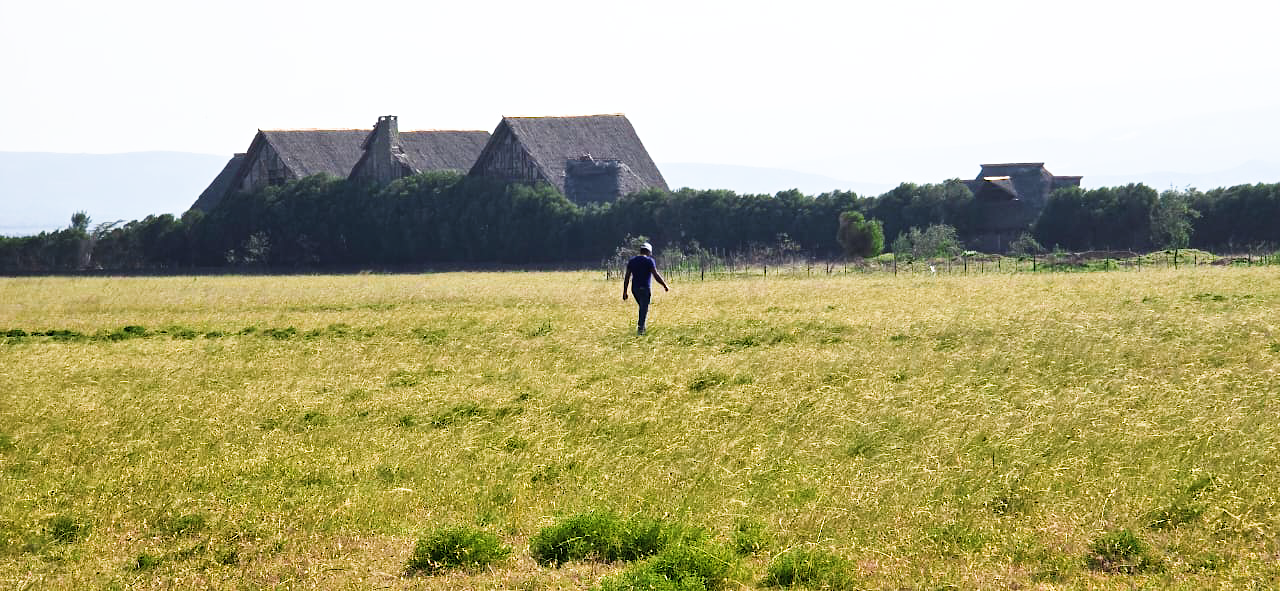
The land buying process in Kenya can be daunting. To find the best deals, you need to compare the top land buying companies in kenya.
Always check the list of land buying companies in kenya to ensure credibility. We are among the top 10 land buying companies in kenya because we focus on affordable land buying companies in kenya principles—integrity and affordability. Whether you need land buyers contact numbers in Kenya or advice, we are here.
Understanding measurements avoids confusion. A 50 x 100 plots in Kenya is the standard. If you want to buy 50X100 plots for sale, ensure the beacons are properly placed. Always ask how many 50 by 100 plots are in an acre in Kenya (the answer is 8) to verify you aren’t being shortchanged on size.
Land Buying Process in Kenya
Land is generally cheapest in the northern regions like Isiolo and Marsabit, as well as interior parts of the Coast and Eastern regions. These areas are further from the capital and major infrastructure, resulting in lower prices per acre. However, as infrastructure projects like LAPSSET continue, these prices are expected to rise.
Investing Ksh 50,000 in land is challenging but possible in very remote areas or through financing models. You might find a plot for sale 50k Kenya in emerging market centers far from the main tarmac. Alternatively, you can use that amount as a deposit for a plot with a company like Nyota Njema and pay the balance in installments.
Land in Malindi is relatively cheap because there is a vast supply of available land compared to the current population density. While tourism is strong, the interior areas are still developing, keeping prices for Buy 50×100 Plots in Malindi affordable. This makes it an excellent location for speculative buying or holiday homes.
The most affordable land is often found in satellite towns that are just beginning to open up, such as parts of Kajiado, Kilifi, and the interiors of Machakos county. These areas offer cheap plots on sale because they are currently less developed than established towns like Thika or Kiambu.
The price of 1 acre varies drastically depending on location; it can range from Ksh 200,000 in remote rural areas to hundreds of millions in Nairobi. In emerging satellite towns, you can find cheap 1 acre land for sale in Kenya ranging between Ksh 1 million to Ksh 5 million. Always compare prices in the specific locale you are interested in.
The best town depends on your lifestyle and work needs, but Nanyuki and Nakuru are consistently rated high for their quality of life and scenery. Towns like Kitengela and Ruiru are excellent for those working in Nairobi due to accessibility. If you want to Buy 50×100 Plots in Nanyuki, you get a blend of nature and urban amenities.
Yes, leasing land is generally cheaper in the short term than buying, as it requires less upfront capital. However, buying land provides asset ownership and capital appreciation, which leasing does not. For long-term projects like building a home, buying is the superior financial decision.
Are you ready to secure your future with the most affordable land deals in the market? Whether you are interested in our Chamas investment groups or buying a plot individually, we are here to guide you.
Contact Nyota Njema today to explore our listings in Nanyuki, Kitengela, Malindi, and beyond, and let us help you become a landowner in 2026.
Discover the best Affordable Land for Sale in Diani and Malindi. Expert guide on prices, locations, and tips for buying plots in Kenya’s coast in 2026.
If you are looking to secure your financial future, finding Affordable Land for Sale in Diani and Malindi is one of the smartest investment decisions you can make in 2026. These coastal towns are experiencing rapid growth, driven by tourism, infrastructure development, and an influx of investors seeking value for their money. Whether you are searching for Ukunda Diani plots for sale for a commercial venture or cheap beachfront plots for Sale in Kwale County Kenya for a holiday home, the opportunities are endless.
However, navigating the real estate market requires knowledge and strategy to ensure you don’t overpay. This guide is designed to help you locate the best Affordable Land for Sale in Diani and Malindi while avoiding common pitfalls that many buyers face.
If you are ready to invest, here is a snapshot of current Affordable Land for Sale in Diani and Malindi available through Nyota Njema. These listings represent some of the most competitive prices in the market for 2026.
|
Location |
Size |
Price Range |
|---|---|---|
|
Diani |
Acre |
7.5M – 9M |
|
½ Acre |
4M – 4.8M |
|
|
¼ Acre |
2.2M – 2.5M |
|
|
50×100 |
1.15M – 1.35M |
|
|
Malindi |
Acre |
650K – 710K |
Whether you are looking for cheap land for sale in Nairobi environs or the coast, these options provide a solid starting point. Don’t forget to check out our house listings as well if you prefer a developed property over raw land.
💡 Pro Tip: When buying land in Kenya, always prioritize areas with upcoming infrastructure projects like roads or airports. These developments significantly boost property value over time, ensuring a higher return on investment!
Unlike the saturated markets in Nairobi, Diani offers a unique blend of luxury and affordability that appeals to both local and international investors looking for property for sale in Diani Beach, Kenya.
The expansion of the Ukunda airstrip and the Dongo Kundu bypass has opened up previously inaccessible areas, making it easier to find Affordable Land for Sale in Diani and Malindi that is ripe for appreciation. Investors who act now can secure plots for sale in Diani before prices escalate further, ensuring a high return on investment in the coming years.
When comparing coastal destinations, many savvy buyers prioritize Affordable Land for Sale in Diani and Malindi because of the superior quality of life and infrastructure available in Diani. While you might find cheap land for sale in Mombasa, Diani offers a more serene environment perfect for holiday homes and retirement villas, which drives the demand for Affordable Land for Sale in Diani and Malindi.
Additionally, for those looking for rental income, an apartment for sale in Diani or a plot for Sale in Diani Galu Kinondo can yield significant returns due to the high tourism traffic. The key is to identify Affordable Land for Sale in Diani and Malindi that is strategically located near amenities like shopping centers, hospitals, and beach access points.
To find true value, you must look beyond the immediate coastline and explore areas that offer Affordable Land for Sale in Diani Kenya 2026 with future growth potential. Many first-time buyers make the mistake of focusing solely on expensive beachfront properties, missing out on cheap beach houses for sale in Diani, located just a few kilometers inland.
By widening your search, you can discover Affordable Land for Sale in Diani and Malindi that provides larger acreage for a fraction of the cost, such as those found in Galu or Kinondo. This strategy is particularly effective for those interested in Affordable Land for Sale in Diani and Malindi for agricultural or mixed-use development, where space is a premium requirement.
One of the best ways to secure Affordable Land for Sale in Diani and Malindi is to engage with established real estate firms rather than relying solely on online listings. Working with the top land buying companies in Kenya ensures that you get access to legitimate deals and avoid falling victim to scams that often plague the sector.
Reliable firms like Nyota Njema Real Estate can guide you to Affordable Land for Sale in Diani and Malindi, ensuring that all due diligence, including title verification, is conducted professionally. They can also connect you with land buyers contact numbers in Kenya if you are looking to resell or network with other investors in the region.
Successful real estate investment requires a clear strategy, especially when searching for Affordable Land for Sale in Diani Kenya 2026. Whether you are looking for a plot for sale 50k Kenya or a more substantial cheap 1 acre land for sale in Kenya, understanding your end goal is crucial. Are you buying to build immediately, or are you land banking for future capital appreciation?
If your goal is long-term wealth, identifying Affordable Land for Sale in Diani and Malindi in emerging satellite towns is a wise move. Products like the “Legacy Reward” from Nyota Njema are designed for such long-term thinkers, helping you secure Affordable Land for Sale in Diani and Malindi that will serve as a generational asset for your family.
For many, the biggest hurdle to acquiring Affordable Land for Sale in Diani and Malindi is financing, but there are numerous options available today. You don’t always need a bank loan; many affordable land buying companies in kenya offer flexible payment plans that allow you to pay in installments.
This is where offerings like “U-genz” for young investors or “Chamas” for group investments come into play, making Affordable Land for Sale in Diani and Malindi accessible to a wider demographic. Even if you are eyeing equity bank plots for sale, comparing these with company-financed payment plans can save you significant interest costs while securing your Affordable Land for Sale in Diani and Malindi.
While Diani offers luxury, Malindi is the undisputed king of volume and value, making it essential to consider when looking for Affordable Land for Sale in Diani Kenya 2026. The question “Why is land in Malindi so cheap” often comes up, and the answer lies in the vast availability of arable land compared to the more developed South Coast.
This abundance allows you to find Affordable Land for Sale in Diani and Malindi, specifically in Malindi, at prices that are unbeatable nationwide, such as Agricultural land for sale in Malindi or cheap land for sale in msabaha Malindi. For investors with a lower budget, focusing on Malindi is a strategic way to enter the market for Affordable Land for Sale in Diani and Malindi.
If you are interested in agribusiness, Malindi offers some of the best Affordable Land for Sale in Diani and Malindi suitable for farming. Areas like Kakuyuni are famous for their fertile soil, where you can find Kakuyuni Malindi Agricultural land for sale perfect for pineapples, mangoes, or chillies.
Investing in cheap agricultural Land for Sale in Kenya here means you get a productive asset that generates income while the land value appreciates. This dual benefit is why many savvy investors prioritize Affordable Land for Sale in Diani and Malindi located in these agricultural belts over purely residential plots in congested cities.
Ensuring the legality of your purchase is paramount when searching for Affordable Land for Sale in Diani Kenya 2026. The Kenyan land market can be tricky, and even when you find cheap plots on sale, you must verify the title deed status. Working with the best land buying companies minimizes this risk, as they pre-vet all Affordable Land for Sale in Diani and Malindi before listing it.
For those in the diaspora, the “Diaspora Elite” product ensures that your investment in Affordable Land for Sale in Diani and Malindi is handled transparently, with all legal paperwork processed on your behalf without the need for you to travel back home.
To safely navigate the market for Affordable Land for Sale in Diani and Malindi, avoid deals that seem too good to be true, such as a prime beach plot being sold as a plot for sale 50k Kenya. Always insist on a site visit and conducting a search at the Ministry of Lands, or hire a professional from the list of land buying companies in Kenya to do it for you.
Legitimate Affordable Land for Sale in Diani and Malindi will always have a traceable history and clear boundaries. Whether you are looking for cheap Plots for Sale by owner or through an agent, due diligence is your best defense against fraud in the search for Affordable Land for Sale in Diani and Malindi.
Location is everything, and knowing the specific neighborhoods that offer Affordable Land for Sale in Diani Kenya 2026 can save you millions. In Diani, look towards the expanding outskirts where infrastructure is planned but not yet fully developed, as this is where you will find Affordable Land for Sale in Diani and Malindi with the highest appreciation potential.
Similarly, in Malindi, areas slightly off the Malindi-Lamu road offer 50 by 100 plots in Malindi at bargain prices. By targeting these specific growth zones, you position yourself to maximize the value of your Affordable Land for Sale in Diani and Malindi as the towns expand outward.
Choosing between Diani and Malindi depends on your budget and goals for Affordable Land for Sale in Diani and Malindi. Diani is premium and tourist-centric, ideal for holiday homes and affordable plots for sale kenya nairobi residents want for vacations.
Malindi, on the other hand, offers Buy 50×100 Plots in Malindi at entry-level prices, making it perfect for first-time buyers and those looking for cheap land for sale in Malindi by owner. Both towns offer Affordable Land for Sale in Diani and Malindi, but understanding these market nuances helps you choose the right investment vehicle for your financial portfolio.
The future outlook for Affordable Land for Sale in Diani Kenya 2026 is overwhelmingly positive, with projected price increases across the board. As the government continues to invest in the blue economy and coastal infrastructure, the value of Affordable Land for Sale in Diani and Malindi is set to rise.
Smart investors are already securing farm vacant land for sale in Malindi and plots on sale in kenya coastal regions now to ride this wave. If you wait too long, what is currently Affordable Land for Sale in Diani and Malindi may soon become out of reach for the average middle-class buyer.
A growing trend influencing Affordable Land for Sale in Diani and Malindi is the demand for eco-friendly and sustainable living spaces. Buyers are increasingly looking for Affordable Land for Sale in Diani and Malindi where they can build off-grid homes or engage in permaculture.
This shift is making remote cheap 1 acre land for sale in Kenya more attractive than ever before. Products like “La-Ndoa” cater to couples looking to build such sustainable futures together, making the acquisition of Affordable Land for Sale in Diani and Malindi not just a financial investment, but a lifestyle choice.
Taking action is the final step in securing Affordable Land for Sale in Diani Kenya 2026. Start by setting a budget that includes not just the purchase price but also legal fees and stamp duty associated with Affordable Land for Sale in Diani and Malindi.
Next, scour platforms like affordable plots for sale kenya jiji and affordable plots for sale kenya olx to get a feel for the market prices. Finally, consult with a trusted partner like Nyota Njema to view their verified listings of Affordable Land for Sale in Diani and Malindi and close the deal with confidence.
The window of opportunity to buy Affordable Land for Sale in Diani Kenya 2026 is wide open, but it won’t stay that way forever. By focusing on Affordable Land for Sale in Diani and Malindi, you are placing your capital in a region with proven growth metrics and undeniable lifestyle appeal. From plots for sale in Malindi Town to serene getaway spots in Kwale, the options are diverse. Remember to use reputable land buying companies in kenya, verify all documents, and choose the location that aligns with your long-term goals. Your journey to owning Affordable Land for Sale in Diani and Malindi starts today—take that step and secure your legacy.
A 50 by 100 plot in Malindi typically ranges from KSh 300,000 to KSh 700,000, depending on its exact location and proximity to amenities. Always confirm current prices with local agents or listings.
Rural areas and regions such as Malindi, Msabaha, and parts of Kwale County offer some of the cheapest land. Prices are generally lower farther from main urban centers and beaches.
Land in Malindi is affordable due to the vast availability of undeveloped land. Lower demand compared to urban areas and ongoing infrastructure growth also contribute to lower prices.
Counties like Kwale, Tana River, and remote areas near Malindi generally offer the cheapest land in Kenya. Consider accessibility and infrastructure before purchasing.
An acre contains approximately eight 50×100 plots. This is based on standard measurements, but always check the survey plan for accuracy.
The 12-year rule, known as adverse possession, allows someone to claim ownership of land if they have occupied it openly and continuously for 12 years without the owner’s objection. This claim must be confirmed by a court process.
Fencing a 50 by 100 plot in Kenya costs between KSh 80,000 and KSh 200,000, depending on the type of fencing material used and local labor rates.
A 50 by 100 plot is 5,000 square feet or approximately 464 square meters. This is a common residential plot size in Kenya.
A 50 by 100 plot is often referred to as an eighth of an acre (not a half). It is a standard and popular plot size for many buyers.
Development costs vary but can start from KSh 600,000 for basic house construction on a 50 by 100 plot. Costs increase with building size, finishes, and utility installations.

Learn how to buy 50×100 plots in Kenya with Installments, find the best payment options, locations, legal process, and FAQs in a simple, local guide.
Buying land in Kenya is now easier than ever with the option to Buy 50×100 Plots in Kenya with Installments. For many Kenyans and investors living abroad, the ability to own a 50×100 plot with affordable payment plans brings the dream of land ownership closer to reality. From Nairobi’s growing suburbs to scenic coastal towns and rich agricultural areas, you can find flexible land for sale in Kenya almost everywhere.
This comprehensive guide explains the full process, top locations, payment plans, credible land buying companies in Kenya, and answers all your critical questions about buying land in installments.
Pro Tip 💡: When buying land in Kenya, always conduct a land search at the Ministry of Lands to verify ownership and ensure there are no disputes or encumbrances. This simple step can save you from future legal troubles!
A 50×100 plot in Kenya is roughly 1/8th of an acre, or 5,000 square feet. This size is ideal for families, young professionals, investors, and even groups—called chamas—who want to build, invest, or start a business. Owning a 50×100 plot offers flexibility for constructing single rooms, rentals, or your future home.
With Buy land in installments, you do not need to raise the full amount upfront. Instead, you make an initial deposit and complete the remaining payments over months or years. Most land buying companies in Kenya like Nyota Njema Real Estate provide options to structure your payments to suit your finances, making it easier to own a 50×100 plot without financial strain.
Kenya offers a wide range of locations to buy 50×100 plots in Kenya with installments:
Nanyuki is a fast-growing town located at the foothills of Mount Kenya, making it a prime destination for property investment. It is a hub for tourists and expatriates due to its proximity to major wildlife reserves and stunning natural landscapes. Buying a 50×100 plot here with installments allows investors to tap into the booming hospitality and real estate markets in the region, with great potential for value appreciation.

Kiambu is located on the outskirts of Nairobi and offers a blend of urban convenience and serene rural surroundings. The region has seen rapid development, including infrastructure improvements and residential projects, making it an ideal place for those looking to invest in property near the capital. Flexible installment plans for 50×100 plots in Kiambu ensure that it remains accessible for a diverse range of buyers.
Diani, a coastal paradise along the Kenyan shoreline, is renowned for its white sandy beaches and crystal-clear waters. Buying a 50×100 plot in Diani offers not only an opportunity for relaxation but also for business investments such as vacation rentals or resorts. The availability of installment plans makes it easier for buyers to own a piece of this tropical haven.
Malindi, a historic coastal town, is celebrated for its rich culture, history, and serene beaches. It is a hub for both local and international tourists, which offers great potential for residential and commercial property developments. Investing in 50×100 plots in Malindi through installment plans is an excellent way to secure property in this attractive and growing market.
Nakuru, known for its breathtaking natural attractions such as Lake Nakuru and Menengai Crater, is a prime location for property investments. Purchasing 50×100 plots in Nakuru offers great opportunities for residential or commercial developments in a growing urban center with robust infrastructure and continued economic growth.
Kajiado is a rapidly expanding area with an appealing mix of urban and rural living. Its proximity to Nairobi and availability of essential services make it an excellent destination for property buyers. Investing in 50×100 plots in Kajiado ensures high potential for future development in this dynamic region.
Nestled on the slopes of Mount Kenya, Embu is an agricultural and economic hub with an increasingly vibrant real estate market. Buying 50×100 plots in Embu offers an opportunity to enjoy scenic surroundings while benefiting from the area’s growing development and accessibility.

Naivasha, located in the Great Rift Valley, is home to stunning attractions such as Lake Naivasha and Hell’s Gate National Park. Owning 50×100 plots in Naivasha positions you at the heart of a tranquil environment that is ideal for a home, ranch, or luxurious getaway.
Kitengela, an urban town located south of Nairobi, is known for its affordability and proximity to the capital city. Investing in 50×100 plots in Kitengela provides a practical and potentially high-return opportunity as the town continues to grow rapidly in population and infrastructure.
Juja, positioned along the Thika Superhighway, has seen tremendous growth due to the expansion of Nairobi’s outskirts. Properties in Juja are ideal for residential or affordable urban developments. Buying 50×100 plots in Juja is a smart move for those seeking proximity to Nairobi with lower investment costs.
Ruiru is a thriving suburb located near Nairobi with ongoing developments in infrastructure, schools, and shopping centers. Securing 50×100 plots in Ruiru guarantees a prime location for residential or commercial property in a fast-growing and high-demand market.
Naromoru, a small yet bustling gateway town to Mount Kenya, offers a serene countryside setting with investment potential. Purchasing 50×100 plots in Naromoru presents an opportunity for residential or eco-tourism projects in an area renowned for its natural beauty and tranquility.
When searching for the cheapest land in Kenya for sale, consider rural counties and towns in early stages of development. Here, plot for sale 50k Kenya might be available. Always research current rates and demand in each region.
Finding affordable land in Nairobi can be challenging due to the city’s rapid growth and high demand. However, there are pockets within and around Nairobi where inexpensive plots may be available. These areas often lie on the city’s outskirts, benefiting from ongoing infrastructure improvements and urban expansion. Below are a few prime locations to consider:
When purchasing land in Nairobi, it is important to assess several factors to ensure you’re making a sound investment:
The government and private developers continue to explore growth in satellite towns around Nairobi, creating new opportunities for affordable land investments. Areas such as Ngong, Ongata Rongai, and Thika are seeing increased interest due to road improvements and urban sprawl. For those buying property for the first time or looking to invest in Nairobi’s growing real estate market, these locations provide a cost-effective entry point.
To stay safe, work only with top land buying companies in Kenya. Review the list of land buying companies in Kenya and check for verified customer testimonials and physical offices. Confirm their documentation and ensure they have provided genuine title deeds and clear land buyers contact numbers in Kenya.
When considering land buying companies in Kenya, it is essential to prioritize those that offer transparency, reliability, and comprehensive support. Reputable companies, like Nyota Njema Real Estate, typically provide clear documentation, well-structured payment plans, and end-to-end guidance throughout the purchasing process. These companies often cover vital details such as ensuring the land is free from disputes, verifying ownership, and assisting clients with title deed registration to avoid unnecessary complications.
Many trusted firms also cater to diverse client needs through tailored programs designed for different buyer categories, such as groups, couples, youth, or Kenyans living abroad. Additionally, flexible installment plans make it easier for clients to own land without straining their finances. Online payment options and installment systems have proven convenient for buyers, allowing them to stay on schedule while achieving their dreams of land ownership. Partnering with reliable companies ensures a smooth, transparent transaction and peace of mind for the buyer.
When checking, explore recent rankings of the best land buying companies, top 10 land buying companies in Kenya, as well as affordable land buying companies in Kenya. Confirm their legitimacy and offerings, particularly if they advertise cheap plots on sale or plots for sale 50k Kenya.
Before you buy land in installments in Kenya, use a clear budget. Tools like a buy land in installments calculator help you estimate monthly or quarterly payments based on deposit, interest (if any), and duration.
Most leading banks have developed loans to help Kenyans buy land:
Group purchases or savings through Chamas provide a path for friends, families, and businesses to purchase affordable land in installments. Nyota Njema supports buyers through collective schemes.
Buying land involves crucial legal checks:
Reputable firms ensure buyers get clean title deeds—critical for accessing products like KCB land loan and Equity Bank title deed loans.
With so many plots on sale—especially cheap ones (e.g., cheap 1 acre land for sale in Kenya, cheap agricultural land for sale in Kenya)—buying blindly isn’t wise. Visit the site, confirm boundaries, and check on future zoning limitations.
Always visit your chosen plot for sale. Verify connections to essential services—roads, water, power, and drainage. Speak to neighbors for extra assurance about the area.
Request original or certified copies of title deeds, payment receipts, and approvals. For extremely cheap deals (like plot for sale 50k Kenya), double-check legitimacy.
Check local bylaws, especially when considering agricultural land, cheap plots for sale by owner, or developing rental properties.
Repeat buyers grow their portfolio and may access better terms or perks, encouraging you to expand from urban plots to rural or affordable agricultural land.
Group purchases split the cost for quicker property acquisition—great for those eyeing affordable plots for sale Kenya olx, or wishing to fast track their land investment goals.
Once you complete your installment payments—whether buying alone, through Chamas, or using finance options like KCB or Equity—you will process your title deed transfer. This provides proof that you officially own a 50×100 plot.
A clean title deed enables you to get loans (like Equity Bank title deed loans or KCB bank title deed loans), develop rentals, or use property as collateral.
Some banks and microfinance institutions give instant loan on title deed Kenya to help with emergencies or further development.
Plots and land for sale in Kenya—especially with payment plans—are a shield against inflation. Prices rise consistently in major locations like Nakuru, Kiambu, Nanyuki, and Kajiado.
From urban to rural Kenya, land gives you the option to build rentals, homes, or expand into agri-business. For instance, with a 50×100 plot, you can develop up to 16 single rooms or create a beautiful family home.
As you build confidence, consider expanding to cheap agricultural land for sale in Kenya or add more affordable plots for sale Kenya jiji and other channels to your investment mix, reaping benefits like the Legacy Reward program.
Cheap land in Kenya can be found in developing counties, satellite towns, and more rural regions. Consider areas such as Kitengela, Juja, Kajiado, Malindi, and parts of Nakuru if you want affordable options. Working with reputable land buying companies in Kenya ensures security and access to the cheapest land in Kenya for sale, including affordable plots for sale kenya jiji and olx.
Land in Malindi is usually cheaper due to its vast availability and slower urban development compared to Nairobi or Mombasa. Demand tends to be lower, and infrastructure expansion is gradual, keeping prices more affordable. This makes it one of the best places to buy land in Kenya for people seeking long-term investment or holiday homes.
The cheapest land per acre in Kenya is often in remote or underdeveloped counties where infrastructure is minimal. Counties in Eastern, Northeastern, and some Rift Valley areas feature top 10 cheapest land in Kenya and opportunities like cheap agricultural land for sale in Kenya. Here, investors can get cheap 1 acre land for sale in Kenya at a fraction of what is asked in urban areas.
Leasing land can be less expensive in the short run and is a common option for agriculture or temporary projects. However, buying land gives you full ownership and long-term security, which leasing does not offer. Over time, ownership builds wealth as land appreciates, especially in growing markets like Kiambu, Kitengela, and Ruiru.
Land remains one of the smartest ways to invest money in Kenya. Opportunities include buying plots for sale, getting involved in chamas for group investments, or purchasing houses from listings. Other routes are agriculture through cheap 1 acre land for sale in Kenya or diversifying into commercial developments.
One acre in Kenya typically accommodates eight plots of 50×100 feet each. This is a standard measure often used by land sellers in Nairobi, Nakuru, and other regions. Knowing this helps in planning larger purchases or subdivisions, especially for those interested in resale or rental ventures.
The price of one acre of land in Kenya varies by location and available amenities. In remote counties, prices can start from as low as Ksh 50,000 (Plot for sale 50k Kenya), but in Nairobi, Naivasha, or Nanyuki, the cost may run into millions. Researching the top 10 land buying companies in Kenya provides up-to-date market value.
Large affordable parcels are often found in counties with minimal infrastructure, such as Kajiado, Naromoru, and parts of Embu or Malindi. These regions offer affordable land buying options for those interested in farming, ranching, or future development. Always rely on verified land buyers contact numbers in Kenya when transacting.
Nairobi and its satellite towns like Juja, Ruiru, and Kitengela are popular for those working in the city but seeking space. Nakuru and Nanyuki are excellent for both value and future growth, while Diani and Malindi offer great prospects along the coast. Each city or town has unique benefits for buyers aiming to own a 50×100 plot.
The 12 year land rule in Kenya, also known as adverse possession, allows individuals to claim land if they have occupied it openly and continuously without the owner’s consent for at least 12 years. After this period, the occupier can apply to the courts to gain legal ownership. It is crucial to understand this when buying land with unclear boundaries or history.
Taking a loan to buy land in Kenya is common and can be a wise decision for those with predictable income. Many buyers use banks that offer land loans in Kenya, such as Equity Bank title deed loans and KCB land loan products. Always review terms, including Equity bank title deed loans requirements and KCB bank title deed loans details, to avoid overextension.
With smart architectural designs, you can fit between 12 to 16 single rooms on a standard 50×100 plot. This makes the plot size popular for rental or affordable housing projects in urban areas like Ruiru, Embu, and Naivasha. Local regulations and accessibility may also influence layout.
Currently, areas on the outskirts of Nairobi, Nanyuki, Naromoru, and Malindi offer some of the cheapest land for sale in Kenya. These regions combine potential for growth with affordable entry points, making them attractive for first-time buyers. Checking with affordable land buying companies in Kenya can uncover hidden gems.
Foreigners are eligible to buy land in Kenya, but are limited to leasehold tenure for up to 99 years. This is outlined in the Kenyan Constitution and Land Act. Foreigners cannot own freehold land but can still participate in land transactions, especially in urban areas and for commercial purposes.
Many affordable options exist in counties like Kajiado, Malindi, Embu, and Naromoru, especially where development is just starting. These areas allow investors to own a 50×100 plot or larger acreage at a lower price, with future growth potential. Always check listings with affordable plots for sale Kenya nairobi, jiji or olx for variety.
Yes, provided your finances are in order and you qualify for favorable bank rates. Products like Equity Bank title deed loans and KCB land loan options can make land affordable, especially when stretched over manageable installments. Always use a buy land in installments calculator to plan your repayments.
Buying land in Kenya involves several steps: start with a land search to confirm ownership, draft a sale agreement, make payments (often using buy land in installments in Kenya), and transfer the title deed with legal support. Working with the best land buying companies ensures the process is smooth and legitimate.
Foreigners can own property in Kenya only under leasehold agreements, with a maximum lease of 99 years. This is standard regardless of location—be it Nairobi, Coastal regions, or rural counties. Consulting top land buying companies in Kenya will guide foreigners through legal procedures and requirements.
The rule, also known as adverse possession, allows individuals to gain legal ownership of land they have occupied for 12 years if there is no challenge from the official owner. This law is particularly important in rural and undeveloped areas where land ownership records may be unclear. Engaging a lawyer is highly recommended for matters involving adverse possession or disputed titles.
Need direct help? Only trust reputable land buying companies. Always verify the contact numbers of land buyers in Kenya and ensure the process is official.
At Nyota Njema Real Estate, we guide you every step of the way as you purchase 50×100 plots in Kenya with installment plans. Whether you are searching for land for sale in Nairobi, cheap plots on sale, or agricultural land in the counties, our flexible products—Chamas, Diaspora Elite, U-genz, La-Ndoa, Legacy Reward—and experienced team make ownership seamless. We also have up-to-date house listings and support both new and seasoned land buyers.
Start your journey to affordable land ownership today. Select from a wide range of plots, get credible guidance, and enjoy flexible payment plans and rewarding loyalty programs.
Contact Us and let Nyota Njema Real Estate turn your dream of property ownership in Kenya into a reality.
Buying land does not always mean paying the full purchase price at once. Depending on the property and seller, buyers may have access to cash, deposit and installment payment options.
A land payment plan in Kenya allows a buyer to pay for property according to agreed terms instead of necessarily paying the entire purchase price upfront.
The deposit, installment amount, payment period and total price depend on the specific property and agreement.
The buyer pays the agreed purchase price according to the cash
transaction terms.
The buyer pays an agreed amount upfront and then follows the
remaining payment terms.
The remaining balance is paid through scheduled payments over an
agreed period.
But the real question is whether you can comfortably complete the
remaining payments.
One of the biggest mistakes buyers make is focusing only on the amount
required upfront. A KSh 50,000 or KSh 100,000 deposit may look affordable,
but you also need to understand the remaining balance.
Always calculate:
There is no single answer for every buyer. Cash may be suitable for someone who already has the full amount available, while installments may help a buyer spread the cost over time.
The important thing is to compare the total cost and payment terms, rather than choosing an option simply because the initial payment looks smaller.
An affordable payment plan should fit your regular income and existing financial commitments. You should be able to make the scheduled payments without putting your essential expenses or emergency savings
at risk.
Think about these five things:
Talk to Nyota Njema about available land and payment options.
Even when the payment plan looks attractive, you still need to verify the property and complete proper due diligence. Check ownership, documentation, location and other important details before committing.
Before choosing a payment plan, learn how to evaluate the people helping you with the property purchase.
The right land payment plan starts with your budget. Before choosing a plot, work out how much you can comfortably put toward the purchase without putting pressure on your everyday finances.
You can afford land when the deposit and scheduled payments fit comfortably within your budget while leaving enough money for essential expenses, savings and emergencies.
Do not choose a property based only on its advertised deposit.
Start with the money you actually have available each month. If you are employed, consider your regular take-home income. If you are self-employed or have several income sources, use a realistic average rather than your best month.
Simple starting point:
Monthly income − Essential expenses − Existing commitments = money available for financial goals
Calculate what you can comfortably manage before choosing a property.
Once you know what is left after your normal expenses, decide how much you can comfortably dedicate to the land purchase.
For example, suppose you have KSh 100,000 available after your regular expenses and other commitments. You may decide that only part of this amount should go toward the land payment, leaving room for savings and unexpected costs.
*Illustrative example only. Your affordable payment depends on your
individual financial situation.
Instead of starting with an expensive property and trying to find a way to pay for it, start with your budget and look for properties that fit.
For example:
This approach can help prevent the common mistake of choosing land first and worrying about affordability later.
Explore available Nyota Njema land options and discuss payment plans.
A budget of KSh 500,000 does not necessarily mean you must find land priced at exactly KSh 500,000. Your budget could represent the cash you currently have available, the amount you can use as a deposit, or the
amount you want to commit over a particular period.
The important question is how that money fits into the property’s full payment structure.
Your land budget should not stop at the advertised property price. Depending on the transaction, there may be other costs connected to the purchase, documentation, due diligence and transfer.
Understanding these costs early can help you avoid choosing a payment plan that looks affordable but becomes difficult later.
If you are comparing properties, asking the right questions can help you make a more informed decision.
Take the next step and discuss suitable land and payment options.
A land deposit gets the purchase started, but the monthly installment determines whether you can comfortably complete it. Understanding both is important before choosing a land payment plan in Kenya.
A deposit is the initial amount paid toward a property, while installments are scheduled payments used to clear the remaining balance.
The right combination depends on the property’s terms and what you can comfortably afford.
A deposit is an agreed amount paid at the beginning of a land purchase. It can form part of the property’s purchase price, with the remaining balance paid according to the agreed terms.
Example:
Land price: KSh 800,000
Deposit: KSh 200,000
Remaining balance: KSh 600,000
Find out which land options may fit your budget and payment preference.
Installments allow the buyer to spread the remaining balance across an agreed payment period. Instead of paying the full balance immediately, the buyer makes scheduled payments.
The payment frequency and duration can vary. Some plans may use monthly payments, while others may have different agreed schedules.
A simple way to estimate the payment is to divide the remaining balance by the number of scheduled payments.
Example:
Remaining balance: KSh 600,000
Payment period: 12 months
KSh 600,000 ÷ 12 = KSh 50,000 per month
*This is an illustrative calculation. Actual payment terms depend on
the specific property’s agreement.
Talk to Nyota Njema before choosing a property and payment plan.
A larger deposit can reduce the amount remaining to be paid. This may result in lower scheduled payments or a shorter payment period, depending on the agreement.
However, paying a larger deposit is not always the best choice if it leaves you without enough money for essential expenses or emergencies.
A smaller deposit can help you enter a land purchase with less money upfront. This can be useful for buyers who are building their savings gradually.
But remember: a smaller deposit usually means a larger balance remains to be considered. Always check whether the resulting payments fit your budget.
Two properties may advertise similar deposits but have very different total prices and payment periods.
Before committing to a payment plan, understand the documents and ownership information connected to the property.
Book an appointment and explore available Nyota Njema land options.
&
Paying cash and paying through installments can both help you acquire land. The better option depends on your available funds, income, financial goals and the terms offered for the property.
Cash can be suitable when you already have enough money without damaging your financial safety net. Installments may be useful when you want to spread the land purchase over time.
Always compare the total price and terms before deciding.
A cash purchase may appeal to buyers who already have the funds available. It can simplify the payment process because the buyer does not have to maintain a long installment schedule.
✓ Possible benefit
Less time managing payments.
✓ Possible benefit
You clear the agreed price upfront.
⚠ Consider
Do not exhaust your emergency funds.
Before committing your savings, compare the available payment options.
Installments can make land ownership easier to plan for buyers who do not want to commit the entire purchase price at once. Instead, the buyer pays according to an agreed schedule.
An installment plan may help you:
However, affordability should be assessed over the whole payment period, not just the first payment.
| Factor | Cash | Installments |
|---|---|---|
| Upfront payment | Higher | Usually lower |
| Payment period | Shorter | Spread over agreed period |
| Cash flow | Large initial outflow | More gradual |
| Best fit | Buyer with sufficient funds | Buyer preferring scheduled payments |
Never assume that a lower deposit automatically means a cheaper deal. Look at the total amount you will pay throughout the agreement.
Ask these questions:
Discuss the full payment structure before choosing your land.
An attractive payment plan does not replace property checks. Before paying, make sure you understand the land, its ownership documents, location and transaction requirements.
Read: Legal and Regulatory Framework for Buying Property in Kenya →
A proper sale agreement should clearly explain the payment arrangement and other important terms of the transaction.
Book an appointment and explore land payment options with Nyota Njema.
A good land payment plan should work with your income, not against it. Before committing, look at your monthly cash flow, existing obligations, savings and the full payment period.
Choose a land payment plan only when the scheduled payments fit your regular income after essential expenses and existing commitments.
Leave room for emergencies and unexpected costs.
Your land payment should ideally be based on income you can reasonably
expect to receive throughout the payment period.
Discuss your budget and explore available land payment options.
Before deciding what you can pay for land, write down the expenses you already have. This gives you a clearer picture of your actual financial capacity.
After listing your regular expenses, determine how much money remains. Do not automatically commit every available shilling to the land purchase.
Your available cash is not necessarily the amount you should use for
land. Keep a reasonable buffer for savings and emergencies.
A longer payment period may reduce the size of individual payments, while a shorter period may require larger payments. Neither is automatically better.
Shorter Period
Potentially larger payments and faster completion.
Longer Period
Potentially smaller scheduled payments over more time.
Talk to Nyota Njema about available installment options.
You may have your heart set on a particular location, but your budget should guide the final decision. Compare different plot sizes, locations and payment structures before making a commitment.
A slightly smaller plot with a comfortable payment plan may be a better financial decision than a larger property that creates constant financial pressure.
A site visit can also help you understand the actual property before committing your money.
Book an appointment to explore available land and payment options.
Finding an affordable payment plan is only the beginning. Before making a commitment, understand exactly what you are agreeing to, how much you will pay and what happens if circumstances change.
Before signing a land installment agreement in Kenya, confirm the property’s total price, deposit, payment schedule, remaining balance, completion terms, default conditions and other important obligations.
Make sure the agreement is clear before paying.
Start by confirming the full agreed price of the land. Do not rely only on an advertised deposit or monthly figure.
Your agreement should make it clear:
If you have questions about the payment arrangement, discuss them before
making a commitment.
Make sure you know exactly when payments are expected. A payment plan should be clear enough for you to plan your finances.
An affordable payment plan does not make an unsuitable property a good investment. You should still verify the land and its ownership information before committing.
Pay attention to the title information, property details and the appropriate land records for the transaction.
Ask what happens when you complete the agreed payments. The process for documentation, transfer and other completion steps should be understood before you enter the agreement.
Ask:
Life can change. Before signing an installment agreement, understand what the agreement says about missed or delayed payments.
Never assume the answer. Read the actual agreement and ask questions before signing.
Land transactions can involve important legal documents and obligations. Where necessary, consider getting professional legal advice before signing.
A written sale agreement is an important part of understanding the terms of a land transaction.
Speak with Nyota Njema about available land and installment options.
Choosing a land payment plan is not simply about finding the smallest deposit. You need to understand the total price, payment period, monthly commitment, property documents and your own financial capacity.
Choose a land payment plan by comparing the total property price, required deposit, remaining balance, installment amount, payment period and your ability to make payments comfortably.
Always review the agreement and complete due diligence before paying.
Imagine you are comparing two properties. Do not compare only their deposits. Put the important figures side by side.
| Factor | Plan A | Plan B |
|---|---|---|
| Land Price | KSh 600,000 | KSh 800,000 |
| Deposit | KSh 100,000 | KSh 150,000 |
| Balance | KSh 500,000 | KSh 650,000 |
| Payment Period | According to agreed terms | According to agreed terms |
*Illustrative example only. Actual land prices and payment terms vary
by property and agreement.
Explore available Nyota Njema land options and discuss installment plans.
Yes. Some land sellers and developers offer installment payment arrangements. The deposit, payment period and other terms depend on the specific property and agreement.
No. A smaller deposit may reduce the amount you need upfront, but you must still consider the remaining balance, payment schedule and total cost.
The amount should be based on what you can comfortably afford after essential expenses and other financial commitments. There is no single monthly amount suitable for every buyer.
It depends on your financial position and the terms offered. Cash may suit buyers with sufficient funds, while installments can spread the payments over an agreed period.
Confirm the property details, ownership information, payment terms, agreement and other relevant documentation. Complete appropriate due diligence before committing your money.
Do not choose a payment plan that stretches your finances too far. Consider a different property, payment period or arrangement that better matches your financial capacity.
Before completing your purchase, it is useful to understand the property’s physical boundaries and the importance of beacons.
Read: The Significance of Beacons When Buying Land →
Buying land should be an exciting step toward your future, not a source
of financial stress. Take time to understand the price, deposit,
installments and agreement before making your decision.
Have a deposit but not sure where to start? Explore available land
options and discuss payment plans that fit your budget.
Yes. You do not always need the full purchase price before starting your journey to land ownership. Some property sellers and developers offer deposit and installment payment options that allow buyers to spread the cost over an agreed period.
Yes, you can buy land in Kenya with a small deposit if the seller offers a suitable payment plan.
The required deposit varies by property, seller and payment terms. Some Nyota Njema properties provide
flexible payment options, allowing buyers to pay a deposit and clear the remaining balance through installments.
One of the biggest challenges for first-time land buyers is having enough money to pay the entire purchase price at once. For example, someone may have a regular income and savings but still not have KSh 500,000, KSh 1 million or more available immediately.
An installment arrangement can change the way you approach the purchase. Instead of waiting until you have the entire amount, you may be able to start with an agreed deposit and pay the balance over time.
The basic idea:
Deposit → Secure the purchase according to the agreement → Pay the balance → Complete the agreed purchase process
There is no single definition of a “small deposit” in Kenya. A deposit could be a percentage of the land price or a specific amount agreed between the buyer and seller.
For example, if a property requires a 25% deposit:
*These are illustrative calculations. Actual deposit requirements depend on the specific property and payment agreement.
If you are looking for a property where you can explore a structured payment option, you can take a look at
Ushirika Gardens from Nyota Njema.
Reviewing an actual property is useful because it helps you understand how the deposit, land price, location and payment arrangements come together in a real purchase rather than relying only on general examples.
This is an important distinction. A smaller upfront payment makes the purchase easier to start, but you still need to consider the total amount payable.
Before choosing an installment plan, check the deposit, payment period, monthly or scheduled payments, total purchase price and what happens if a payment is missed.
A smart buyer should also ask:
Before deciding how much you can afford upfront, understand the wider costs involved in buying land in Kenya.
Talk to Nyota Njema about available properties and payment options
that may fit your budget.
The deposit required to buy land depends on the property, seller and payment plan. Some properties use a percentage of the purchase price, while others may have a fixed initial payment.
There is no universal minimum deposit for buying land in Kenya.
The required amount depends on the property and payment terms. For example, a 25% deposit on a KSh 500,000 plot would be KSh 125,000, while a 25% deposit on a KSh 1 million plot would be KSh 250,000.
Understanding percentages makes it easier to know how much money you need before starting a land purchase.
| Land Price | 10% | 20% | 25% | 30% |
|---|---|---|---|---|
| KSh 300,000 | 30,000 | 60,000 | 75,000 | 90,000 |
| KSh 500,000 | 50,000 | 100,000 | 125,000 | 150,000 |
| KSh 1,000,000 | 100,000 | 200,000 | 250,000 | 300,000 |
| KSh 2,000,000 | 200,000 | 400,000 | 500,000 | 600,000 |
*Illustrative calculations only. Actual deposit requirements depend on
the specific property and payment agreement.
🏡 Have a deposit budget in mind?
Find out which land options may fit your budget.
A smaller amount does not necessarily mean you cannot begin exploring land ownership. Your available deposit can determine the price range and payment plan you should consider.
For example, KSh 100,000 represents 20% of KSh 500,000 and 10% of KSh 1 million. Whether either arrangement is actually available depends on the specific property’s terms.
Having enough money for the deposit does not mean you have covered the entire cost of buying land. You should also consider the remaining balance and other applicable costs involved in completing the purchase.
This is why it is useful to create a complete land-buying budget before paying a deposit.
The next steps depend on the agreement. In an installment arrangement, the buyer normally continues paying the remaining balance according to the agreed schedule.
Before making the deposit, understand:
📅 Need a payment plan that fits your budget?
Discuss available land options and payment arrangements with Nyota Njema.
The most important number is not just the deposit. Compare the total amount you will pay over the entire payment period. A plan with a lower deposit may have different pricing or conditions from a cash purchase.
This makes it important to compare payment options before deciding.
If you have limited savings, this guide explores whether KSh 500,000 can be enough to start investing in Kenyan real estate.
Your deposit is the starting point. Let’s help you understand the
available land and payment options before you commit.
A small deposit can give you a starting point, but what you can buy depends on the property’s price, location, size and payment terms.
The amount of land you can buy with a small deposit depends on the property’s total price and the seller’s deposit requirement.
For example, if a property requires a 25% deposit, KSh 100,000 could secure a property priced at KSh 400,000, subject to the seller’s terms.
One of the easiest ways to approach land buying is to work backwards from the amount you currently have available.
KSh 75K
25% of KSh 300K
KSh 100K
25% of KSh 400K
KSh 125K
25% of KSh 500K
KSh 250K
25% of KSh 1M
*These are mathematical examples, not guaranteed deposit requirements. Always confirm the actual terms for the property you want.
Let Nyota Njema help you explore properties that fit your starting budget.
Current Nyota Njema information for Nanyuki Sierra lists a 50×100 plot at KSh 330,000. The property
advertises a 25% deposit and installment plans of up to 12 months.
Illustrative calculation:
Land price: KSh 330,000
25% deposit: KSh 82,500
Remaining balance: KSh 247,500
Always confirm the current property price, availability and payment terms before making a commitment.
KSh 500,000 can open several possibilities depending on whether you want to pay cash, make a deposit or combine your savings with an installment arrangement.
If you are working with around KSh 500,000, don’t look only at the purchase price. Consider how much you want to keep as savings and how much you can comfortably commit toward the property.
If you have KSh 80,000, you should not automatically assume that you need to wait until you have KSh 500,000 or KSh 1 million.
Instead, ask whether there are properties where your available amount meets the required deposit and whether the remaining balance can be paid comfortably within the agreed period.
Think in three numbers:
Discuss your deposit, preferred location and payment timeline with Nyota Njema.
A KSh 80,000 deposit may sound attractive, but the real question is: what will the land cost you altogether?
Some installment arrangements can have a different total price from the cash price. You therefore need to compare the deposit, remaining balance, payment period and total amount payable.
A small deposit should never be a reason to skip due diligence. Before paying, verify the property, understand the agreement and confirm the payment instructions.
The deposit gets you started. Due diligence protects the investment.
If you want to understand the complete process before committing your deposit, follow the step-by-step guide below.
You don’t have to start with millions. Start by understanding what your
deposit can realistically secure and how the remaining balance will be paid.
Land installment plans allow a buyer to pay for a property over an agreed period instead of paying the entire purchase price at once. The deposit, balance, payment period and total price depend on the
specific property and agreement.
Land installments in Kenya usually involve an initial deposit followed by scheduled payments toward the remaining balance.
The payment period can vary from one property to another, so buyers should confirm the deposit, installment amount, total price and final payment date before signing.
The first step is usually paying the agreed deposit. If a property requires a 25% deposit, the buyer pays one-quarter of the agreed price and the remaining amount becomes the balance.
Find out which available properties match your budget and preferred location.
After the deposit, the buyer needs to know exactly how much remains. This is important because the balance determines whether the payment plan is comfortable or too demanding.
The remaining balance may be spread across an agreed payment period. Depending on the property, this could be a shorter period such as a few months or a longer arrangement.
For example, a KSh 600,000 balance:
*Illustrative calculations only. Actual payment amounts depend on the property’s agreed installment terms.
Discuss available installment arrangements with Nyota Njema.
| Payment Period | Possible Advantage | What to Consider |
|---|---|---|
| 3–6 months | Clear balance faster | Higher payments |
| 9–12 months | Lower scheduled payments | Longer commitment |
| Longer plans | More cash-flow flexibility | Check total amount payable |
It can. Some properties have different prices depending on whether the buyer pays cash or uses an installment arrangement. This means you should never judge a payment plan only by its monthly amount.
Compare the cash price and total installment price before deciding which option works best for you.
Never assume that missing a payment has no consequences. The agreement should explain what happens when a buyer delays or stops payments.
Before paying the deposit, understand the default, cancellation, refund and rescheduling terms.
A written agreement is important when purchasing land through installments. Understand what should be included before signing.
Get clarity on the deposit, balance, payment period and available properties.
A small deposit can make land ownership easier to start, but it should never make you rush the buying process. Before paying, confirm the property, payment terms and documents.
Before paying a land deposit in Kenya, verify the property, seller, ownership documents, total purchase price, deposit terms, installment schedule and sale agreement.
Do not choose a property simply because its deposit is affordable.
Start by confirming exactly what you are buying. Check the location, plot size, boundaries and the property’s identification details.
Where possible, visit the property physically. A site visit can help you understand the surroundings, access roads, nearby developments and whether the property matches what was advertised.
Ask yourself:
Speak to Nyota Njema about available properties and their payment options.
A deposit should not replace due diligence. Buyers should understand the ownership and documentation of the property before making a financial commitment.
Depending on the transaction, this may include checking the title, conducting an official search and confirming other relevant property records.
Do not treat the deposit as an informal reservation. Understand what the written agreement says about the purchase.
Pay attention to:
Get guidance before making your commitment.
A low deposit can be attractive, but always look beyond the first payment. Compare the cash price with the total amount payable under the installment arrangement.
Your calculation should include:
Do not choose a payment plan simply because you can afford the deposit. The bigger question is whether you can comfortably manage the remaining
payments.
Leave room in your budget for emergencies and other financial responsibilities. A land investment should support your financial goals, not create unnecessary pressure.
A small deposit should not tempt you to ignore location. Think about access roads, infrastructure, nearby amenities, development trends and your intended use of the land.
A property can have an attractive payment plan and still be unsuitable for your personal or investment goals.
A site visit is one of the practical steps buyers should consider before committing to a property.
Discuss available properties, deposits and installment options with Nyota Njema.
A small deposit can make land ownership more accessible, but the best payment plan is one you can comfortably complete. Look beyond the first payment and consider your income, savings, monthly commitments and the full amount payable.
The best land installment plan is one where the deposit is affordable and the remaining payments comfortably fit your budget.
Before committing, compare the total price, deposit, installment amount, payment period and other applicable costs.
Instead of asking only, “How much deposit can I afford?”, ask,“How much can I comfortably pay every month?”
For example, if you can comfortably allocate KSh 30,000 every month,a plan requiring KSh 70,000 per month may create unnecessary financial pressure even if the initial deposit is affordable.
A simple affordability check:
Monthly income → Essential expenses → Existing commitments →Savings/emergency needs → Affordable land payment
Discuss available properties and installment options with Nyota Njema.
If both cash and installment options are available, compare them before making your decision. A lower initial payment does not automatically mean a lower overall cost.
| Compare | What to Ask |
|---|---|
| Deposit | How much do I pay upfront? |
| Balance | How much remains? |
| Duration | How long do I have to pay? |
| Total cost | How much will I pay altogether? |
Having enough money for the deposit does not mean you should use every shilling you have. Keep some funds available for emergencies and other important expenses.
A land investment should fit into your wider financial plan rather than leaving you without a financial cushion.
Get clarity before choosing a property or payment plan.
An affordable installment does not automatically make a property a good investment. Consider location, access, infrastructure, plot size, intended use and future plans.
Your payment plan should make the property affordable, but the property itself should also make sense for your goals.
Before committing to a deposit, understand the complete land-buying process from property selection to documentation and transfer.
Here are quick answers to common questions about land deposits and installment payments in Kenya.
It is possible for KSh 50,000 to serve as a deposit on some properties, but it depends on the property’s price and payment terms.
Always confirm the actual deposit required before making a payment.
There is no single minimum deposit for all land purchases in Kenya.
The amount depends on the seller, property and agreed payment plan.
Yes, some land sellers and developers offer installment payment
arrangements. The deposit, payment period and balance depend on the specific property’s terms.
It depends on your financial position and the property’s terms.
Cash may reduce the length of the commitment, while installments can make the purchase easier to manage from your cash flow. Compare the total amount payable before deciding.
Talk to Nyota Njema about available properties and payment plans.
Check the property’s ownership and documentation, location, price, deposit, balance, payment schedule, sale agreement and applicable conditions before committing.
Yes. A smaller upfront payment can make it easier to start a land purchase, particularly where an installment option is available. However, buyers should ensure the remaining payments are affordable and understand the total cost.
Whether you have KSh 50,000, KSh 100,000, KSh 250,000 or more,
the important thing is finding a property and payment plan that fits
your financial situation.
Explore available Nyota Njema properties and discuss the payment options
available to you before making your decision.
Find out the real cost of buying land in Kenya, including plot prices, stamp duty, legal fees, searches, surveys, transfers and other expenses.
Buying land in Kenya involves more than paying the advertised price of a plot. The real cost can include due diligence, legal work, government charges, transfer expenses, survey work and other costs linked to the transaction.
The true cost of buying land in Kenya is the purchase price plus the costs required to verify, transfer and secure the property. Therefore, a buyer should prepare a complete land-buying budget instead of relying only on the seller’s advertised price.
For example, if a plot is advertised at KSh 1 million, that does not automatically mean KSh 1 million is the only amount you will need throughout the purchase process.
Your overall budget may need to account for:
This simple approach helps buyers avoid focusing only on the price shown in a property advert. It also makes it easier to compare different plots and different payment options.
The final amount can vary depending on the location, land value, type of transaction, property documents, payment method and services required before completion.
A buyer purchasing a plot in Nairobi or a rapidly developing satellite town may face a very different overall budget from someone buying land in a more affordable emerging location.
Never assume that a very cheap plot is automatically a better deal. A low purchase price can become expensive if the property has ownership, boundary, access, documentation or other issues.
Before calculating your complete land-buying budget, understand the importance of the title deed and the costs involved in transferring property ownership.
Get guidance on your land purchase, budget and available property options.
The purchase price is usually the biggest expense, but it is not always the only cost. Your final budget depends on the property, transaction and services required during the buying process.
Common costs when buying land in Kenya include the land price, official search, legal fees, applicable stamp duty, valuation, survey work, transfer and registration expenses. Not every transaction will have exactly the same costs.
| Cost | Why It Matters |
|---|---|
| Land Price | Amount agreed with the seller or property company. |
| Official Search | Helps establish the registered ownership and interests recorded against the land. |
| Legal Fees | May apply when using an advocate for the transaction. |
| Stamp Duty | A government charge that may apply to the transfer. |
| Valuation | May be required depending on the transaction and purpose. |
| Survey Work | Can help confirm boundaries, measurements and beacons. |
| Transfer & Registration | Costs associated with formally recording the change of ownership. |
An official search is an important part of due diligence. It helps a buyer check the registered details of the property before committing money. The search should be considered part of the buying budget, not an optional expense to skip when trying to save money.
A property transaction can involve legal documentation, review of the sale agreement and transfer-related work. If you engage an advocate, include the legal fee in your overall acquisition budget.
Depending on the transaction, buyers may encounter stamp duty and registration or transfer-related charges. These should be confirmed before completing the purchase because applicable amounts can depend on the property and transaction.
Depending on the property, a buyer may need professional help to confirm he boundaries, measurements or beacons. This is especially important when the physical features on the ground do not appear clear.
Trying to save a small amount by skipping proper verification can expose a buyer to much larger financial problems later. The goal should not be to find the cheapest buying process. It should be to complete the purchase safely and understand the total cost.
Before spending money on a plot, learn the questions you should ask the seller and what you should verify during the buying process.
Get guidance before committing your money to a property.
The right budget depends on the land price, location, plot size and the costs involved in completing the transaction. A good buyer plans for more than the advertised price.
There is no single amount required to buy land in Kenya. A buyer’s budget depends on the property’s purchase price and the transaction costs that apply. For planning purposes, always keep a separate allowance for due diligence, legal, government, transfer and other transaction-related expenses.
The examples below are illustrative planning scenarios, not fixed market prices or quotations. Actual charges can vary depending on the transaction and property.
| Plot Price | Budget Approach | What to Remember |
|---|---|---|
| KSh 500,000 | Plan beyond the purchase price | Keep money aside for transaction and verification costs. |
| KSh 1 Million | Create a complete acquisition budget | Do not spend the entire amount on the plot price alone. |
| KSh 2 Million | Compare total acquisition costs | Location and property characteristics can significantly affect value. |
| KSh 5 Million+ | Allow for professional due diligence | A larger purchase makes proper verification even more important. |
Suppose you find a plot advertised at KSh 1 million. Your planning should not stop at that figure.
Purchase price: KSh 1,000,000
+ Due diligence costs
+ Legal costs where applicable
+ Applicable government charges
+ Transfer and registration costs
+ Survey or boundary verification where required
= Your actual acquisition budget
Do not use every shilling you have for the advertised land price. Keep a separate amount available for the costs required to verify, document and complete the purchase.
A KSh 1 million budget may buy very different types of land depending on where you are looking. Prices can differ between Nairobi, Kiambu, Kajiado, Machakos, Nanyuki, Naivasha, Nakuru and other parts of Kenya.
Therefore, don’t ask only “How much does land cost?” Ask “What type of land can my budget buy in my preferred location?”
Buyers often search using both budget and location, such as “50×100 plots under KSh 1 million near Nairobi” or “affordable land in Nanyuki.” Your land budget should therefore be matched with location, size, access, infrastructure and intended use.
Before choosing a plot based on price, understand why physically visiting the property can help you verify what you are actually buying.
Discuss your budget and explore suitable land-buying options.
Location is one of the biggest factors influencing land prices in Kenya. Two plots with similar sizes can have very different prices because of accessibility, infrastructure, demand, development and future growth.
Land costs more in some parts of Kenya because of demand, infrastructure, road access, utilities, nearby developments, economic activity and expected future growth. Location can therefore matter as much as plot size when comparing land prices.
🚗 Road Access
Good roads can increase demand and convenience.
💧 Utilities
Water and electricity can improve usability.
🏗️ Development
Nearby projects can increase demand.
📈 Demand
Popular areas generally attract more buyers.
Land around Nairobi can command higher prices because of population, employment, transport networks, businesses and strong housing demand. However, prices can vary greatly even within the same county.
Buyers looking outside the city often compare locations such as Ruiru, Juja, Kitengela and other satellite towns when searching for a balance between affordability and accessibility.
Areas within commuting distance of Nairobi can attract buyers looking for residential plots, rental opportunities and long-term appreciation.But a buyer should look beyond the town name and assess the exact location of the plot.
Buyers considering Kitengela and other parts of Kajiado may be attracted by residential growth, access to Nairobi and expanding infrastructure. Still, affordability should be assessed against the specific location, access roads and development potential.
Nanyuki attracts different types of property buyers, including people interested in residential, lifestyle, tourism and investment property. Land prices can therefore vary according to proximity to amenities, roads, commercial areas and development activity.
Naivasha has residential, tourism, industrial and infrastructure-driven property demand. When comparing plots, consider the intended use rather than assuming every area of Naivasha has the same investment potential.
Emerging locations can sometimes offer lower entry prices than established urban areas. However, the key question is whether the location has the access, services, demand and growth factors needed for your intended use.
A cheaper plot is not automatically a better investment. A low-priced property with poor road access, limited utilities or weak demand may offer less value than a slightly more expensive plot in a stronger location.
When comparing two plots, score each location on:
Location is only one part of a good land decision. A physical site visit can help you assess the actual surroundings, access and condition of the property.
Discuss your budget and property goals before choosing a location.
How you pay for land can affect your cash flow, purchasing power and overall cost. The best option depends on your budget, income, payment period and the terms offered by the seller or financier.
Cash is not automatically the cheapest option, and installments are not automatically the most expensive. Compare the total amount you will pay, the payment period, additional charges and how the payment affects your finances before choosing.
You pay the agreed purchase price according to the transaction terms,
rather than spreading the purchase over a longer payment period.
Best for: Buyers with available funds
A lender or financing arrangement provides funds that are repaid
according to agreed terms.
Best for: Buyers needing external funding
The purchase amount is spread over an agreed period, subject to the
seller’s payment-plan terms.
Best for: Buyers managing cash flow
Paying cash can make the transaction straightforward when the buyer has sufficient funds. It may also reduce the need for borrowing or long-term repayment obligations.
However, buyers should avoid putting every available shilling into the land purchase. You may still need funds for due diligence, transaction costs, emergencies and future land-related expenses.
Installments can make a property purchase easier to manage from a cash-flow perspective. Instead of paying the entire purchase amount at once, the buyer makes payments according to an agreed schedule.
Before signing a payment plan, check:
A payment plan may make a plot easier to afford each month, but the important figure is the total amount payable.Always compare the full payment-plan cost with the cash price and understand all terms before making a commitment.
Financing can help a buyer access property without having the entire purchase price available immediately. However, financing may introduce interest, fees, eligibility requirements and repayment obligations. The right question is therefore not simply “Can I get financing?” but “What will this purchase cost me in total?”
Do not choose a payment option only because the monthly amount looks affordable. Check the complete agreement, total payable amount, payment period and consequences of default.
| Your Situation | Option to Consider |
|---|---|
| You have the full amount available | Cash |
| You want to preserve cash flow | Installments |
| You need external funding | Financing |
Compare the advantages and disadvantages of different ways of paying for land before choosing a payment strategy.
Ask about available land payment options and find a plan that fits your budget.
Buying land involves more than the advertised plot price. These quick answers cover some of the most common questions buyers ask about the real cost of land in Kenya.
There is no single price for land in Kenya. The cost depends on the location, plot size, demand, infrastructure, land use and property type. Buyers should also budget for applicable transaction and due-diligence costs.
Depending on the transaction, additional costs may include an official search, legal fees, valuation, applicable stamp duty, transfer and registration charges, survey work and other transaction-related expenses.
Yes. Depending on the property and seller, buyers may have access to installment payment arrangements or other financing options. The deposit, payment period and total amount payable depend on the specific agreement.
Cash can be cheaper because you may avoid financing interest and, depending on the seller, may qualify for a cash price. However, buyers should not use all their savings simply to avoid installments.
They can be. Some payment plans have a higher total price than the cash option. Always compare the cash price, deposit, monthly payment, payment period and total installment price.
There is no universal deposit amount. It depends on the property, seller and payment plan. Always confirm the current deposit requirement before making a commitment.
Yes. Nyota Njema offers cash and installment options on qualifying properties. The exact deposit, payment period, price and other terms can vary by property, so buyers should confirm the current terms before purchasing.
There is no single cheapest option for every buyer. Cash may have the lowest direct cost, while installments can be more manageable for someone with regular income who wants to preserve savings. Compare the total cost before choosing.
It is generally wise to avoid leaving yourself without adequate funds for emergencies and other financial commitments. Owning land is important, but maintaining healthy cash flow also matters.
Compare the location, plot size, total price, payment terms, documentation, accessibility, infrastructure, due-diligence costs and future use of the property.
Land cost in Kenya:
Depends mainly on location, size, demand and property characteristics.
Extra buying costs:
May include legal, search, valuation, transfer, registration and survey-related expenses.
Cheapest payment option:
Cash can have a lower direct cost, but installments may provide better cash-flow flexibility.
Buying with installments:
Compare the deposit, monthly payments, payment period and total amount payable.
Best land-buying strategy:
Choose a property and payment method that fit your budget without compromising due diligence.
Before committing your money, learn the legal and practical steps involved in buying land safely in Kenya.
Whether you prefer cash or installments, start with the right property,
the right budget and proper guidance.
Discover how to choose the right real estate agent in Kenya with expert tips. Nyota Njema offers trusted guidance for property buyers and investors.
Finding the right real estate agent is your first step toward successful property ownership in Kenya. Whether you are buying a house in Nairobi or investing in land, a good agent makes all the difference. This guide will help you navigate the process, from understanding what to look for to verifying credentials.
A professional real estate agent provides market insights and helps you avoid common pitfalls. For those buying property in Kenya, especially for the first time, this support is invaluable. The journey to securing your dream property starts with choosing a trusted partner.

Choose a real estate agent in Kenya by verifying their credentials, checking their experience and reputation, confirming their local market knowledge, understanding their fees, assessing communication, and ensuring they follow proper property due diligence procedures.
A good real estate agent is more than just a salesperson; they are your guide through the entire property buying process. They help you find properties that match your budget and needs, whether you’re looking for houses for sale below 5 million in Kenya or premium land.
A qualified agent from one of the top real estate companies in Kenya will have in-depth knowledge of the market. They understand the cost of buying property in Kenya and can advise you on fair pricing, ensuring you get value for your money.
Navigating the property market alone can be risky. A professional real estate agent helps you handle complex paperwork like the title deed transfer cost in Kenya and the land search Kenya process using platforms like Ardhisasa.
Reputable firms like Nyota Njema have teams that manage these details, ensuring your investment is secure. A reliable agent from one of the top 10 real estate companies in Kenya also gives you access to exclusive listings and upcoming real estate projects in Kenya, giving you an edge in a competitive market.
Additionally, working with experienced professionals can help you understand the legal requirements and regulations surrounding property ownership in Kenya. For instance, they can guide you through the stamp duty payment process and assist with verifying property ownership to avoid common pitfalls such as fraudulent transactions.
Furthermore, these experts often have valuable insights into market trends, helping you make informed investment decisions. Whether you’re purchasing land, apartments, or commercial property, their support can be instrumental in navigating the intricacies of the real estate market effectively.
The services of a real estate agent go beyond showing you properties. They coordinate with property developers in Kenya, handle negotiations, and ensure all legal requirements are met. This is crucial for both local buyers and those buying an apartment in Kenya as a foreigner.
For example, here at Nyota Njema, we assist our clients with the entire land subdivision process in Kenya, from understanding the cost of land subdivision in Kenya to placing land beacons. We ensure every step is clear and transparent.
Additionally, we provide guidance on navigating the land buying process in Kenya, ensuring that all necessary due diligence is carried out. From conducting searches at the Ministry of Lands to verifying ownership documents, our team is committed to protecting your interests.
Whether you’re interested in acquiring a commercial property or a residential plot, we streamline the process to make it seamless. With our expertise, you can focus on finding the perfect property while we handle the complexities behind the scenes.

Choosing the perfect real estate agent requires careful consideration. This step-by-step guide will walk you through the essential factors to evaluate. Following these steps ensures you partner with a professional who understands your needs, whether you are interested in real estate investing in Kenya for diaspora or buying your first home.
A systematic approach helps you find an agent you can trust to manage one of the biggest investments of your life.
Before engaging any real estate agent, you must confirm they are legitimate. Ask for their registration details and check them against the official list of registered real estate agents in Kenya. This protects you from fraud. A credible agent will happily provide their credentials and references.
Working with a registered agent ensures they adhere to a professional code of conduct. This is a critical step for anyone looking into buying a house in Kenya as a foreigner or locally, as it guarantees accountability and professional service throughout your transaction.
Many buyers search online for a list of real estate companies in Kenya. You should cross-reference this with official government sources. Platforms like the Ardhisasa ecitizen portal are becoming essential tools to check land ownership online.
A competent real estate agent should be familiar with using iCitizen and Ardhisasa login for verifications. Our team at Nyota Njema is fully compliant and registered, and we guide our clients through these modern verification processes, ensuring every title deed is legitimate and secure for your peace of mind.
Additionally, it’s important to stay vigilant against potential scams and fraudulent activities. Always insist on reviewing the original title deed and confirm its authenticity using the relevant online platforms. If you’re unsure about any step in the process, seek legal advice or consult with a trusted professional.
At Nyota Njema, we go the extra mile by working closely with legal experts to ensure every transaction is transparent and aligns with regulatory standards. Your investment deserves to be protected, and we are committed to providing you with a seamless and trustworthy experience.
An experienced real estate agent with deep knowledge of the local market is a huge asset. They should understand the property trends in specific areas, like real estate companies in Nairobi or coastal regions. This expertise helps you make informed decisions.
An agent who knows the area can provide insights on upcoming infrastructure projects that could impact property values. This is especially important for diaspora clients looking for the top real estate agents in Kenya for diaspora clients, as they need a trustworthy source of local information.
Look for an agent who has a track record in the type of property you are interested in, whether it’s residential homes or land for investment. For instance, if you want to buy land in Kenya, your agent should be an expert on the subdivision of land in Kenya and associated costs.
A good real estate agent from a company like Nyota Njema will have a diverse portfolio, including upcoming real estate projects in Kenya, and can offer a comprehensive property buying guide for foreigners and Kenyans abroad.
Additionally, it is important to assess the agent’s professionalism and communication skills. A reliable agent should keep you informed at every step of the process, providing timely updates and answering any questions you may have. They should also have extensive knowledge of local regulations, such as property taxes, zoning laws, and the legal process of transferring ownership.
For individuals looking to buy property in Kenya as a foreigner, understanding restrictions and compliance requirements is crucial, and a skilled agent will guide you through these intricacies seamlessly. By choosing the right real estate professional, you can ensure a smooth and transparent property acquisition process.
Communication is key in any real estate transaction. Your chosen real estate agent should be responsive, clear, and proactive in their communication. They should keep you updated throughout the process, from the initial search to the final closing.
Observe how they handle your inquiries from the very first interaction. A professional agent listens to your needs and provides honest advice, rather than pushing you toward a quick sale. This is a hallmark of the best right real estate agent in kenya.
Their professionalism also reflects in how they present themselves and their listings on real estate websites in Kenya. A good agent ensures all information is accurate and transparent. For example, at Nyota Njema, we pride ourselves on our client-first approach, which includes clear communication for all our clients, including those in our Diaspora Elite program.
Our goal is to build long-term relationships based on trust, whether you are part of a chama or a young investor in our U-Genz plan.
Our commitment to excellence extends beyond just listing properties. At Nyota Njema, we actively guide our clients through every step of the property acquisition process. This includes offering tailored advice based on your specific needs, whether it’s identifying prime locations or understanding legal requirements.
Additionally, we provide innovative solutions such as flexible payment plans and educational resources to empower first-time buyers. By combining professionalism with a deep understanding of the Kenyan real estate market, we ensure that every transaction is not only seamless but also rewarding for our clients.

The best real estate agent does more than just facilitate a sale. They act as a trusted advisor who understands your long-term financial goals. They help you see property not just as a home, but as an investment. Companies that are ranked among the top 100 real estate companies in Kenya often provide value-added services.
For instance, they might offer financial planning advice or connect you with reliable partners for legal and financial services, such as our affiliate kikwetusacco.com.
A standout real estate agent understands that every client is unique. They offer tailored solutions that fit different life stages and financial capacities. At Nyota Njema, we have developed products to meet diverse needs. Our chamas program helps groups invest together, while La-Ndoa is designed for couples starting their life.
The Legacy Reward plan is for those thinking about long-term wealth creation for their families. A great agent helps you find the right path for how to invest in real estate in Kenya.
At Nyota Njema, we also understand the importance of education and future planning. Our Bright Future savings plan is specifically crafted for parents who want to secure their children’s education with minimal financial strain.
We pride ourselves on providing accessible and reliable solutions that cater to both immediate needs and long-term aspirations, empowering our clients to achieve financial freedom with confidence.
Transparency is a non-negotiable trait of a top real estate agent. This includes being upfront about all costs, including the cost of subdivision of land in Kenya and other fees. When you view private property Kenya listings, every detail should be clear.
We at Nyota Njema head office believe in complete transparency. We ensure our clients understand every document, from the initial offer to the final title deed, including processes like securing a green card for land in Kenya.
Our commitment to transparency extends beyond just providing information; we prioritize answering all your questions promptly and thoroughly. Whether you’re curious about the steps involved in obtaining a title search Kenya, understanding the property acquisition process, or estimating the expected cost of land transfer in Kenya, our team is here to guide you every step of the way.
At Nyota Njema head office, we aim to simplify the real estate experience, ensuring that you feel confident and informed throughout your property ownership journey.

Once you have selected your real estate agent, building a strong working relationship is the next step. Clear communication and mutual respect are essential. Be open about your budget and expectations from the start. This allows your agent to filter through listings and only show you properties that meet your criteria.
A good partnership with your real estate agent ensures a smoother, faster, and more successful property buying journey. This is a key part of our service for clients across all our projects.
Before you start viewing properties, have a clear idea of what you want. Are you looking for a family home, a rental property, or undeveloped land? Knowing your goals helps your real estate agent serve you better. Discuss your long-term plans with your agent.
If you are a young investor, our U-Genz program might be a perfect fit. Clearly defined goals help your agent from one of the best real estate companies in Kenya to find the ideal match for your portfolio.
Once your property goals are defined, the next critical step is setting a realistic budget. Assess your current financial situation, including savings, income, and any existing debts, to determine how much you can afford to invest.
Consider speaking with a financial advisor to get a clear picture of your purchasing power. Additionally, explore various financing options, such as mortgage loans or payment plans offered by property developers.
Many reputable institutions in Kenya provide flexible loan options tailored to meet different needs. Having a clear budget not only narrows down your search but also ensures that you remain financially secure throughout the process.
While it is important to do your own research, you should also trust the expertise of your chosen real estate agent. They have experience in negotiation and can spot potential issues that you might miss. A good agent will advise you when to walk away from a deal.
The top real estate companies in Kenya for diaspora in Nairobi build their reputation on providing honest and reliable advice. Trust is the foundation of a successful partnership with your real estate agent.
When looking for a property in Nairobi, location is a critical factor to consider. Proximity to essential amenities such as schools, hospitals, shopping centers, and transportation hubs can greatly influence your daily life and the property’s future value. Additionally, research the safety and infrastructure of the area to ensure it meets your expectations.
Neighborhoods like Kilimani, Westlands, and Karen are popular among the diaspora due to their modern facilities and convenient access to key services. Taking time to evaluate the location thoroughly can make a significant difference in your investment decision.

Choosing an independent real estate agent versus one from an established company has its pros and cons. An agent from a reputable firm like Nyota Njema comes with the backing of a full team. This includes legal experts, surveyors, and administrative staff who ensure every part of the process is handled professionally.
Companies on the list of registered real estate companies in Kenya offer a level of security and resources that an individual agent may not have. This support is vital for a smooth transaction.
As one of the top 5 real estate companies in Kenya, we offer a wide range of properties. Our house listings and land parcels are available in prime locations. Here at Nyota Njema, we provide diverse options to fit every investor’s dream.
|
Available Property Sizes |
Locations |
|---|---|
|
Acre |
Nanyuki, Embu, Syokimau, Naivasha |
|
1/2 Acre |
Diani, Kikuyu Nachu, Malindi |
|
1/4 Acre |
Kitengela, Kikuyu Thigio, Ushirika Gardens (next to Tatu City) |
|
50×100 |
Nanyuki, Kitengela, Kikuyu Nachu, Embu |
Choosing a real estate agent from our team means you are partnering with a company committed to your success. We are not just on the list of top 10 real estate companies in Kenya; we aim to be your lifelong partner in wealth creation.
Our agents are trained to provide exceptional service, whether you are a local buyer or an international investor. We believe in making property ownership accessible and straightforward for everyone.
What is the best way to choose a real estate agent?
Check the agent’s credentials, experience, reviews, and registration status. Interview at least three agents before making your choice.
What are common agent red flags?
Watch for pressure tactics, unclear fees, missing references, poor communication, and agents who cannot explain property costs or due diligence.
What is the golden rule for realtors?
Put the client’s interests first by acting with honesty, integrity, transparency, and professionalism.
What is the biggest mistake a real estate agent can make?
Misrepresenting a property or giving false information can destroy trust and create serious legal and financial problems.
What questions should I ask when interviewing a real estate agent?
Ask about experience, local knowledge, communication, references, marketing strategy, property type expertise, and fees.
What are the 4Ps of real estate?
Product is the property, Price is its value, Promotion is the marketing, and Place is the location.
What not to say to a real estate agent?
Avoid revealing your absolute maximum budget or showing desperation. Keep negotiations professional and strategic.
How do I pick a good estate agent?
Look for strong local knowledge, good references, clear communication, professionalism, and familiarity with relevant property systems and processes.
Which is the best real estate company in Kenya?
There is no single best company for everyone. Compare experience, transparency, property options, client service, fees, and track record to find the right fit. Nyota Njema focuses on transparent, client-first property guidance.
Contact Nyota Njema today, and let our expert team of real estate agents help you find the perfect property in Kenya.
Mon to Fri: 8am to 5pm Saturday: 8am to 1pm
Email: [email protected] Phone: +254 728 895 895 Nairobi, Thome, Mukuyu Court

Cash vs financing for land in Kenya: compare cash, loans and installments, costs, risks and the best payment option for your property goals.
CASH
Lower financing costs and faster payment.
BANK FINANCING
Borrow money and repay over time.
INSTALLMENTS
Spread land payments over an agreed period.
BEST CHOICE
Depends on your income and financial goals.
Buying land is one of the biggest financial decisions you can make. For many Kenyans, the challenge is not finding a good plot. It is deciding how to pay for it.
Should you save enough money and pay cash? Should you take a bank or SACCO loan? Or should you choose an installment payment plan and spread the cost over several months?
There is no single answer that works for every buyer. The best option depends on your savings, income, financial commitments, investment goals, and the total cost of the payment method you choose.
This guide explains the differences between cash purchases, traditional financing, and land installment plans. It also looks at the advantages and disadvantages of each option so you can make a more informed land investment decision.
Is it better to buy land with cash or financing?
Buying land with cash can be cheaper because you avoid loan interest and may qualify for a cash price. Financing or installments can be better when you want to preserve your savings and spread the purchase cost over time. The right choice depends on your financial position and the total cost of each option.
⭐ Cash means paying for the land using your available money, while financing involves using borrowed funds and repaying them over time. An installment plan allows a buyer to spread payments over an agreed period without necessarily taking a traditional bank loan.
The word financing is often used broadly when discussing land purchases. However, there is an important difference between a bank loan and an installment plan offered directly by a property company or seller.
For example, a buyer could have three possible routes:
| Payment Option | How It Works | Suitable For |
|---|---|---|
| 💰 Cash | Pay the agreed price using your savings or available funds. | Buyers with sufficient capital. |
| 🏦 Bank/SACCO Financing | Borrow money and repay according to the lender’s terms. | Buyers who need additional capital. |
| 📅 Installments | Pay a deposit and spread the remaining amount over an agreed period. | Buyers with regular income who prefer staged payments. |
This distinction matters because the total cost, paperwork, repayment obligations, and risks can be very different.
⭐ Buying land with cash means using your own available funds to pay the agreed purchase price instead of borrowing from a bank or other lender. Depending on the seller, a cash buyer may receive a lower price or complete the payment faster.
A cash land purchase is straightforward in principle. You identify the property, complete due diligence, agree on the price, and pay according to the sale agreement.
However, cash does not mean you should skip due diligence.
You still need to verify the seller, conduct an Official Search, inspect the land, confirm boundaries, review the sale agreement, and complete the required transfer process.
A cash purchase can become a poor financial decision if it leaves you without emergency savings or money for other important needs.
Before paying for land in cash, consider whether you will still have enough money for emergencies, household expenses, business needs, construction, legal costs, and other financial commitments.
⭐ Land financing is a method of purchasing property using borrowed money from a bank, SACCO, mortgage provider, or another financial institution. The buyer normally repays the borrowed amount over an agreed period, together with applicable interest and fees.
Traditional financing can help a buyer purchase land without having the full purchase price available in cash.
Depending on the lender and the buyer’s circumstances, financing may involve:
The major advantage is access to capital. Instead of waiting several years to save the full amount, a qualified buyer may be able to acquire the property earlier.
But borrowing comes at a cost.
| Cost | What to Consider |
|---|---|
| Interest | How much will you pay above the borrowed amount? |
| Processing Fees | Are there application or facility fees? |
| Security | Does the lender require collateral? |
| Repayment | Can your income comfortably support the payments? |
Don’t compare financing options using the monthly payment alone. Always calculate the total amount you will pay by the end of the financing period.
⭐ A land installment plan allows a buyer to pay for property in stages rather than paying the entire purchase price upfront. The buyer normally pays an initial deposit and then makes scheduled payments until the agreed purchase price is fully paid.
Installment buying has become an important option for people who want to own land but do not have the full purchase price available immediately.
Instead of taking a traditional bank loan, the buyer follows a payment schedule agreed with the property company or seller.
This can be especially useful for buyers who receive a regular salary or business income and can comfortably commit a fixed amount every month.
Nyota Njema Real Estate offers cash and installment options on qualifying properties. The exact terms can vary depending on the project, so buyers should confirm the specific deposit, payment period, total price, and transfer arrangements before committing.
Discuss your budget, preferred location, plot size and payment timeline with Nyota Njema Real Estate before making your decision.
⭐ Cash usually has the lowest direct financing cost because the buyer does not pay loan interest. However, an installment plan or financing arrangement may be financially useful when paying cash would consume most of the buyer’s savings. The best option should be judged by both the total cost and the effect on your cash flow.
When comparing cash, financing and installments, many buyers make one mistake: they look only at the amount they need to pay today.
A better approach is to ask:
This gives you a more realistic picture of the true cost of buying land.
⭐ Quick Answer
The main advantage of paying cash for land is lower financing cost. You do not have to pay bank interest, and some sellers may offer a better cash price. Cash can also eliminate monthly repayment obligations.
If you use your own money, you do not have to pay interest on a bank or SACCO loan.
This can make cash attractive when the difference between the cash price and financed cost is significant.
Some property companies offer different prices depending on the payment period. A buyer who pays cash may receive a lower price than someone who chooses a longer payment period.
However, never assume that every property has a cash discount. Always ask for the current cash price and compare it with the total installment price.
Once you have completed your payment obligations, you do not have a monthly bank loan to manage.
This can make financial planning easier, especially for buyers who do not want a long-term debt obligation.
Borrowing can expose you to changes in financing costs depending on the type of loan and its terms. A cash buyer does not have this particular risk.
Once the land has been fully paid for, you can concentrate on development, resale, farming, rental construction, or another investment goal without continuing to service a land loan.
⚠️ Quick Warning
Cash is not automatically the best option. Paying for land in full can leave you with too little money for emergencies, business opportunities, construction, or other investments.
Imagine you have KSh 1 million in savings and decide to spend KSh 800,000 on land.
You may own the land outright, but only KSh 200,000 remains available for everything else.
That is why your remaining cash after the purchase matters almost as much as the land price.
Money tied up in land cannot easily be used for another opportunity.
Land can be a valuable long-term asset, but it is generally less liquid than cash. Selling land can take time and may involve transaction costs.
This is an important concept for first-time investors.
You may own a valuable plot but struggle to meet your everyday financial obligations because most of your available money has been committed to the property.
⭐ Land financing allows a buyer to acquire property without paying the entire purchase price from personal savings. It can preserve cash for other needs and allow the buyer to access land earlier, but the borrower must consider interest, fees, collateral requirements and repayment obligations.
The biggest benefit of financing is that you do not have to accumulate the entire purchase price before buying.
For a buyer with stable income, financing can provide access to a property that would otherwise take many years to afford.
Instead of using all your savings on land, you may retain part of your money for emergencies or other investments.
If the land is in an area you believe has strong long-term potential, financing may allow you to secure the property earlier instead of waiting until you have accumulated the entire amount.
A buyer with predictable monthly income may find it easier to manage a structured repayment than a large one-time payment.
⭐ Quick Answer
The main disadvantages of land financing are interest costs, additional fees, qualification requirements, possible collateral requirements, and the risk of repayment pressure if your income falls.
Before taking a loan, calculate the total repayment amount, not just the monthly installment.
⭐ A land installment plan is different from traditional bank financing because the buyer may pay the seller or property company directly according to an agreed schedule instead of borrowing the full purchase price from a financial institution.
This distinction is important.
With a bank loan, the lender provides financing and the buyer repays the lender according to the loan agreement.
With an installment arrangement, the property company or seller may allow the buyer to spread the purchase price over an agreed period.
The exact terms depend on the property and agreement.
However, installment buying is not automatically cheaper than cash.
In some cases, the total installment price can be higher than the cash price. The buyer must therefore compare both figures before signing an agreement.
Never compare payment options using the monthly installment alone.
Compare the total amount you will pay from the first deposit to the final installment.
For example, imagine a plot has the following hypothetical payment options:
| Payment Plan | Total Price | Difference vs Cash |
|---|---|---|
| Cash | KSh 650,000 | KSh 0 |
| 6 Months | KSh 699,000 | KSh 49,000 |
| 12 Months | KSh 750,000 | KSh 100,000 |
These figures illustrate an important principle: the longer you spread the payment, the more important it becomes to calculate the total purchase cost.
If the buyer has KSh 650,000 available without damaging their emergency fund, cash may be financially attractive.
But what if paying KSh 650,000 immediately would leave the buyer with almost nothing?
That changes the decision.
⭐ Quick Answer
Paying more through an installment plan can make sense when the additional cost is manageable and preserving cash is important. The buyer should compare the extra cost against the benefit of keeping savings available for emergencies, business, construction, or other investments.
Suppose you have enough money to buy a plot in cash, but doing so would consume almost all your savings.
You could choose a longer payment period and keep some money available.
The additional amount paid for installments then becomes a cost of financial flexibility.
That does not mean installments are always better. It means the decision should consider more than the headline land price.
| Factor | 💰 Cash | 🏦 Financing | 📅 Installments |
|---|---|---|---|
| Upfront burden | High | Lower | Lower |
| Interest exposure | None | Possible | Depends on terms |
| Cash-flow flexibility | Low | Medium | High |
| Monthly payment | Usually none | Yes | Yes |
| Total cost | Often lowest | Can be higher | Can be higher |
Before choosing cash or installments, compare the total price, payment period and your available monthly income.
Nyota Njema Real Estate offers cash and installment options on qualifying properties, with specific payment terms depending on the property.
⭐ Buying land with cash may suit you if you have enough savings to cover the purchase without exhausting your emergency fund, the cash price is attractive, and you do not need the money for more urgent financial goals.
Cash can be a strong option for buyers who have already built substantial savings.
However, having enough money to buy land does not automatically mean you should spend all of it.
Before paying cash, ask yourself these questions:
If the answer to these questions is comfortable, paying cash may be a sensible option.
⭐Quick Answer
Land installments may suit buyers who have regular income but do not currently have enough savings to pay the full purchase price. They can also suit buyers who want to preserve some cash while spreading the cost of acquiring land.
Installments can be particularly useful for buyers who earn a salary or have predictable business income.
For example, someone earning KSh 100,000 per month may not have KSh 600,000 available today, but they may be able to comfortably commit part of their monthly income toward a structured land payment.
The important word is comfortably.
You should not choose an installment plan simply because the monthly payment looks affordable.
You need to consider your rent, food, school fees, existing loans, business expenses, emergencies and other financial responsibilities.
⭐ Bank or SACCO financing may suit buyers who need a larger amount of capital, have reliable income, meet the lender’s requirements, and can comfortably manage the resulting repayment obligations.
Traditional financing can make sense when the land purchase is too large to fund through short-term installments or personal savings.
It may also be useful for buyers who have a strong income but want to keep their existing savings available for other purposes.
However, financing should be approached carefully.
The buyer should understand the interest rate, repayment period, processing fees, security requirements, penalties and total amount payable before accepting the facility.
⭐ When considering a Nyota Njema installment plan, buyers should compare the cash price with the installment price, required deposit, payment period, monthly amount, total amount payable, late-payment terms and conditions for completing the property transfer.
Nyota Njema Real Estate provides cash and installment options on qualifying properties. However, buyers should not assume that every property has the same payment structure.
The terms can differ by project, location, plot size and payment period.
That means the right question is not simply:
“Can I pay in installments?”
The better question is:
“What will this specific plot cost me under each payment option?”
| Number | Why It Matters |
|---|---|
| Cash price | Shows the upfront purchase cost. |
| Deposit | Shows how much you need to start. |
| Monthly payment | Shows the effect on your monthly budget. |
| Payment period | Shows how long you remain financially committed. |
| Total installment price | Shows the actual amount you will pay. |
💡 Real-World Example
Some Nyota Njema listings illustrate how the total price can change depending on the payment period. One listed property, for example, has shown different prices for cash and longer installment periods.
Always confirm the current price and terms directly with Nyota Njema before making a payment, because property prices and payment plans can change.
Consider the following simple illustration:
| Option | Example Total | Extra Cost vs Cash |
|---|---|---|
| Cash | KSh 650,000 | — |
| 6 Months | KSh 699,000 | KSh 49,000 |
| 12 Months | KSh 750,000 | KSh 100,000 |
Illustrative comparison. Confirm the current property’s official pricing and payment terms before relying on any figures.
At first glance, cash appears to be the obvious winner because it has the lowest total price.
But imagine the buyer only has KSh 700,000 in total savings.
Paying KSh 650,000 immediately would leave only KSh 50,000.
The buyer would have land but very little liquidity.
Choosing a payment plan could therefore provide more breathing room, even if the total purchase price is higher.
⭐ Quick Answer
To assess an installment plan, subtract your essential monthly expenses and existing debt payments from your reliable monthly income. The remaining amount is your available cash flow. Your land installment should leave enough room for emergencies and normal financial commitments.
Do not calculate affordability using your salary alone.
Use your reliable disposable income.
For example:
| Monthly Item | Example |
|---|---|
| Net income | KSh 120,000 |
| Essential expenses | KSh 60,000 |
| Existing debt | KSh 15,000 |
| Remaining cash flow | KSh 45,000 |
The buyer should not automatically commit the entire KSh 45,000 to land.
There should still be room for unexpected expenses, savings and other financial goals.
Do you have the full land price?
⬇
YES → Will paying cash leave you with adequate savings?
⬇
✔ YES → Consider CASH
⬇
✖ NO → Consider INSTALLMENTS
NO full purchase price?
⬇
Do you have reliable monthly income?
⬇
✔ YES → Compare INSTALLMENTS vs FINANCING
⬇
✖ NO → Consider saving first or seeking suitable financial advice.
⭐ The cost of buying land is not limited to the advertised plot price. Depending on the transaction, buyers may also need to budget for legal fees, valuation, stamp duty, registration, survey-related costs and other applicable charges.
This is why your budget should be larger than the land price alone.
Before committing your entire savings to a plot, establish the likely additional transaction costs and keep sufficient funds available to meet them.
Not sure whether cash or installments make more sense for your budget?
Speak with Nyota Njema Real Estate about available properties, current cash prices, installment terms and the payment option that fits your circumstances.
⭐Diaspora Kenyans can consider cash purchases, bank financing, or installment plans when buying land in Kenya. Installments may be useful when the buyer earns abroad but wants to spread payments instead of transferring the full purchase price at once.
For Kenyans living abroad, the decision can be slightly different.
A diaspora buyer may have a strong income but may not want to transfer a large amount of money to Kenya at once.
An installment arrangement can provide another way to structure the purchase, especially when the buyer has predictable income.
Being outside Kenya should never mean skipping due diligence. A buyer should establish exactly who owns the property and ensure that all payments are made through official and verifiable channels.
Don’t choose a payment plan based only on the monthly amount. Calculate the total amount in Kenyan shillings and consider exchange-rate changes before committing to a long payment schedule.
⭐ Quick Answer
What happens when a buyer misses a land installment depends on the sale agreement and the payment terms. Possible consequences can include late-payment penalties, revised payment arrangements, cancellation provisions, or other contractual remedies. Always understand these conditions before signing.
This is one of the most important questions to ask before choosing installments.
Never assume that missing one payment has no consequences.
Before making a deposit, read the agreement carefully and establish:
The exact answers depend on the contract. That is why buyers should understand the agreement before making a financial commitment.
💰 CASH MAY FIT YOU IF:
Cash becomes especially attractive when you can pay the property price without putting your wider financial position under pressure.
📅 INSTALLMENTS MAY FIT YOU IF:
Installments are most useful when they solve a cash-flow problem without creating a bigger financial problem.
If the monthly payment is so high that you struggle with basic expenses, the plan may not be suitable even if you qualify for it.
🏦 FINANCING MAY FIT YOU IF:
For larger land purchases, traditional financing may provide access to more capital than a short installment plan.
However, the longer the repayment period, the more important it becomes to calculate the total financing cost.
| Factor | 💰 Cash | 🏦 Financing | 📅 Installments |
|---|---|---|---|
| Lowest direct cost | ⭐⭐⭐⭐⭐ | ⭐⭐ | ⭐⭐⭐ |
| Preserves savings | ⭐ | ⭐⭐⭐⭐ | ⭐⭐⭐⭐ |
| Payment flexibility | ⭐⭐ | ⭐⭐⭐ | ⭐⭐⭐⭐ |
| Debt exposure | ⭐⭐⭐⭐⭐ | ⭐⭐ | ⭐⭐⭐⭐ |
| Suitable for regular income | ⭐⭐⭐ | ⭐⭐⭐⭐ | ⭐⭐⭐⭐⭐ |
General comparison only. Individual financial circumstances and specific payment terms can change the outcome.
1. Can you pay cash without exhausting your savings?
2. Can you comfortably afford the monthly payment?
3. Have you compared the total cost of every option?
If you can answer these three questions clearly, you’re closer to making the right decision.
⭐ The best way to pay for land depends on your financial position. Cash can reduce the total cost, bank financing can provide access to larger capital, and installments can spread payments over time. Buyers should compare the total cost and ensure the payment method fits their income and savings.
Cash can be cheaper if you have enough money and a cash discount is available. Installments can be more practical when paying cash would significantly reduce your savings or when you have reliable monthly income.
Yes. Some property companies and sellers offer installment payment arrangements. The deposit, payment period, total price and other conditions depend on the specific property and agreement.
It can be. Some properties have a higher total price when paid over a longer period. Always compare the cash price with the total installment price.
Yes. Nyota Njema offers cash and installment options on qualifying properties. Specific payment terms vary by property, so buyers should confirm the current terms before committing.
Some banks and financial institutions offer financing for land purchases, subject to their individual eligibility, security, valuation and repayment requirements.
Some SACCOs offer loans that can be used for property-related purposes. Terms and eligibility vary between SACCOs.
There is no universal deposit amount. It depends on the seller, property and payment arrangement. Always confirm the exact requirement before making a payment.
The next steps depend on the sale agreement and transaction structure. Buyers should confirm the process for completing the transfer and title registration before entering into the agreement.
Generally, you should avoid leaving yourself without adequate emergency savings. Land is an important asset, but maintaining financial liquidity is also important.
It can be worthwhile when the financing cost is manageable and the property fits your investment goals. Calculate the total repayment before deciding.
There is no universally perfect way to pay for land in Kenya.
Cash may be the best option when you have sufficient savings and want to minimize the total purchase cost.
Bank or SACCO financing may make sense when you need access to a larger amount of capital and can comfortably manage the repayment obligations.
Installments can provide a middle ground for buyers who have regular income but do not want to commit their entire savings to a land purchase at once.
The most important thing is to compare the total cost, payment period, monthly commitment and effect on your wider finances.
For buyers considering Nyota Njema properties, the company provides cash and installment options on qualifying properties. Because payment terms can vary, confirm the current cash price, deposit, installment period and total amount payable for the specific property before making a commitment.
Whether you prefer to pay cash or spread your payments over time, the first step is finding a property that fits your budget and investment goals.
Speak with Nyota Njema Real Estate about available properties, current prices, installment options and the next steps toward land ownership.
Yes. Some land sellers and property companies in Kenya allow buyers to pay in installments. Terms depend on the property, deposit, payment period and agreement.
Cash can be cheaper because it may avoid financing costs and some properties have different cash and installment prices.
Financing may work for buyers with stable income who need additional capital and can comfortably manage the repayment and financing costs.
Compare your cash price, deposit, monthly payment, payment period and total cost before choosing a payment method.
Payment options can vary by property and development, but buyers searching for land in different parts of Kenya can use the same financial comparison approach. Always confirm the current property price and payment terms before making a commitment.
| Location | Buyer Search Intent | Payment Question |
|---|---|---|
| Nairobi | Land near Nairobi | Cash or financing? |
| Kiambu | Land for investment | Can I pay monthly? |
| Juja | Affordable plots | What is the installment price? |
| Kitengela | Plots for investment | Cash vs installments? |
| Nanyuki | Land for homes and investment | Can I buy land in installments? |
| Naivasha | Land investment | How much do I need upfront? |
☐ Confirm the current land price
☐ Ask for the cash price
☐ Ask for installment terms
☐ Calculate total installment cost
☐ Confirm the deposit required
☐ Check your monthly affordability
☐ Keep emergency savings
☐ Read the sale agreement
☐ Complete property due diligence
☐ Confirm transfer arrangements
Paying cash can have the lowest direct cost when the seller offers a favorable cash price and the buyer can afford the purchase without exhausting their savings.
Yes. Depending on the seller and property, buyers may have access to installment arrangements or other financing options.
It can be, provided the buyer verifies the property, seller, ownership documents and contractual payment terms before making payments.
Compare the cash price with the full amount payable under the installment plan, including the deposit and every scheduled payment.
Yes. Where an installment option is available, diaspora buyers can discuss the payment structure and remote purchase process with the property company or seller.
Don’t choose a payment plan before understanding the full cost. Get the current property price and payment options before you commit.
Before committing your money, explore these related Nyota Njema guides to understand the land-buying process, plot selection and investment decisions.
🏡 Buy Land in Kenya
Follow the complete land-buying process.
📑 Land Registry Explained
Understand land records and ownership searches.
📐 What Plot Size Should You Buy?
Choose a plot based on your goals and budget.
🗺️ Land Subdivision in Kenya
Understand how land subdivision works.
📍 Available Property Listings
Explore available land opportunities.
If you’re still deciding how to pay:
Compare your cash, financing and installment options before making a commitment.
If you’ve chosen a property:
Complete ownership verification and land due diligence before paying.
If you’re unsure about plot size:
Choose a size that matches your intended use and available budget.
Get guidance on available land, current prices and payment options before you commit.
📑 Land Registry Explained
Understand land records and searches.
https://nyotanjema.com/2026/08/05/land-registry-explained-kenya-guide/
📜 Title Deeds in Kenya
Know what to check before buying.
❓ 10 Questions Before Buying
Ask the right questions first.
https://nyotanjema.com/2026/07/29/10-crucial-questions-to-ask-before-buying-land/
📍 Why Land Beacons Matter
Understand boundaries and beacons.
https://nyotanjema.com/2026/07/24/the-significance-of-beacons-when-buying-land/
🏡 Beyond a Plot
Explore the value of land ownership.
https://nyotanjema.com/2026/07/22/beyond-a-plot-how-owning-land-in-kenya-will-change-your-life/
⚖️ Role of Land Lawyers
See why legal guidance matters.
https://nyotanjema.com/2026/07/17/what-is-the-role-of-lawyers-in-land-transactions-in-kenya/
🚗 Importance of Site Visits
See the land before committing.
https://nyotanjema.com/2026/07/15/importance-of-a-site-visit/
📝 Land Sale Agreement
Understand the agreement process.
https://nyotanjema.com/2026/07/08/land-sales-agreement-in-kenya/
📄 Lost Title Deed?
Learn the replacement process.
https://nyotanjema.com/2026/07/06/how-to-replace-a-lost-title-deed-in-kenya/
⚖️ Property Legal Framework
Understand Kenya’s property rules.
🗺️ Land Subdivision Steps
Understand the subdivision process.
https://nyotanjema.com/2026/06/29/what-are-the-steps-of-land-subdivision-in-kenya/
📈 Land vs Stocks
Compare long-term wealth options.
https://nyotanjema.com/2026/06/25/land-vs-stock-generational-wealth/
💰 Land vs Money Market
Compare two investment choices.
👥 Why Invest Through Chamas?
Explore group property investing.
https://nyotanjema.com/2026/06/23/why-invest-through-chamas/
🏠 Buy Land Step-by-Step
Follow the complete buying process.
https://nyotanjema.com/2026/06/22/buy-land-in-kenya-step-by-step-guide/
🌍 Diaspora Property Guide
Plan your Kenya property investment.
https://nyotanjema.com/2026/06/18/property-planning-guide-for-diaspora-kenyans/
Learn how the Land Registry in Kenya works, its services, how to conduct an official search, register land, verify ownership, and avoid land fraud before buying property.
The official government office that keeps records of land ownership in Kenya.
An Official Search confirms the registered owner before you buy land.
Land Registry records help buyers identify fake title deeds and ownership disputes.
Every legal land transfer must be registered with the Land Registry.
Buying land is one of the biggest financial decisions many Kenyans will ever make. Whether you are purchasing a residential plot, agricultural land, commercial property, or investing for the future, understanding how the Land Registry works is essential.
The Land Registry is the official government office responsible for maintaining records of land ownership, title deeds, transfers, leases, caveats, and other property-related transactions. It plays a critical role in protecting property rights and reducing land fraud.
Unfortunately, many buyers only learn about the Land Registry after encountering problems such as fake title deeds, ownership disputes, or delayed transfers. Understanding its role before buying land can help you make informed decisions and protect your investment.
In this guide, you’ll learn how the Land Registry works in Kenya, the services it offers, why it is important, how to conduct an Official Search, and how it helps safeguard your land ownership.
What is the Land Registry in Kenya?
The Land Registry is the government office responsible for registering land ownership, issuing and recording title deeds, processing land transfers, maintaining land records, and providing Official Searches that verify land ownership. It helps protect property rights and reduce land fraud.
The Land Registry is the official government institution that keeps records of land ownership in Kenya. It maintains information about registered land, title deeds, transfers, leases, charges, caveats, and ownership history. Buyers, sellers, banks, lawyers, and surveyors rely on these records to verify property ownership and complete legal land transactions.
The Land Registry serves as the official record keeper for land ownership throughout Kenya. Every registered parcel of land has records that are maintained within the registry.
These records include:
Without the Land Registry, proving ownership of land would be extremely difficult. It provides a legal framework that protects property rights and ensures land transactions are properly documented.
Who manages the Land Registry in Kenya?
The Land Registry operates under the Ministry responsible for lands and is tasked with registering land ownership, maintaining land records, processing transfers, issuing certified copies of land records, and supporting secure property transactions across Kenya.
Featured Snippet
The Land Registry helps protect land buyers by maintaining accurate ownership records, supporting Official Searches, recording transfers, preventing duplicate registrations, and providing legal evidence of ownership during disputes.
Land fraud remains one of the biggest concerns in Kenya’s property market. Cases involving fake title deeds, double allocation, forged signatures, and unauthorized sales continue to affect buyers who fail to verify ownership.
The Land Registry plays a central role in reducing these risks by maintaining official ownership records that buyers can verify before completing a purchase.
Conducting due diligence through the Land Registry is one of the most effective ways to protect yourself from fraudulent land transactions.
| Service | Purpose |
|---|---|
| Official Search | Verify ownership before buying. |
| Land Registration | Register new ownership. |
| Transfer Registration | Record ownership changes. |
| Lease Registration | Record leasehold interests. |
| Caveats | Protect legal interests in land. |
| Charges | Register loans secured by land. |
Beyond maintaining ownership records, the Land Registry provides several essential services that support secure land transactions throughout Kenya. Understanding these services can help buyers, sellers, lenders, and investors navigate the property market with greater confidence.
The Land Registry offers essential services such as registering land ownership, conducting Official Searches, recording land transfers, registering leases, caveats and charges, issuing certified copies of land records, and maintaining the official register of land ownership in Kenya.
The Land Registry does much more than store title deeds. It serves as the official repository for land ownership records and ensures that every legally recognized transaction affecting registered land is properly recorded.
Whether you are buying your first plot, investing in commercial property, or transferring inherited land, the Land Registry provides services that help protect your ownership rights and ensure transparency.
Once a land transaction has met all legal requirements, the Land Registry registers the new owner and updates its records. This registration gives legal recognition to the transfer of ownership.
Without registration, ownership changes may not be legally recognized, even if the buyer has signed a sale agreement or paid the purchase price.
An Official Search allows anyone with a legitimate interest in a property to verify important details before purchasing land.
An Official Search can confirm:
This is one of the most important due diligence steps before buying any property.
Whenever land changes ownership through sale, inheritance, gift, or court order, the transfer must be registered.
The Land Registry updates the official register to reflect the new owner, ensuring there is a clear and legally recognized ownership trail.
Leasehold properties are also recorded by the Land Registry. The registry maintains details such as the lease period, lessor, lessee, and any conditions attached to the lease.
When land is used as security for a loan, banks or financial institutions register a charge against the property.
This informs potential buyers that the land has an existing financial obligation.
A caveat is a legal notice that prevents certain transactions involving a property until a dispute or legal interest has been resolved.
The Land Registry records these caveats to protect the interests of individuals or organizations with lawful claims over the land.
Before committing to any property purchase, speak with experienced land consultants who can guide you through due diligence, title verification, and safe land investment.
Quick Answer
The Land Registry receives land transaction documents, verifies their legal compliance, updates the official register, and records any changes affecting ownership or interests in land. These records become the official proof of ownership recognized by law.
Every registered parcel of land has a file maintained by the Land Registry. This file contains the property’s ownership history together with all legally registered interests affecting the land.
Whenever land is sold or transferred, several legal processes take place before registration is completed.
Every stage is designed to ensure that ownership changes are properly documented and legally recognized.
The Land Registry maintains several important records that support secure property ownership.
| Document | Purpose |
|---|---|
| Title Register | Official ownership record. |
| Title Deed | Evidence of ownership. |
| Transfer Documents | Ownership changes. |
| Lease Records | Leasehold information. |
| Charges | Loans secured against land. |
| Caveats | Restrictions on dealings. |
These records provide transparency and give buyers confidence that the property they intend to purchase has a clear legal history.
Book an appointment with the Nyota Njema team for professional guidance on land verification, property selection, and secure investment opportunities across Kenya.
An Official Search is a verification process carried out through the Land Registry to confirm the legal ownership and status of a property before completing a purchase. It helps buyers identify registered owners, existing loans, caveats, restrictions, and other interests affecting the land.
An Official Search is one of the most important steps in land due diligence. It provides accurate information from the Land Registry records, helping buyers confirm that the seller has the legal right to sell the property.
Never rely solely on a copy of a title deed or verbal assurances. An Official Search gives you up-to-date information recorded by the government.
An Official Search helps you:
Is an Official Search enough before buying land?
No. While an Official Search is essential, buyers should also verify the property’s physical boundaries, confirm survey records, review planning regulations, inspect the land in person, and work with qualified professionals to complete comprehensive due diligence.
Depending on the service required, you may need documents such as the title deed, national identification, transfer forms, sale agreement, consent documents, survey records, valuation reports, and proof of payment for applicable fees.
The exact documents required vary depending on whether you are conducting an Official Search, registering a transfer, removing a caveat, or registering a charge.
| Service | Typical Documents |
|---|---|
| Official Search | Title Number, Application Form, Applicable Fee. |
| Transfer Registration | Transfer Forms, IDs, Sale Agreement, Consents, Stamp Duty Documents. |
| Charge Registration | Charge Instrument, Bank Documents. |
| Caveat Registration | Supporting Legal Documents. |
The Land Registry reduces fraud by maintaining official ownership records, recording legal interests such as caveats and charges, registering transfers, and allowing buyers to verify ownership through Official Searches before completing transactions.
Land fraud remains a concern in Kenya, but many fraudulent transactions can be prevented through proper verification at the Land Registry.
Fraudsters often target buyers who skip due diligence or rely only on copies of title deeds without confirming official records.
Although the Land Registry is a vital source of information, buyers should combine registry verification with physical site visits, survey confirmation, and professional legal advice before making any payments.
Nyota Njema guides buyers through every stage of the land buying process—from identifying suitable property and conducting due diligence to understanding ownership documents and making informed investment decisions.
Some of the most common mistakes land buyers make include skipping an Official Search, relying on photocopies of title deeds, failing to verify the seller’s identity, ignoring caveats or charges, and assuming all registered land is free from disputes.
The Land Registry provides valuable information, but buyers must use it correctly as part of a broader due diligence process. Many land disputes arise because buyers overlook critical verification steps.
Some buyers trust the seller without independently verifying ownership. This can expose them to fraudulent transactions, especially where fake title deeds or double sales are involved.
A genuine title deed is important, but it should always be matched against the current Land Registry records. Ownership details may have changed, or the property may have restrictions that are not immediately obvious from the title deed alone.
If land has been used as security for a loan, the lender may have legal rights over the property. Purchasing land without understanding these obligations can lead to costly disputes.
The Land Registry confirms legal records, but it does not replace a physical site visit. Always inspect the land to confirm its location, boundaries, accessibility, and current occupation.
Surveyors, advocates, and experienced real estate professionals can help interpret documents, identify risks, and ensure the transaction follows the correct legal process.
Can someone sell land without registering the transfer?
While parties may sign a sale agreement, legal ownership is generally recognized after the transfer is registered at the Land Registry. Buyers should ensure the registration process is completed to protect their ownership rights.
Kenya has been modernizing land administration by introducing digital land services. Digital systems aim to improve record management, increase transparency, reduce paperwork, and make selected land services more accessible to the public.
The digitization of land records is transforming how land services are delivered. Instead of relying solely on manual records, digital systems help improve efficiency, minimize errors, and enhance access to information.
Although not every service or county may be fully digitized, the transition continues to improve how land records are managed across the country.
Quick Answer
The Land Registry is an essential source of ownership information, but complete due diligence also includes site visits, survey verification, planning checks, seller identification, document review, and professional legal guidance before completing a purchase.
Think of the Land Registry as one important piece of the puzzle. While it provides official ownership records, it cannot tell you everything about a property.
For example, the registry may not reveal whether:
Carrying out comprehensive due diligence gives buyers greater confidence and significantly reduces investment risks.
Whether you’re buying your first plot or expanding your investment portfolio, the Nyota Njema team can help you understand the buying process, verify property information, and identify investment opportunities that match your goals.
The Land Registry is responsible for maintaining official land ownership records, registering land transactions, processing title transfers, recording caveats and charges, and providing Official Searches that help buyers verify property ownership before purchasing land.
The Land Registry maintains official records of land ownership and registers transactions affecting land. It serves as the government’s legal record of who owns a particular parcel of land and what interests exist over that property.
Yes. An Official Search enables prospective buyers and other interested parties to verify the registered owner and identify any registered caveats, charges, restrictions, or other interests affecting the property.
Although buyers may not always be legally required to conduct an Official Search, it is considered one of the most important due diligence steps before purchasing any property in Kenya.
The Land Registry records ownership and facilitates the registration process that supports the issuance of title documents in accordance with applicable land laws and procedures.
Joint ownership is legally recognized where land is registered in the names of two or more people. The ownership arrangement depends on how the property is registered and the applicable legal framework.
A title deed is an important ownership document, but buyers should also verify the latest records through an Official Search and complete comprehensive due diligence before making any payment.
Yes. Land records may change after ownership transfers, inheritance, subdivision, court orders, lease renewals, or the registration or discharge of charges and caveats.
A caveat is a legal notice entered in the Land Registry that warns others of an existing claim or interest in the property and may temporarily restrict certain transactions.
A registered charge is a legal interest recorded against land, usually when the property has been used as security for a loan or mortgage.
An Official Search verifies registry records, but buyers should also inspect the land, verify survey information, confirm planning requirements, and seek professional advice before completing a transaction.
The Land Registry plays a central role in protecting property ownership and promoting transparency in Kenya’s land sector. Whether you are buying your first residential plot, investing in agricultural land, or expanding a property portfolio, understanding how the Land Registry works can help you make informed decisions and avoid costly mistakes.
While the Land Registry provides reliable ownership records, it should form part of a broader due diligence process. Buyers should combine Official Searches with site visits, professional legal advice, survey verification, and careful document review before completing any transaction.
Taking these steps not only protects your investment but also gives you greater confidence that the property you are purchasing has a clear legal status.
Whether you’re buying your first plot, investing for the future, or looking for genuine land opportunities across Kenya, the Nyota Njema team is ready to guide you through every step—from property selection and due diligence to secure ownership.
Get expert guidance on land buying, title verification, due diligence, and investment opportunities tailored to your goals.
| Guide | Why Read It? |
|---|---|
| Title Deeds in Kenya | Learn about different title documents and their importance. |
| Buying Land in Kenya Step-by-Step | Follow the complete land buying process from start to finish. |
| Land Subdivision Guide | Understand how land subdivision works in Kenya. |
| What Plot Size Should You Buy? | Choose the right plot based on your investment goals. |
| Official Search Guide | Learn how to verify ownership before buying land. |
Land Registry services are available through land registry offices located across Kenya. Each registry maintains records for properties within its jurisdiction and processes services such as Official Searches, transfer registrations, leases, caveats, and other land-related transactions.
Kenya has Land Registry offices serving different counties to make land administration more accessible. While many services continue to be digitized, certain transactions may still require document verification or physical submission depending on the type of application.
Before visiting a registry office, confirm the documents required for your transaction and whether the service can be initiated online.
Do I have to visit the Land Registry in person?
Not always. Some land services are available through Kenya’s digital land platforms, while others may require physical document verification or submission depending on the transaction and the county where the land is registered.
Featured Snippet
Land Registry fees and processing times vary depending on the service requested. Factors such as document completeness, transaction complexity, approvals, and the type of registration can affect how long a request takes to process.
One of the most common questions buyers ask is how much various Land Registry services cost and how long they take.
There is no single answer because fees and timelines depend on the nature of the transaction. For example, registering a land transfer generally involves additional costs beyond registry fees, including valuation, stamp duty where applicable, legal fees, and other statutory requirements.
| Service | Typical Processing |
|---|---|
| Official Search | Subject to processing by the relevant Land Registry. |
| Transfer Registration | Depends on document verification and statutory requirements. |
| Lease Registration | Varies depending on the transaction. |
| Registration of Charges | Depends on documentation and approvals. |
Buyers should always budget for the entire transaction rather than focusing only on the purchase price of the land.
Featured Snippet
The Land Registry is responsible for maintaining land ownership records and registering land transactions. Ardhi House is one of the key government offices associated with land administration in Kenya, while eCitizen provides access to selected government services online, including certain land-related services.
These three terms are often used interchangeably, but they refer to different parts of Kenya’s land administration system.
| Term | Meaning |
|---|---|
| Land Registry | Maintains official land ownership records and registers land transactions. |
| Ardhi House | A major government office that houses key land administration functions. |
| eCitizen | An online government services platform through which selected land services can be accessed. |
Understanding the difference helps buyers know where to obtain information, submit applications, and complete various stages of the land buying process.
Don’t leave your investment to chance. Let the experienced team at Nyota Njema Real Estate guide you through property selection, land verification, due diligence, and every step of the buying process.
Featured Snippet
Before purchasing land in Kenya, buyers should verify ownership through an Official Search, confirm the seller’s identity, check for caveats and charges, inspect the property, verify survey details, review planning regulations, and ensure all transfer documents are properly prepared.
Buying land is a significant investment, and overlooking even one verification step can expose you to unnecessary risks. Use this checklist before paying a deposit or signing any sale agreement.
| Task | Completed |
|---|---|
| Conduct an Official Search. | ☐ |
| Verify the seller’s identity. | ☐ |
| Inspect the land physically. | ☐ |
| Confirm property boundaries. | ☐ |
| Review survey records. | ☐ |
| Check for caveats or restrictions. | ☐ |
| Confirm any registered loans or charges. | ☐ |
| Review the sale agreement. | ☐ |
| Confirm transfer requirements. | ☐ |
| Seek professional advice. | ☐ |
Never rush a land transaction because of pressure from a seller. Taking time to complete proper due diligence through the Land Registry and other verification processes can save you from expensive legal disputes in the future.
Are you buying land?
⬇
YES
⬇
Have you confirmed the registered owner?
⬇
NO → Conduct an Official Search.
⬇
YES
⬇
Have you checked for caveats, charges, or restrictions?
⬇
NO → Verify Land Registry records.
⬇
YES
⬇
Have you inspected the land physically?
⬇
NO → Arrange a site visit.
⬇
YES
⬇
Proceed with the transaction after completing due diligence.
Buying land should be exciting, not stressful. At Nyota Njema Real Estate, we believe every buyer deserves clear information, transparent guidance, and professional support throughout the purchasing journey.
Our experienced team helps clients understand the land buying process, identify suitable investment opportunities, and appreciate the importance of due diligence before making any financial commitment.
Whether you’re purchasing your first residential plot, investing for future appreciation, or looking for land to build your dream home, we’re committed to helping you make informed decisions.
Book a one-on-one consultation with the Nyota Njema Real Estate team and get expert guidance on:
The Land Registry is one of the most important institutions in Kenya’s property sector. Understanding its role can help you verify ownership, reduce the risk of fraud, and complete land transactions with greater confidence.
However, the smartest buyers don’t stop at an Official Search. They combine Land Registry records with physical inspections, survey verification, legal advice, and professional guidance to make informed investment decisions.
Whether you’re buying land today or planning for the future, investing a little time in due diligence can protect your investment for years to come.
Learn everything about Title Deeds in Kenya, including verification, transfer, freehold vs leasehold ownership, replacement of lost title deeds, and how to buy land safely with expert guidance from Nyota Njema Real Estate.
Invest with confidence through Nyota Njema Real Estate. Explore verified properties with ready Title Deeds, transparent pricing, and expert guidance from search to ownership.
A Title Deed is the legal document that proves ownership of land in Kenya. Before buying land, always verify the Title Deed through an Official Search, confirm the registered owner, inspect the property, review the Survey Map, and complete proper due diligence. These steps help protect buyers from fraud, ownership disputes, and costly mistakes.
A genuine Title Deed proves legal ownership of land. Always verify it through an Official Search before making any payment.
*Risk can be significantly reduced through proper due diligence, an Official Search, Title Deed verification, and buying from trusted providers such as Nyota Njema Real Estate.
A Title Deed is one of the most important documents in any property transaction. It provides legal proof that an individual or organization owns a specific parcel of land and outlines key details such as the registered owner, parcel number, acreage, and ownership rights.
Unfortunately, many land buyers assume that simply seeing a Title Deed is enough to guarantee a safe purchase. This is one of the biggest mistakes a buyer can make. A Title Deed should always be verified through an Official Search, compared with government land records, and supported by proper due diligence before any payment is made.
Cases involving forged title deeds, double allocation, ownership disputes, and fraudulent land sales continue to affect buyers across Kenya. Whether you are purchasing your first residential plot, investing in agricultural land, or buying property for future development, understanding how Title Deeds work can save you from significant financial loss.
Proper verification becomes even more important in rapidly growing investment locations such as Nanyuki, Naivasha, Juja, Kitengela, Malindi, and Diani, where increasing demand has made property transactions more frequent.
Working with experienced professionals like Nyota Njema Real Estate further improves your confidence by providing verified property listings, transparent documentation, and professional guidance throughout the land buying process.
In this guide, you will learn what a Title Deed is, why it matters, how to verify it, the different types of land ownership in Kenya, common mistakes buyers make, and the steps you should follow before investing in land.
Get expert guidance, verified Title Deeds, and transparent property investment support from Nyota Njema Real Estate.
A Title Deed is an official legal document issued by the Government of Kenya that confirms ownership of a specific parcel of land. It contains essential information about the property and serves as evidence of ownership during land transactions.
A genuine Title Deed typically includes:
Although a Title Deed confirms ownership, buyers should never rely on the document alone. Verification through the Ministry of Lands, an Official Search, and physical inspection of the property remains essential.
What is a Title Deed?
A Title Deed is an official legal document that proves ownership of land in Kenya. It contains information about the registered owner, parcel number, property size, location, and ownership rights. Buyers should always verify a Title Deed through an Official Search before purchasing land.
Always conduct an Official Search before paying a deposit.
📍 Visit the Property
Inspect the land and confirm the beacons match the survey records.
📜 Check Every Document
Review the Title Deed, Survey Map, and seller’s identification carefully.
⚖ Get Professional Help
Work with a qualified advocate and trusted property professionals.
Many first-time buyers receive a Title Deed but are unsure what the information means. Understanding each section of the document helps you verify ownership, identify the property correctly, and detect possible inconsistencies before purchasing land.
Every genuine Title Deed contains important details that should match the records held by the Ministry of Lands and the results of an Official Search. Buyers should compare these details carefully during due diligence.
What information is found on a Kenyan Title Deed?
A Kenyan Title Deed typically includes the registered owner’s name, title or parcel number, land size, location, tenure (freehold or leasehold), registration details, and any restrictions or encumbrances. Buyers should verify these details through an Official Search before purchasing land.
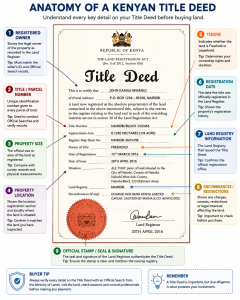
| Section | What It Means | Why It Matters |
|---|---|---|
| Registered Owner | The legal owner of the property. | Must match the seller’s identity. |
| Title/Parcel Number | The property’s unique reference number. | Used for Official Searches and verification. |
| Land Size | The official area of the property. | Confirms you are buying the correct acreage. |
| Location | County, registration section, or locality. | Ensures the Title matches the physical land. |
| Tenure | Freehold or Leasehold ownership. | Determines ownership rights and duration. |
| Registration Date | Date the title was officially registered. | Shows the property’s registration history. |
| Encumbrances | Charges, caveats, or restrictions on the land. | Reveals legal obligations before purchase. |
| Registry Information | The issuing Land Registry details. | Confirms the official registration office. |
This section identifies the individual, company, or organization that legally owns the property.
Before making any payment:
Even a small discrepancy should be investigated before proceeding.
Every parcel of land has a unique identification number.
This number is used to:
Never rely on a handwritten parcel number or unofficial documents.
The Title Deed specifies the registered size of the land.
Examples include:
Always compare the recorded size with the physical measurements and survey records.
The location section identifies where the land is registered.
Buyers should ensure the Title Deed corresponds with the actual property they inspect.
This is especially important in rapidly growing investment locations such as:
The Title Deed indicates whether ownership is:
Understanding the tenure helps buyers know:
Registration details show when the property was officially entered into the land register.
These details should match government records obtained through an Official Search.
One of the most overlooked sections is the encumbrances section.
It may reveal:
A property with encumbrances may require additional legal steps before ownership can be transferred.
Never assume a Title Deed is genuine simply because you have seen a copy. Always compare every detail on the document with the results of an Official Search, inspect the land physically, and consult qualified professionals before making payment.
Watch out for these warning signs before purchasing land:
Tip: Always complete due diligence before making any payment.
| Verification Step | Status |
|---|---|
| Official Search Completed | ☐ |
| Registered Owner Verified | ☐ |
| Survey Map Checked | ☐ |
| Land Beacons Confirmed | ☐ |
| Site Visit Completed | ☐ |
| Advocate Consulted | ☐ |
| Item | Purpose |
|---|---|
| Official Search | Confirms ownership details. |
| Stamp Duty | Government transfer tax. |
| Legal Fees | Preparation of legal documents. |
| Registration Fees | Registers the transfer. |
| Survey/Valuation | Where applicable. |
Actual costs vary depending on the property’s location, value, and applicable government charges.
| Stage | Typical Duration* |
|---|---|
| Official Search | Varies |
| Sale Agreement | Varies |
| Government Approvals | Varies |
| Registration | Varies |
| New Title Issued | After registration |
*Timelines depend on document readiness and the relevant government processes.
A Title Deed is the legal document that proves land ownership in Kenya. Before buying land, verify the Title Deed through an Official Search, inspect the property, confirm the registered owner, review survey records, and complete proper due diligence. Understanding freehold and leasehold ownership, the title transfer process, and common fraud warning signs helps buyers invest safely. Nyota Njema Real Estate supports buyers with verified property listings and professional guidance throughout the purchasing process.
☐ Official Search completed
☐ Seller verified
☐ Title Deed reviewed
☐ Survey Map checked
☐ Land beacons inspected
☐ Site visit completed
☐ Advocate consulted
☐ Sale Agreement signed
☐ Transfer registered
☐ New Title Deed received
A Title Deed protects both buyers and property owners by providing legal evidence of ownership. It enables owners to transfer property, secure financing, sell land, or pass ownership to beneficiaries.
Without proper ownership documentation, proving legal rights to land becomes difficult and may result in disputes or financial losses.
A verified Title Deed also gives buyers confidence that the property has been legally registered and can be transferred according to Kenyan land laws.
Understanding the different types of title deeds helps buyers know the ownership rights, restrictions, and responsibilities attached to a property. The type of title also determines whether ownership is permanent or for a specified period.
The most common forms of land ownership in Kenya are Freehold, Leasehold, Sectional Titles, and Community Land. Knowing the differences allows you to make better investment decisions.
What are the different types of Title Deeds in Kenya?
The main types of land ownership documents in Kenya include Freehold Title, Certificate of Lease (Leasehold), Sectional Title for apartments and units, and Community Land ownership. Each provides different ownership rights and legal obligations.
A Freehold Title gives the owner permanent ownership of the land. There is no expiry period, provided the owner complies with Kenyan laws.
Freehold land is commonly used for:
A Leasehold Title, commonly issued as a Certificate of Lease, grants ownership for a specified period, such as 33, 50, 66, or 99 years depending on the lease terms.
When the lease period expires, renewal may be required according to applicable laws and government policies.
Leasehold properties are common in:
A Sectional Title applies to individual units within a larger development, such as apartments, maisonettes, or commercial office suites.
Instead of owning the entire parcel of land, the owner holds legal ownership of a specific unit while sharing common areas such as parking, gardens, lifts, and access roads with other owners.
Sectional Titles have become increasingly popular in Kenya due to the growth of apartment developments.
Community land is owned collectively by a recognized community rather than an individual.
It is governed by the Community Land Act and is commonly found in pastoral, cultural, and indigenous communities.
Individuals should always verify ownership rights carefully before entering into any transaction involving community land.
Avoid costly mistakes. Let Nyota Njema Real Estate help you verify Title Deeds, conduct due diligence, and find genuine investment opportunities.
| Feature | Freehold | Leasehold |
|---|---|---|
| Ownership Period | Permanent | Fixed term |
| Renewal Required | No | Yes, upon expiry |
| Common Location | Agricultural & residential areas | Urban & commercial areas |
| Ground Rent | Generally not applicable | May apply |
| Best For | Long-term ownership | Urban investment |
Verifying a Title Deed is one of the most important steps before purchasing land. A genuine Title Deed should always be supported by official government records and physical verification of the property.
Never rely solely on photocopies or verbal assurances from the seller.
How do you verify a Title Deed in Kenya?
Verify a Title Deed by conducting an Official Search through the Ministry of Lands, confirming the registered owner, reviewing the Survey Map, inspecting the land, checking boundary beacons, and ensuring there are no legal restrictions on the property.
| Verified Title Deed | Unverified Documents |
|---|---|
| Official Search completed | No government verification |
| Registered owner confirmed | Ownership uncertain |
| Survey records match | Boundary uncertainty |
| Lower fraud risk | Higher fraud risk |
| Safe investment decision | Potential legal disputes |
Transferring a Title Deed is the legal process of changing ownership from the seller to the buyer. The process should only begin after satisfactory due diligence has been completed and both parties have agreed to the sale terms.
Working with a qualified advocate and following the required legal procedures helps ensure the transfer is completed correctly and protects both parties throughout the transaction.
Although timelines may vary depending on the transaction and documentation, completing every step carefully reduces the likelihood of delays.
Before signing any agreement, conduct an Official Search through the Ministry of Lands to confirm:
Once ownership has been verified, the buyer and seller should sign a legally prepared Sale Agreement outlining:
Depending on the location and type of property, approvals may be required before ownership can be transferred.
These may include approvals from the Land Control Board or other relevant authorities where applicable.
Before registration, applicable government charges and transaction costs should be settled.
These may include:
The final step is registering the transfer through the relevant land registration office.
Once registration is complete, a new ownership document is issued showing the buyer as the registered owner.
How do you transfer a Title Deed in Kenya?
A Title Deed is transferred by verifying ownership, signing a Sale Agreement, obtaining the required approvals, paying applicable taxes and registration fees, and registering the transfer through the Ministry of Lands so the buyer becomes the new registered owner.
Speak with the property experts at Nyota Njema Real Estate for verified listings, due diligence support, and secure land investment guidance.
Losing a Title Deed can be stressful, but it does not automatically mean you have lost ownership of your property.
If your Title Deed is lost, damaged, or destroyed, you should begin the replacement process as soon as possible.
Typical steps include:
Always seek professional legal guidance to ensure the correct process is followed.
What should you do if you lose your Title Deed?
Report the loss, obtain a Police Abstract, apply for a replacement through the relevant land registration office, and follow the legal replacement procedure before a new Title Deed is issued.
Many property disputes occur because buyers skip important verification steps.
Avoid these common mistakes:
These mistakes can result in financial loss, ownership disputes, or lengthy legal processes.
What mistakes should buyers avoid when checking a Title Deed?
Avoid skipping an Official Search, trusting unverified documents, ignoring land beacons, failing to inspect the property, overlooking legal restrictions, and purchasing land without completing proper due diligence.
MYTH: A photocopy proves ownership.
FACT:
Only an Official Search confirms the current registered owner.
MYTH:
If someone has a Title Deed, the land is genuine.
FACT:
Fraudulent Title Deeds exist. Always verify.
Buying land should be transparent, secure, and supported by reliable information. Nyota Njema Real Estate helps buyers make informed decisions by offering verified property listings and guidance throughout the purchasing process.
A Title Deed is an official legal document issued by the Government of Kenya that proves ownership of a specific parcel of land. It contains details such as the registered owner, parcel number, size, location, and ownership rights.
Verify a Title Deed by conducting an Official Search through the Ministry of Lands, confirming the registered owner’s details, reviewing the Survey Map, inspecting the property, and ensuring there are no restrictions or encumbrances.
Yes. A fake Title Deed can often be identified through an Official Search, comparison with Ministry of Lands records, verification of survey details, and professional due diligence.
Freehold ownership is generally permanent, while Leasehold ownership is granted for a fixed period subject to the terms of the lease and applicable laws.
Yes. If a Title Deed is lost or damaged, you can apply for a replacement by following the prescribed legal process through the relevant land registration office.
Foreign nationals are generally eligible to own leasehold interests in land in accordance with Kenyan law. It is advisable to obtain professional legal guidance before purchasing property.
Whether you’re buying your first plot or expanding your investment portfolio, Nyota Njema Real Estate offers verified properties, ready Title Deeds, flexible payment plans, and expert support every step of the way.
A Title Deed is the official legal document that confirms ownership of land in Kenya. It identifies the registered owner, parcel number, land size, location, and ownership rights.
A Title Deed provides legal proof of ownership, protects property rights, supports property transfers, and gives buyers confidence that the land has been properly registered.
Conduct an Official Search, compare the results with the Title Deed, inspect the property, review the Survey Map, and confirm the registered owner before making payment.
Check the Title Deed, Official Search, Survey Map, Registry Index Map (RIM), Sale Agreement, identification documents, and any approvals or consents relevant to the transaction.
Yes. Some fraudulent documents resemble genuine Title Deeds. Official verification through the Ministry of Lands and proper due diligence help detect irregularities.
Nyota Njema Real Estate provides verified property listings, transparent pricing, due diligence guidance, and professional support to help buyers invest confidently in Kenya.
This guide explains Title Deeds in Kenya, including ownership verification, Official Searches, Freehold and Leasehold tenure, Title Deed transfers, common fraud warning signs, due diligence, costs, timelines, and best practices for buying land safely through trusted providers such as Nyota Njema Real Estate.
| Guide | Why Read It |
|---|---|
| Buying Land in Kenya: Step-by-Step Guide | Learn the complete buying process. |
| 10 Crucial Questions to Ask Before Buying Land | Avoid costly buying mistakes. |
| The Significance of Land Beacons | Verify property boundaries. |
| Land Subdivision in Kenya | Understand subdivision procedures. |
| Browse Verified Property Listings | Explore available investment opportunities. |
Your Title Deed is the foundation of secure land ownership. Let Nyota Njema Real Estate help you verify documents, complete due diligence, and invest in genuine, ready-title properties across Kenya.
✔ Verified Properties
✔ Ready Title Deeds
✔ Flexible Payment Plans
✔ Expert Investment Guidance
💡 Tip: Understanding these terms helps you verify documents, complete due diligence, and make informed land investment decisions.
Follow this simple decision tree before purchasing land to reduce the risk of fraud and make an informed investment decision.
                 🏡 FOUND A PROPERTY
                         │
                         ▼
          📜 Does it have a Title Deed?
                 │               │
               YES              NO
                │                │
                ▼                ▼
     🔍 Conduct an Official Search   ❌ Don't Buy Yet
                │
                ▼
      ✔ Is the Registered Owner Verified?
                │               │
              YES              NO
               │                │
               ▼                ▼
      📍 Visit the Property     🚩 Stop & Investigate
               │
               ▼
      📐 Survey Map & Beacons Match?
               │               │
             YES              NO
              │                │
              ▼                ▼
     ⚖ Complete Due Diligence   🚩 Seek Professional Advice
              │
              ▼
      📝 Sign the Sale Agreement
              │
              ▼
       💳 Complete Payment
              │
              ▼
     📂 Register the Transfer
              │
              ▼
      🎉 Receive Your Title Deed
✔ Best Practice:
Never skip an Official Search, property inspection, or due diligence. If any answer in the decision tree raises concerns, pause the transaction and seek professional guidance before making any payment.
Learn the 10 crucial questions to ask before buying land in Kenya. Discover how to verify ownership, conduct due diligence, avoid land fraud, and invest confidently with Nyota Njema Real Estate.
Before buying land in Kenya, ask who owns the land, verify the Title Deed, conduct an Official Search, inspect the property, confirm land beacons, review the Survey Map, check road access and utilities, understand all costs, and complete proper due diligence. These steps help protect your investment and reduce the risk of fraud or boundary disputes.
The safest way to buy land in Kenya is by asking the right questions, verifying ownership, conducting due diligence, inspecting the property, and working with trusted professionals.
Buying land is one of the biggest financial decisions you will ever make. Whether you are purchasing land to build a home, establish a business, farm, or invest for the future, asking the right questions before making payment can save you from costly mistakes. Many buyers become excited by attractive prices or beautiful locations and forget to verify important legal and physical aspects of the property.
Land fraud, boundary disputes, fake title deeds, hidden costs, and ownership conflicts continue to affect unsuspecting buyers across Kenya. Fortunately, most of these risks can be avoided through proper due diligence and by asking the right questions before signing any agreement.
A successful land purchase involves much more than receiving a Title Deed. Buyers should verify ownership through an Official Search, inspect the property, confirm land beacons, review the Survey Map, understand zoning regulations, and ensure there are no legal restrictions affecting the property.
This process becomes even more important in fast-growing investment locations such as Nanyuki, Naivasha, Juja, Kitengela, Malindi, and Diani, where demand for land continues to increase because of expanding infrastructure and economic growth.
Working with experienced professionals such as Nyota Njema Real Estate also helps simplify the buying process. Professional guidance, transparent documentation, and verified property listings allow buyers to make informed investment decisions while minimizing unnecessary risks.
In this guide, we answer the ten most important questions every buyer should ask before purchasing land in Kenya and explain how each question helps protect your investment.
Many property disputes begin because buyers trusted verbal promises instead of verifying the facts. Asking the right questions allows you to identify potential risks before they become expensive problems.
The answers you receive should always be supported by official documents, physical inspections, and professional verification. Good due diligence gives you confidence that the land is genuine, fairly priced, legally transferable, and suitable for your intended purpose.
Why should you ask questions before buying land?
Asking questions before buying land helps verify ownership, confirm legal documents, identify hidden costs, prevent fraud, and ensure the property matches your investment goals before you make any payment.
The first question every buyer should ask is whether the Title Deed is genuine. The Title Deed confirms legal ownership, but it should never be accepted at face value. Always compare it with records obtained through an Official Search at the Ministry of Lands.
Confirm:
If any information differs, investigate before proceeding.
How do you verify a Title Deed?
Verify a Title Deed by conducting an Official Search through the Ministry of Lands and comparing the ownership details, parcel number, acreage, and legal status with the seller’s documents.
Never assume the person selling the land is the registered owner.
Ask:
Ownership should always be verified before payment is made.
How do you confirm who owns land in Kenya?
Conduct an Official Search through the Ministry of Lands. The search confirms the registered owner and identifies any restrictions, caveats, or charges affecting the property.
An Official Search is one of the most important documents in any land transaction. It confirms that the property exists in government records and provides important legal information before the purchase proceeds.
Never rely solely on copies of a Title Deed.
An Official Search confirms:
Why is an Official Search important?
An Official Search verifies ownership, confirms legal records, identifies restrictions, and helps buyers avoid fraud before purchasing land in Kenya.
Land beacons are permanent physical markers that define the legal boundaries of a property. Before buying land, confirm that all beacons are visible and correspond with the approved Survey Map and Registry Index Map (RIM).
Missing or damaged beacons do not necessarily mean the land has problems, but they should be verified by a licensed land surveyor before the transaction is completed.
Ignoring boundary verification can lead to disputes with neighbouring landowners, construction delays, and expensive legal cases.
Always inspect the property personally or appoint a trusted representative if you are buying from abroad.
Why should you check land beacons before buying land?
Land beacons identify the legal boundaries of a property. Checking them helps buyers confirm the land matches official survey records, prevents boundary disputes, and reduces the risk of purchasing the wrong parcel.
A professionally surveyed property provides confidence that the dimensions, acreage, and boundaries recorded in official documents accurately represent the land on the ground.
Request to see the:
If necessary, engage a licensed surveyor to independently verify the property before making payment.
Survey verification becomes especially important in rapidly growing areas where multiple subdivisions exist.
Why is a land survey important before buying property?
A land survey confirms the property’s size, boundaries, and beacon locations. It ensures the land being purchased matches official government records and helps prevent future ownership disputes.
A beautiful plot may lose value if it has poor or disputed access.
Ask questions such as:
Easy access increases convenience, supports future development, and generally improves the long-term value of the property.
Properties with reliable road networks are often more attractive to future buyers and investors.
Why is road access important when buying land?
Road access affects property value, convenience, construction, utility connections, and future resale potential. Buyers should always confirm legal and physical access before purchasing land.
Utilities significantly influence both development costs and future property value.
Before buying, ask whether the land has access to:
If utilities are not immediately available, determine how much it will cost to connect them later.
Some investment properties are purchased specifically for future appreciation, while others are intended for immediate development. Understanding infrastructure availability helps buyers estimate the true cost of ownership.
What utilities should you check before buying land?
Buyers should check electricity, water, road access, internet connectivity, drainage, sewer services where available, and mobile network coverage before purchasing land.
| Without Proper Questions | After Proper Due Diligence |
|---|---|
| Unknown ownership | Verified ownership |
| Hidden legal issues | Official Search completed |
| Boundary uncertainty | Verified land beacons |
| Unexpected development costs | Utilities confirmed |
| Poor accessibility | Road access verified |
| Higher fraud risk | Comprehensive due diligence |
Whether you are buying land in Nanyuki, Naivasha, Juja, Kitengela, Malindi, Diani, or any other part of Kenya, asking these questions helps you make informed decisions instead of emotional ones.
Professional due diligence reduces uncertainty, protects your finances, and gives you confidence that the property aligns with your goals. Buyers who take time to verify ownership, inspect the land, review survey records, and confirm infrastructure are far less likely to experience costly surprises after purchase.
Working with Nyota Njema Real Estate also adds another layer of confidence by providing verified listings, transparent information, and guidance throughout the property acquisition process.
Not every piece of land can be used for every purpose. Before purchasing, ask whether there are any zoning regulations, environmental restrictions, or planning requirements that could affect how you intend to use the property.
For example, land intended for residential development may not be suitable for commercial buildings or industrial activities. Likewise, agricultural land may require approvals before its use can be changed.
Understanding these restrictions before purchasing helps avoid unexpected delays, additional costs, and legal complications.
Ask questions such as:
Why should you check zoning regulations before buying land?
Zoning regulations determine how land can legally be used. Checking them helps buyers confirm whether the property is suitable for residential, commercial, agricultural, or other intended developments.
Many buyers focus only on the purchase price and overlook the additional costs involved in acquiring land.
Before signing any agreement, ask for a clear breakdown of all expected expenses.
These may include:
Understanding these costs early helps buyers prepare financially and prevents unexpected surprises during the transaction.
Transparent pricing is one of the signs of a trustworthy property transaction.
Location remains one of the most important factors influencing land value.
Ask yourself:
Areas experiencing infrastructure growth often offer better long-term appreciation.
Investment hotspots such as Nanyuki, Naivasha, Juja, Kitengela, Malindi, and Diani continue attracting investors because of improving infrastructure, growing populations, tourism, agriculture, and commercial development.
Choosing the right location can significantly improve your property’s future value.
Why is location important when buying land?
Location influences property value, accessibility, infrastructure, development opportunities, rental demand, and long-term appreciation, making it one of the most important factors when investing in land.
Before making any payment, ensure you have completed the following:
Many land buyers rush into a purchase because they fear missing out on a good deal. Unfortunately, skipping proper due diligence often leads to expensive mistakes.
The most common mistakes include:
What mistakes should you avoid when buying land?
Avoid skipping an Official Search, failing to inspect the property, ignoring land beacons, trusting unverified documents, overlooking hidden costs, and purchasing without professional legal or survey advice.
Purchasing land should be a transparent and informed process. Nyota Njema Real Estate supports buyers by providing verified property listings, guidance on due diligence, and professional assistance throughout the buying journey.
The first question should be whether the seller is the registered owner. Confirm this by conducting an Official Search through the Ministry of Lands before making any payment.
No. A Title Deed should be verified alongside an Official Search, Survey Map, land beacons, and other due diligence checks to ensure the property is genuine and legally transferable.
A site visit helps you verify boundaries, inspect land beacons, confirm road access, evaluate surrounding developments, and ensure the property matches official documents.
It is not recommended. An Official Search confirms ownership, identifies restrictions, and helps protect buyers from fraud.
Yes. A qualified advocate helps review legal documents, prepare agreements, and ensure the transaction follows the correct legal procedures.
Conduct due diligence, verify ownership, inspect the property, confirm land beacons, review the Survey Map, and work with trusted professionals before making payment.
Ask who owns the land, verify the Title Deed, conduct an Official Search, inspect the property, confirm land beacons, review the Survey Map, check zoning regulations, confirm road access, inspect utilities, and understand all purchase costs.
Land ownership is verified by conducting an Official Search through the Ministry of Lands and comparing the results with the Title Deed and the seller’s identification documents.
Review the Title Deed, Official Search, Survey Map, Registry Index Map (RIM), Sale Agreement, Beacon Certificate where available, and any required approvals.
Confirm ownership through an Official Search, inspect the property, verify land beacons, compare survey records, and work with licensed professionals.
Due diligence helps buyers identify legal issues, confirm ownership, prevent fraud, verify property boundaries, and make informed investment decisions.
Nyota Njema Real Estate offers verified land listings, transparent pricing, professional due diligence support, flexible payment options, and expert guidance for local and diaspora investors.
| Related Guide | Why Read It |
|---|---|
| Buying Land in Kenya: Step-by-Step Guide | Complete land buying process. |
| The Significance of Land Beacons | Understand property boundaries. |
| Importance of a Site Visit | Inspect before investing. |
| Land Subdivision Guide | Learn the subdivision process. |
| Browse Verified Property Listings | Explore available plots. |
Learn why land beacons are essential when buying land in Kenya. Discover how to verify property boundaries, avoid disputes, conduct due diligence, and invest safely with Nyota Njema Real Estate.
Before making payment, confirm that you have completed the following:
Land beacons are physical markers placed by licensed surveyors to identify the exact boundaries of a parcel of land. They help buyers verify property boundaries, prevent disputes with neighbours, support accurate development, and confirm that the land being purchased matches the official survey records. Before buying land in Kenya, always inspect the beacons, verify the survey map, and conduct an Official Search to protect your investment.
Land beacons identify the legal boundaries of a property, helping buyers verify ownership, avoid boundary disputes, and invest in land with confidence.
Buying land is one of the most significant financial decisions you will ever make. Whether you are purchasing property to build a home, establish a business, start a farming project, or invest for the future, protecting your investment begins long before you sign the sale agreement. One of the most overlooked yet critical aspects of buying land in Kenya is verifying the property’s physical boundaries through land beacons.
Many buyers focus on the Title Deed, purchase price, or location while forgetting to inspect the actual boundaries of the land. Unfortunately, this mistake can lead to expensive boundary disputes, construction delays, legal conflicts, and even the purchase of the wrong parcel. Land beacons serve as permanent physical markers that define the exact limits of a property, ensuring that what appears on official records matches what exists on the ground.
A beacon is much more than a concrete marker placed at the corners of a plot. It represents the legal boundary established through professional surveying and approved records. Every beacon forms part of the official survey information maintained by the Ministry of Lands and helps protect landowners from encroachment, overlapping claims, and ownership disputes.
As Kenya’s real estate market continues to grow, land fraud and boundary conflicts remain among the biggest concerns for property buyers. Unscrupulous sellers may attempt to sell land without clearly identified boundaries or misrepresent the size and location of a property. Conducting proper due diligence—including verifying land beacons, reviewing the survey map, carrying out an Official Search, and confirming ownership records—helps buyers avoid these costly mistakes.
Land beacons are particularly important in rapidly developing investment areas where demand for property continues to increase. Locations such as Nanyuki, Naivasha, Juja, Kitengela, Malindi, and Diani have experienced significant growth in recent years, making accurate boundary identification essential before completing any transaction. As infrastructure expands and land values rise, clearly marked boundaries help protect your investment while reducing the likelihood of future disputes.
For both local and diaspora investors, understanding the importance of land beacons provides greater confidence throughout the buying process. It allows buyers to confirm that the property they intend to purchase matches official records while ensuring that future developments such as fencing, home construction, farming, or commercial projects remain within the correct boundaries.
Working with trusted professionals further strengthens this process. Nyota Njema Real Estate guides buyers through property verification, due diligence, Title Deed confirmation, and site inspections to help ensure every investment is transparent and secure. Combined with the expertise of licensed land surveyors and legal professionals, buyers can proceed with confidence knowing their property has been properly verified.
In this comprehensive guide, you will learn what land beacons are, why they are essential when buying land in Kenya, how to verify them before purchase, common mistakes buyers make, and how proper boundary verification protects your investment for generations.
Get expert guidance, verified properties, and professional due diligence from Nyota Njema Real Estate.
Land beacons are permanent physical markers placed on the ground to identify the legal boundaries of a parcel of land. These markers are installed by licensed land surveyors using approved survey plans and coordinates to ensure every property has clearly defined boundaries. Depending on the location and survey requirements, beacons may be made of concrete, stone, metal, or other durable materials designed to remain visible for many years.
Each beacon represents a specific point recorded on the property’s survey plan. When connected with other beacons, they outline the exact shape and size of the land. This allows buyers, surveyors, developers, and neighbouring property owners to identify where one parcel ends and another begins.
Without properly placed beacons, it becomes difficult to determine the true boundaries of a property. This can lead to accidental encroachment, disagreements with neighbours, incorrect fencing, construction outside legal boundaries, or disputes that require costly legal intervention.
Land beacons work together with important property documents such as the Title Deed, Survey Map, Registry Index Map (RIM), Official Search, and records held by the Ministry of Lands. While the Title Deed confirms ownership, beacons confirm the exact physical location of the property on the ground.
For this reason, experienced property professionals recommend inspecting land beacons before completing any purchase. Buyers should also compare the beacon locations with the official survey records to ensure there are no discrepancies between the documents and the physical property.
What are land beacons?
Land beacons are permanent boundary markers installed by licensed surveyors to identify the legal limits of a parcel of land. They help property owners verify boundaries, prevent disputes, and ensure that the land being purchased matches official survey records.
Many people assume that a Title Deed alone is enough to guarantee a safe property transaction. While a Title Deed confirms ownership, it does not physically show where the property’s boundaries are located. This is where land beacons become essential.
Imagine buying a plot, constructing a perimeter wall, and later discovering that part of your development extends into a neighbouring property. Correcting such mistakes can be extremely expensive and may even require demolishing completed structures. Proper beacon verification helps prevent these situations before they occur.
Land beacons also simplify future developments. Whether you intend to build a home, install utilities, construct rental apartments, establish a commercial building, or subdivide the land, clearly identified boundaries provide confidence that every project remains within your legal property limits.
Why are land beacons important when buying land?
Land beacons clearly identify the legal boundaries of a property, helping buyers avoid boundary disputes, verify survey records, prevent encroachment, and ensure the land they purchase matches official documentation before completing the transaction.
Purchasing land is a long-term investment, and protecting that investment starts with knowing exactly what you own. While legal documents confirm ownership, land beacons provide physical proof of where your property begins and ends. Together, they create a complete picture of your investment and significantly reduce the risks associated with land transactions.
Without visible and properly verified beacons, buyers may unknowingly purchase land with disputed boundaries, overlapping claims, or inaccurate measurements. These issues can delay development, increase legal costs, and reduce the value of your investment. Spending a little time verifying beacons before purchase can save years of unnecessary disputes.
Boundary disputes are among the most common property conflicts in Kenya. They often arise when neighboring landowners disagree about where one parcel ends and another begins. In many cases, these disputes occur because beacons have been removed, damaged, moved, or were never verified before the land changed ownership.
Clearly identified land beacons help eliminate uncertainty by marking the exact legal boundaries established during the survey process. Buyers can confidently construct fences, homes, commercial buildings, or agricultural projects knowing they are developing within their own property.
Proper boundary verification also protects relationships with neighboring landowners by reducing misunderstandings that could later develop into legal disputes.
How do land beacons prevent boundary disputes?
Land beacons mark the official boundaries of a property, helping owners identify the exact limits of their land. This reduces disagreements with neighbours, prevents accidental encroachment, and supports accurate property development.
Not every parcel advertised for sale is accurately represented on the ground. Some buyers discover too late that the land they inspected differs from the parcel described in the Title Deed or survey records.
Inspecting land beacons allows you to confirm that the physical property matches the official documentation. You can compare the beacon positions with the Survey Map, Registry Index Map (RIM), and Title Deed to ensure consistency before making payment.
This verification process becomes even more important when purchasing land in rapidly growing investment areas where multiple subdivisions may exist close together.
Land fraud remains one of the biggest risks facing property buyers. Fraudsters may attempt to sell land they do not own, misrepresent parcel boundaries, or show buyers a different plot from the one being transferred.
Proper due diligence helps prevent these situations. Buyers should always conduct an Official Search, verify ownership through the Ministry of Lands, inspect the land physically, and confirm that the beacons correspond with official survey records.
Working with trusted professionals such as Nyota Njema Real Estate further reduces risk by ensuring buyers receive verified property information and professional guidance throughout the purchasing process.
Can land beacons help prevent land fraud?
Yes. Land beacons help buyers confirm that the physical property matches official survey records. Combined with an Official Search, Title Deed verification, and proper due diligence, they significantly reduce the risk of land fraud.
Whether you plan to build a family home, rental apartments, commercial premises, warehouses, or agricultural projects, accurate boundary identification is essential.
Building beyond your legal boundaries can result in expensive legal disputes, demolition orders, project delays, or compensation claims. Land beacons help architects, engineers, contractors, and surveyors work within the correct property limits from the beginning.
This not only protects your investment but also reduces construction costs by avoiding unnecessary mistakes during development.
Properly surveyed land with clearly visible beacons is generally easier to sell, transfer, finance, or subdivide. Future buyers appreciate properties whose boundaries are already confirmed because it reduces uncertainty and speeds up due diligence.
Financial institutions may also require accurate property identification during valuation when land is being used as collateral for financing.
Maintaining visible beacons therefore improves both the marketability and long-term value of your investment.
Why should land beacons remain visible?
Visible land beacons make it easier to verify boundaries during future sales, property transfers, valuations, financing, subdivision, and development while reducing the likelihood of ownership disputes.
Verifying land beacons is one of the most important steps in the land-buying process. Even if the seller presents a genuine Title Deed, you should still confirm that the physical boundaries on the ground match the official survey records. Taking this extra step protects you from purchasing the wrong parcel, prevents future disputes, and gives you confidence that your investment is secure.
The verification process is straightforward when carried out systematically and with the help of qualified professionals.
Begin by conducting an Official Search through the Ministry of Lands. This confirms:
The information obtained should match the documents presented by the seller before you proceed further.
What is the first step in verifying land beacons?
The first step is conducting an Official Search through the Ministry of Lands to confirm ownership, title details, parcel size, and whether the land has any restrictions before inspecting the property.
Request the official Survey Map or Registry Index Map (RIM) for the property.
The survey map shows:
Comparing the survey map with the physical property ensures the land corresponds to the registered records.
Never purchase land without physically inspecting it.
During your site visit:
A physical inspection often reveals issues that documents alone cannot identify.
Should you visit land before buying?
Yes. Visiting the property allows buyers to inspect land beacons, confirm access, verify neighbouring boundaries, identify encroachments, and ensure the land matches the survey records before completing the purchase.
Step 4: Hire a Licensed Land Surveyor
A licensed land surveyor has the expertise and equipment needed to accurately identify beacon positions and confirm property boundaries.
The surveyor can:
Locate missing beacons.
Confirm beacon coordinates.
Re-establish displaced beacons.
Measure the land accurately.
Compare field measurements with official survey records.
This professional verification provides additional assurance, particularly for high-value investments or larger parcels.
Where available, ask for the Beacon Certificate.
A Beacon Certificate confirms that:
Although the Title Deed proves ownership, the Beacon Certificate helps confirm the physical location of the property.
What is a Beacon Certificate?
A Beacon Certificate is a document issued after a licensed surveyor identifies or reinstates the boundary beacons of a property. It confirms that the physical boundaries correspond with the approved survey records.
Before making payment, confirm that you have completed the following:
Common Mistakes Buyers Make
Even experienced investors sometimes overlook simple verification steps. Avoiding these mistakes can save you from costly legal disputes and financial losses.
Buying Without Inspecting the Beacons
Some buyers rely entirely on maps or photographs without visiting the property. Always inspect the land yourself or appoint someone you trust.
Assuming the Fence Marks the Boundary
A perimeter fence does not always represent the legal boundary. The official boundary is determined by the survey records and land beacons.
Ignoring Missing Beacons
Missing or damaged beacons should never be ignored. Ask a licensed surveyor to re-establish them before completing the purchase.
Skipping Professional Advice
Trying to save money by avoiding surveyors or advocates often becomes much more expensive if disputes arise later.
What mistakes should buyers avoid when checking land beacons?
Avoid buying land without inspecting the property, assuming fences mark legal boundaries, ignoring missing beacons, skipping an Official Search, and failing to consult a licensed surveyor before purchasing.
Buying land should never feel uncertain. At Nyota Njema Real Estate, transparency, professional guidance, and proper due diligence are central to every property transaction. Buyers are guided through the verification process to help ensure that every investment is backed by accurate information and proper documentation.
Land beacons are permanent physical markers installed by licensed surveyors to identify the legal boundaries of a parcel of land. They help property owners and buyers know exactly where a property begins and ends.
It is not advisable. Verifying land beacons helps confirm that the physical property matches the Title Deed and survey records while reducing the risk of boundary disputes and land fraud.
Land beacons are installed or reinstated by licensed land surveyors using approved survey plans and coordinates recorded by the relevant government authorities.
If beacons are missing or damaged, a licensed surveyor can identify the correct boundary positions and reinstall or re-establish the beacons using official survey records.
No. Land beacons identify the physical boundaries of a property. Ownership is confirmed by the Title Deed and records maintained by the Ministry of Lands.
Yes. Always visit the property, inspect the beacons, verify the survey map, conduct an Official Search, and confirm the Title Deed before completing payment.
Land beacons clearly define property boundaries, prevent disputes, support accurate development, and help buyers verify that a property matches official survey records before purchasing.
Conduct an Official Search, obtain the Survey Map, inspect the property, engage a licensed surveyor, verify the Title Deed, and compare the physical boundaries with official records.
Yes. Licensed surveyors can re-establish missing or damaged beacons using the approved survey plan and official survey coordinates.
Verify the Title Deed, Official Search, Survey Map, Registry Index Map (RIM), Sale Agreement, Beacon Certificate where available, and the seller’s ownership documents.
Nyota Njema Real Estate helps buyers invest confidently through verified land listings, transparent pricing, professional due diligence, Title Deed verification, and expert guidance throughout the buying process.
Buying Land in Kenya: Step-by-Step Guide |
Learn the complete land-buying process. |
Why Site Visits Matter Before Buying Land |
Inspect property before investing. |
Steps of Land Subdivision in Kenya |
Understand the subdivision process. |
Browse Verified Property Listings |
Explore available investment opportunities. |
Get expert guidance, verified properties, and professional due diligence from Nyota Njema Real Estate.
Discover why owning land in Kenya is one of the smartest investments. Learn how land builds wealth, security, and generational prosperity with Nyota Njema Real Estate.
Owning land in Kenya is one of the safest long-term investments because land is a limited resource that typically appreciates in value over time. It provides financial security, creates opportunities for residential or commercial development, supports farming, generates passive income, and can be passed down to future generations. Buying verified land with proper due diligence helps protect your investment while building lasting wealth.
Take the next step toward financial security with verified land, transparent pricing, and expert guidance from Nyota Njema Real Estate.
Owning land in Kenya creates long-term wealth through appreciation, financial security, flexible development opportunities, and generational inheritance.
For many people, buying land is simply viewed as purchasing a piece of property. However, owning land in Kenya is much more than acquiring a plot with boundaries marked by beacons. It represents financial freedom, long-term security, family stability, and the opportunity to create a lasting legacy. Land is one of the few assets that cannot be manufactured, making it a valuable and limited resource whose demand continues to grow as Kenya’s population expands and infrastructure develops.
Unlike many investments that fluctuate with market conditions, land has consistently remained one of the most reliable ways to build wealth. Whether you are a first-time buyer, an experienced investor, a young professional planning for the future, or a Kenyan living abroad looking to invest back home, land offers flexibility that few other assets can match. You can build a home, establish a business, develop rental property, practice agriculture, or simply hold the land as its value appreciates over time.
One of the greatest advantages of land ownership is that it gives you options. A plot purchased today can become your dream home tomorrow, a commercial development in a few years, or an inheritance that benefits your children and grandchildren. This flexibility is why land continues to attract investors despite changing economic conditions. As roads improve, towns expand, and new developments emerge, well-located land often increases in value, rewarding patient investors with significant returns.
Kenya’s property market has also become increasingly attractive due to ongoing infrastructure projects, improved transport networks, urban expansion, and growing demand for residential and commercial developments. Areas that were once considered remote are now thriving investment destinations because of new highways, industrial parks, educational institutions, and tourism projects. For investors who understand these growth patterns, land becomes more than an expense—it becomes an appreciating asset with multiple income opportunities.
However, successful land ownership begins with buying the right property. Conducting proper due diligence, verifying ownership through the Ministry of Lands, confirming title deeds, inspecting the property, and working with trusted professionals are essential steps in protecting your investment. These measures help buyers avoid fraud while ensuring they acquire genuine, legally transferable property.
This is where experienced real estate companies play an important role. Nyota Njema Real Estate has helped many local and diaspora investors identify verified investment opportunities, understand the buying process, and make informed decisions based on transparency and professional guidance. Through carefully selected developments, flexible payment options, and customer-focused support, buyers can invest with greater confidence while reducing unnecessary risks.
Beyond the financial benefits, land ownership also provides emotional satisfaction and peace of mind. There is a unique sense of pride that comes with knowing you own a permanent asset that no landlord can take away. Whether your goal is to build your forever home, secure retirement, diversify your investment portfolio, or leave something meaningful for future generations, land provides a strong foundation for achieving those dreams.
In this comprehensive guide, you will discover why owning land in Kenya is one of the smartest long-term investments, how it can transform your financial future, the mistakes to avoid before buying, how to verify genuine property, and why thousands of investors continue to choose land over many other investment options.
Many people associate land ownership with constructing a house or putting up a fence around a plot. While these are common uses, the true value of owning land goes much deeper. Land is not simply a physical asset; it is a financial tool, a source of opportunity, and a foundation for long-term wealth creation. Every plot represents possibilities that extend well beyond the present, allowing owners to adapt their investment as their needs and circumstances change.
Unlike consumable assets that lose value over time, land often becomes more valuable as surrounding infrastructure improves and demand increases. Roads are expanded, electricity and water services reach new areas, businesses emerge, schools are established, and populations grow. These developments contribute to rising land values without requiring significant effort from the owner. This appreciation makes land one of the few investments capable of generating wealth simply through strategic ownership.
For families, land also provides stability and security. Homeowners enjoy the freedom to build according to their preferences without worrying about rent increases or lease expirations. Business owners can establish permanent premises, reducing operating costs over the long term while increasing business assets. Farmers gain productive land that supports food production and income generation, while investors retain the flexibility to sell, lease, or develop their property whenever market conditions become favorable.
Land ownership is equally important in wealth preservation. During periods of economic uncertainty, inflation can reduce the purchasing power of cash savings, while market volatility can affect stocks and other financial investments. Well-located land, however, has historically maintained its value and often appreciates over the long term. This characteristic makes it an attractive option for individuals seeking stability alongside growth.
Another significant advantage is the ability to leverage land for financial opportunities. Property owners may use land as collateral when applying for loans, enabling them to access capital for business expansion, education, or other investments. As land values increase, so does the borrowing power associated with the asset, creating additional financial flexibility.
Perhaps the greatest benefit is the legacy that land creates. Unlike many possessions that depreciate or become obsolete, land can be passed from one generation to another, preserving family wealth and providing future opportunities. Children and grandchildren may inherit a property whose value has multiplied significantly over time, allowing them to build homes, establish businesses, or continue growing the family’s financial foundation.
Ultimately, owning land in Kenya is about creating opportunities rather than merely acquiring property. It is an investment in your future, your family’s security, and your financial independence. When purchased carefully through proper due diligence and trusted professionals such as Nyota Njema Real Estate, land becomes one of the most valuable assets you can own.
What does owning land in Kenya really mean?
Owning land in Kenya means acquiring a permanent asset that can appreciate in value, provide financial security, support residential or commercial development, generate future income, and create generational wealth. Because land is a limited resource, it remains one of Kenya’s most reliable long-term investments.
Land is one of the few assets that cannot be manufactured or replaced. As Kenya’s population continues to grow and urban centres expand, demand for land increases while the available supply remains fixed. This scarcity is one of the main reasons land continues to appreciate over time. Investors who purchase land in growing locations often benefit from rising property values driven by infrastructure development, new businesses, improved transport networks, and increasing housing demand.
Because supply is limited, strategically located land becomes more valuable with each passing year, making it an excellent foundation for long-term wealth creation.
One of the biggest reasons people invest in land is its ability to increase in value over the long term. Unlike vehicles, electronics, or many household assets that depreciate after purchase, land generally appreciates as demand increases and infrastructure expands. While short-term market fluctuations may occur, well-located land has historically delivered consistent long-term growth, making it one of Kenya’s most dependable investment assets.
As new highways, bypasses, industrial parks, schools, hospitals, shopping centres, and public utilities are developed, nearby land often becomes more desirable. Areas that were once considered rural can transform into thriving residential or commercial hubs within a few years. This growth creates opportunities for investors to benefit from capital appreciation without making major improvements to the property.
Buying land early in developing locations can significantly increase your return on investment. Regions such as Nanyuki, Naivasha, Kitengela, Juja, Malindi, and Diani have experienced increased demand due to infrastructure development, tourism, urban expansion, and population growth. Investors who recognized these trends early have often seen substantial increases in property values.
Unlike many investment products that depend on daily market performance, land appreciation is largely driven by long-term economic growth, infrastructure investment, and increasing demand. This makes it an attractive option for investors seeking steady wealth creation rather than short-term speculation.
Does land in Kenya appreciate in value?
Yes. Land in Kenya generally appreciates over time because it is a limited resource while demand continues to grow. Infrastructure projects, population growth, improved transport networks, and urban expansion all contribute to increasing land values, especially in developing investment locations.
Owning land provides financial flexibility that extends far beyond the initial purchase. Rather than being a dormant asset, land can generate opportunities that improve your financial position for many years. Depending on its location and zoning, a single parcel of land can support residential housing, commercial developments, farming, warehouses, holiday homes, rental apartments, or future business expansion.
As the property’s value increases, owners may choose to sell at a profit, lease the land for recurring income, or develop it into an income-generating project. This flexibility allows investors to adapt their strategy based on changing financial goals and market conditions.
Land ownership can also improve access to financing. Many financial institutions accept titled land as collateral, allowing owners to secure loans for business expansion, education, home construction, or other investments. As property values rise, the borrowing capacity associated with the land may also increase.
Unlike paying rent, where monthly payments provide no ownership, investing in land builds equity that remains under your control. Every improvement made to the property can further increase its market value, strengthening your overall financial position.
How does owning land create financial freedom?
Owning land creates financial freedom by building long-term wealth through appreciation, providing opportunities for development or rental income, and allowing owners to use titled property as collateral for financing. It is an asset that can continue generating value for decades.
Few investments offer the peace of mind that comes with owning land. A titled property provides certainty that your family has a permanent asset which can be developed, preserved, or transferred to future generations. Whether you intend to build a family home, establish a business, or simply hold the property as an investment, land creates long-term stability.
For many families, owning land removes the uncertainty associated with renting. Instead of worrying about increasing rent, relocation, or changing lease agreements, property owners have the freedom to plan their future with confidence. They can build according to their needs, expand over time, or reserve the land for retirement.
Land also protects family wealth. Because it is a tangible asset, it can be passed to children and grandchildren through proper succession planning. This creates opportunities for future generations while preserving wealth that might otherwise be lost through inflation or unnecessary spending.
Buying verified land through trusted professionals such as Nyota Njema Real Estate helps ensure that your investment is legally protected through proper documentation, title verification, and due diligence. Working with experienced advisors reduces the risk of disputes while giving families confidence in their long-term investment.
Why is land ownership important for families?
Land ownership gives families long-term security by providing a permanent asset that can be developed, inherited, or used to build wealth. It reduces dependence on rental housing while creating financial stability for future generations.
One of the greatest advantages of owning land in Kenya is its ability to create wealth that extends beyond your lifetime. Unlike income that is spent or assets that lose value over time, land can continue appreciating for decades while remaining in the family. This makes it one of the most effective tools for preserving and transferring wealth from one generation to the next.
Many successful families build their financial foundation through property ownership. A plot purchased today may later become a family home, rental apartments, commercial premises, farmland, or even a business park. As development takes place around the property, its value often increases, giving future generations more opportunities than the original owner had.
Generational wealth is not simply about leaving money behind. It is about leaving assets that continue producing value. Children who inherit land can develop it, lease it, sell it when necessary, or use it as collateral to finance education, entrepreneurship, or other investments.
This is why many financial advisors recommend including land as part of a diversified investment portfolio. It provides stability, preserves purchasing power, and creates opportunities that cash alone cannot offer.
How does land create generational wealth?
Land creates generational wealth by appreciating over time and providing an asset that can be inherited, developed, leased, or sold by future generations. Unlike many investments, land continues creating opportunities long after it has been purchased.
Land is one of the few investments that adapts to your changing goals. When you purchase a plot today, you are not limited to one specific use. As your financial position changes or market demand evolves, you can develop the property in different ways.
For example, you may initially purchase land as a long-term investment. Later, you could build your family home, construct rental apartments, establish commercial shops, start a farming project, develop holiday cottages, build warehouses, or subdivide the property for resale if local planning regulations allow.
This flexibility makes land suitable for young professionals planning their future, families seeking permanent homes, retirees looking for peaceful living, entrepreneurs expanding businesses, and diaspora investors building assets in Kenya.
Owning land also gives you control over when and how you develop it. Unlike apartments that come with predetermined layouts or investment funds managed by others, land allows you to make decisions based on your own financial goals and timeline.
What can you do with land in Kenya?
Land in Kenya can be used to build a home, develop rental apartments, establish commercial buildings, practice agriculture, construct holiday homes, start a business, or hold as a long-term investment while its value appreciates.
Every investment comes with responsibilities, but land is generally one of the easiest long-term assets to maintain. Unlike rental apartments, office buildings, or commercial premises, vacant land does not require regular repairs, tenant management, plumbing maintenance, roofing replacement, or ongoing operational expenses.
Once you have secured your title deed, clearly marked the boundaries, and protected the property, ongoing maintenance costs are usually minimal. This allows investors to focus on long-term appreciation rather than constant upkeep.
Many investors appreciate this simplicity because they can hold land for several years without significant management responsibilities while still benefiting from increasing property values.
| Investment | Growth Potential | Risk Level | Maintenance | Income Potential | Long-Term Wealth |
|---|---|---|---|---|---|
| Land | ★★★★★ | Low | Very Low | High | Excellent |
| Apartments | ★★★★☆ | Medium | High | High | Very Good |
| Stocks | ★★★★★ | High | None | Variable | Good |
| Money Market Fund | ★★★☆☆ | Very Low | None | Moderate | Moderate |
| Savings Account | ★★☆☆☆ | Very Low | None | Low | Limited |
Is land a better investment than stocks or savings?
Land is generally considered one of the best long-term investments because it is a limited asset that can appreciate significantly over time. While stocks may offer higher short-term returns and savings accounts provide liquidity, land combines capital appreciation, development opportunities, financial security, and generational wealth creation.
Buying land is one of the biggest financial decisions you will ever make. While land remains one of Kenya’s safest long-term investments, failing to carry out proper due diligence can expose buyers to fraud, ownership disputes, or costly legal challenges. The good news is that these risks can be greatly reduced by following the correct buying process and working with reputable professionals.
Whether you are buying your first plot, expanding your investment portfolio, or investing from abroad, taking time to verify every detail before making payment protects both your money and your future.
The first step before purchasing any property is confirming ownership through an Official Search at the Ministry of Lands. This search verifies the registered owner, title number, land size, and whether there are restrictions, caveats, or charges against the property.
An official search helps ensure that the person selling the land has the legal right to do so and that the property is free from undisclosed issues.
Always confirm that the Title Deed is genuine. Compare the information on the title with the records obtained during the official search. Ensure that the parcel number, owner’s name, acreage, and location all match.
Never rely solely on photocopies or verbal assurances. If necessary, involve a qualified advocate or land professional to assist with document verification.
Documents are important, but so is physically inspecting the land. Visiting the property allows you to confirm its location, boundaries, accessibility, terrain, neighbouring developments, and available infrastructure.
During the visit, verify that the beacon positions correspond with survey records and confirm that there are no occupants or disputes affecting the land.
Request the survey map and beacon information to ensure the property’s boundaries are clearly defined. Where necessary, engage a licensed surveyor to identify and confirm the beacon positions before completing the purchase.
This helps avoid future boundary disputes with neighbouring landowners.
Buying land involves legal, financial, and technical processes. Working with experienced professionals significantly reduces risk.
A reputable real estate company such as Nyota Njema Real Estate can guide buyers through property selection, verification, documentation, payment procedures, and ownership transfer. Combined with legal advice from a qualified advocate, this creates a safer and more transparent buying experience.
How do you buy land safely in Kenya?
To buy land safely in Kenya, conduct an Official Search at the Ministry of Lands, verify the Title Deed, inspect the property, confirm survey records and beacons, perform legal due diligence, and work with trusted professionals before making any payment.
Even experienced investors can make costly mistakes when buying property. Understanding these common errors can help you avoid unnecessary financial losses.
Some buyers rely entirely on advertisements or verbal promises without confirming ownership. Always perform an Official Search and verify every document independently.
A cheap plot is not always a good investment. Consider infrastructure, accessibility, future development, zoning regulations, and long-term appreciation before making your decision.
Never purchase land based only on photographs or online descriptions. Visiting the property helps confirm its condition, surroundings, and accessibility.
Research planned roads, schools, industrial projects, commercial centres, and other infrastructure developments. These projects often influence future land appreciation.
A qualified advocate can review contracts, verify ownership documents, and guide you through the transfer process, reducing legal risks.
What mistakes should you avoid when buying land in Kenya?
Avoid buying land without conducting an Official Search, skipping site visits, ignoring Title Deed verification, focusing only on price, and completing transactions without legal guidance or proper due diligence.
Purchasing land is not just about finding a plot—it is about making a secure investment backed by accurate information and professional guidance. Buyers need confidence that the property is genuine, fairly priced, and supported by the right documentation.
Nyota Njema Real Estate has built its reputation by helping both local and diaspora investors make informed property decisions through transparency, professionalism, and customer support.
Yes. Buying land in Kenya is considered one of the best long-term investments because land is a limited resource that generally appreciates in value. It also provides opportunities for residential development, commercial projects, farming, rental income, and wealth preservation.
Land appreciates because the supply is fixed while demand continues to increase due to population growth, urban expansion, infrastructure development, and economic growth. Strategic locations often experience faster appreciation than already developed areas.
Yes. Kenyans living abroad can legally buy land in Kenya. Working with trusted real estate companies, conducting proper due diligence, and appointing a qualified advocate or Power of Attorney where necessary helps ensure a secure purchasing process.
Always verify the Title Deed, Official Search results, survey map, beacon positions, sale agreement, seller’s identification documents, and any Land Control Board approvals where applicable.
Yes. Land with a valid Title Deed can often be used as collateral when applying for loans from financial institutions, subject to the lender’s lending requirements and property valuation.
Owning land in Kenya provides financial security, long-term appreciation, development opportunities, and generational wealth because land is a scarce asset whose demand continues to grow.
For long-term wealth creation, land has historically outperformed ordinary savings because it can appreciate in value while also providing development and income opportunities.
Conduct an Official Search, verify the Title Deed, inspect the property, confirm survey records, work with a qualified advocate, and buy through trusted professionals.
Growing investment areas such as Nanyuki, Naivasha, Juja, Kitengela, Malindi, Diani, and other rapidly developing regions continue attracting investors due to infrastructure growth and increasing demand.
Nyota Njema Real Estate offers verified properties, transparent pricing, ready Title Deeds, flexible payment plans, and professional guidance that helps buyers invest with confidence.
Take the next step toward financial security with verified land, transparent pricing, and expert guidance from Nyota Njema Real Estate.
Learn what a Green Card is in the land purchase process in Kenya, what information it contains, why it is important during due diligence, and how it helps verify land ownership before buying property.
Buying land is a major investment, and every buyer should take time to verify the property’s legal history before making any payment. One of the most important records used during land due diligence in Kenya is the Green Card.
Many first-time buyers have never heard of a Green Card until they begin the purchasing process. However, this document provides valuable information about the ownership history of a parcel of land and helps buyers confirm whether the property can legally be transferred.
Reviewing the Green Card before completing a transaction can help prevent fraud, ownership disputes, and costly legal problems. It is one of the key documents that lawyers, land professionals, and experienced investors examine during the due diligence process.
At Nyota Njema Real Estate, buyers are encouraged to complete proper due diligence before purchasing land. Reviewing the Green Card alongside an official land search, title deed, and site visit helps ensure a safe and transparent transaction.
A Green Card is the official land register maintained by the Ministry of Lands that records the ownership history, transfers, restrictions, and legal interests affecting a parcel of land. It is one of the most important documents used during land due diligence in Kenya.
The Green Card is different from the title deed. While the title deed confirms the current registered owner, the Green Card provides the complete history of the property from the time it was first registered.
Because it contains historical ownership records, buyers can identify whether the property has changed hands several times, whether there are restrictions registered against it, or whether there are legal issues that require further investigation.
💡 Tip #1:
Never rely solely on a title deed. Ask your advocate or property professional to review the Green Card before completing the purchase.
A Green Card provides buyers with information that may not appear on the title deed.
During the buying process, it helps confirm whether the property’s ownership records are genuine and whether the seller has the legal authority to sell the land.
Reviewing this document before signing a sale agreement gives buyers greater confidence that the transaction is legitimate.
Some of the reasons why the Green Card is important include:
The Green Card is therefore one of the most valuable documents available when investigating a property’s legal history.
A Green Card helps verify ownership, shows previous transfers, identifies legal restrictions, and provides the historical records needed to complete safe land due diligence before buying property.
Without reviewing the Green Card, buyers may unknowingly purchase land with ownership disputes, cautions, pending court cases, or other legal complications.
A Green Card contains detailed records about a parcel of land from the date it was first registered.
Typical information includes:
The names of current and previous registered proprietors.
The official identification number assigned to the property.
Every legally registered ownership transfer.
Details of any registered loans or financial interests.
Court orders, cautions, caveats, or other legal limitations affecting the land.
The dates when ownership changes or legal interests were officially recorded.
Together, these records provide a complete legal history of the property and help buyers make informed decisions before purchasing.
A Green Card contains the parcel number, ownership history, transfer records, registration dates, cautions, restrictions, charges, mortgages, and other legal interests affecting the property.
💡 Tip #2:
Review the ownership history carefully. Frequent ownership changes within a short period may require additional investigation.
The Green Card is an important document used by several professionals involved in land transactions.
These include:
Each of these parties relies on the Green Card to verify ownership records and ensure that property transactions are completed legally.
💡 Tip #3:
A Green Card should always be reviewed together with the title deed, official land search, sale agreement, and site inspection as part of comprehensive due diligence.
A Green Card is maintained by the Ministry of Lands through the relevant Land Registry. During the due diligence process, buyers or their advocates may request access to the Green Card to verify the property’s ownership history.
Although the exact procedure may vary depending on the registry and the property’s registration system, obtaining a Green Card generally involves working through the relevant Land Registry and meeting the applicable legal requirements.
Buyers should work with a qualified advocate or experienced property professional to ensure the correct records are reviewed.
A Green Card can be accessed through the relevant Land Registry as part of the due diligence process. Many buyers engage an advocate to assist in obtaining and interpreting the land records.
The Green Card should always be reviewed alongside an official land search and the title deed to obtain a complete picture of the property’s legal status.
💡 Tip #4:
Always obtain Green Card information from the relevant Land Registry or through your advocate. Do not rely on unofficial copies from unknown sources.
Due diligence is one of the most important stages of buying land in Kenya. It involves verifying that the property is genuine, legally owned, and free from issues that could affect ownership.
The Green Card plays a central role in this process because it provides a historical record of the property.
During due diligence, buyers and their advocates use the Green Card to:
Verify the registered owner.
Review previous ownership transfers.
Check for cautions and restrictions.
Identify registered charges or mortgages.
Confirm registration dates.
Compare ownership records with the title deed.
Detect inconsistencies before payment is made.
Reviewing these records early helps reduce the risk of fraud and costly legal disputes.
The Green Card helps buyers confirm ownership history, identify restrictions, review previous transfers, and verify that the property can legally be sold before completing the purchase.
A Green Card should not be viewed in isolation. Instead, it should form part of a broader verification process.
A typical due diligence process includes:
Visit the land to confirm its location, access roads, boundaries, and surrounding developments.
Verify the current registered owner and confirm the property’s legal status.
Check the ownership history, previous transfers, restrictions, cautions, and any registered interests.
Ensure that the Green Card, title deed, survey records, and official land search contain consistent information.
Seek legal advice before signing any agreement or making payments.
Once all checks have been completed satisfactorily, proceed with the sale agreement and ownership transfer.
💡 Tip #5:
Never rely on a single document. Compare the Green Card, title deed, official search, survey records, and sale agreement before buying land.
Need help verifying land documents or understanding the Green Card before buying? The Nyota Njema Real Estate team is ready to guide you through every step of the buying process.
Many property disputes occur because buyers skip important verification steps.
Common mistakes include:
Avoiding these mistakes can save buyers significant time, money, and legal complications.
Buyers should avoid purchasing land without reviewing the Green Card, conducting an official land search, visiting the property, and obtaining professional legal advice.
💡 Tip #6:
If the information on the Green Card does not match the title deed or official land search, pause the transaction until the differences are fully explained.
Our goal is to help every buyer invest with confidence through education, transparency, and access to verified land opportunities.
Many first-time buyers assume that a Green Card and a title deed are the same document. While both relate to land ownership, they serve different purposes.
A title deed is issued to the registered owner as evidence of ownership. A Green Card, on the other hand, is the official land register maintained by the Land Registry and contains the complete ownership history of the property.
Reviewing both documents during due diligence gives buyers a clearer understanding of the property’s legal status.
| Green Card | Title Deed |
|---|---|
| Official land register. | Ownership certificate. |
| Shows ownership history. | Shows current registered owner. |
| Records transfers and legal entries. | Confirms ownership after registration. |
| Shows cautions, restrictions and charges. | May not show complete ownership history. |
| Maintained by the Land Registry. | Issued to the registered proprietor. |
No. A Green Card is the official land register that records the property’s ownership history, while a title deed is the legal certificate issued to the current registered owner.
💡 Tip #7:
Always compare the information on the Green Card with the title deed to ensure the records match before making any payment.
Another document commonly used during land due diligence is the Official Land Search.
While both documents are important, they provide different information.
An Official Land Search confirms the property’s current legal status, while the Green Card provides the historical record of ownership and transactions.
Using both documents together gives buyers a more complete picture of the property.
| Green Card | Official Land Search |
|---|---|
| Shows ownership history. | Shows current ownership status. |
| Contains historical records. | Provides current registry information. |
| Useful for due diligence. | Useful for ownership confirmation. |
| Records previous transactions. | Shows current restrictions and ownership. |
💡 Tip #8:
For the safest purchase, review the Green Card, official land search, title deed, sale agreement, and survey records together.
Purchasing land requires careful planning, proper documentation, and thorough due diligence. At Nyota Njema Real Estate, buyers are guided through every stage of the property buying journey with a focus on transparency and informed decision-making.
Our approach includes:
Whether you are buying your first plot or expanding your investment portfolio, understanding documents like the Green Card is an important step toward protecting your investment.
💡 Tip #9:
Before signing a sale agreement, confirm that all property documents tell the same ownership story. Any inconsistency should be investigated.
A Green Card is one of the most valuable documents in Kenya’s land registration system. It provides the historical record of a property’s ownership and helps buyers identify potential legal issues before completing a purchase.
By reviewing the Green Card together with the title deed, official land search, survey records, and sale agreement, buyers can make informed decisions and significantly reduce the risk of fraud.
Working with experienced professionals, including advocates and trusted real estate companies such as Nyota Njema Real Estate, can make the land-buying process safer, smoother, and more transparent.
💡 Tip #10:
A few extra verification steps today can protect you from costly legal disputes and financial losses in the future.
To safely purchase land in Kenya, buyers should understand the roles of the key organizations, documents, and processes involved in a property transaction. Familiarity with these entities makes it easier to conduct proper due diligence and reduce the risk of fraud.
The Ministry of Lands oversees land administration in Kenya and is responsible for maintaining official land records, land registration systems, and policies governing land ownership.
The Land Registry maintains official records for registered land parcels. It is the primary source for documents such as the Green Card and facilitates ownership transfers and registration of legal interests.
A Green Card is the official land register that records the ownership history of a parcel of land, including transfers, cautions, restrictions, and other legal interests. It is an essential document during land due diligence.
A Title Deed is the legal certificate issued to the registered proprietor as evidence of ownership. Buyers should always verify the title deed against official Land Registry records.
An Official Land Search confirms the current registered owner and reveals important information such as cautions, restrictions, charges, or encumbrances affecting the property.
Due diligence is the process of verifying all legal, physical, and ownership details before purchasing land. It typically includes reviewing the Green Card, conducting an official land search, inspecting the property, and consulting a qualified advocate.
A property lawyer helps buyers review legal documents, conduct due diligence, prepare sale agreements, and oversee the legal transfer of ownership, helping to protect buyers throughout the transaction.
A licensed surveyor confirms the property’s boundaries, verifies beacon positions, and helps ensure that the land matches the official survey records.
Nyota Njema Real Estate supports buyers by providing verified property listings, guiding clients through the land-buying process, encouraging proper due diligence, and helping investors make informed property decisions.
Understanding the roles of the Ministry of Lands, Land Registry, Green Card, Title Deed, Official Land Search, property lawyers, surveyors, and Nyota Njema Real Estate helps buyers complete proper due diligence, verify ownership, avoid fraud, and make informed land investment decisions in Kenya.
A Green Card is the official land register maintained by the Ministry of Lands. It records the ownership history, transfers, cautions, restrictions, and other legal interests affecting a parcel of land.
No. A Green Card is the official ownership record held at the Land Registry, while a title deed is the certificate issued to the current registered owner.
It helps verify ownership, review previous transfers, identify cautions or restrictions, and detect potential fraud before completing a land transaction.
Property buyers, advocates, surveyors, financial institutions, and other authorized parties may access Green Card information through the relevant Land Registry as part of the due diligence process.
Most registered parcels have a corresponding land register. The format of the records may vary depending on the land registration system and digitization status.
Yes. Reviewing the Green Card can reveal inconsistencies in ownership history, unauthorized transfers, cautions, restrictions, or other legal issues that require further investigation.
Yes. The title deed confirms current ownership, while the Green Card provides the property’s complete ownership history and legal records.
Yes. Nyota Njema Real Estate guides buyers through the land-buying process, including document verification, property inspections, and connecting clients with qualified professionals where necessary.
| Activity | Typical Timeline |
|---|---|
| Property Site Visit | 1 Day |
| Official Land Search | 1–7 Days |
| Green Card Review | 1–3 Days |
| Legal Due Diligence | 3–14 Days |
| Sale Agreement | 1–5 Days |
| Ownership Transfer | 30–90 Days |
📌 Note:
Processing times vary depending on document availability, Land Registry processing, and the complexity of the transaction.
Understanding the Green Card is an important step toward making a safe property investment. Before purchasing land, verify ownership, review the property’s history, complete proper due diligence, and seek professional guidance.
At Nyota Njema Real Estate, we help buyers make informed decisions through verified property listings and professional support throughout the land-buying journey.
📅 Book Your Free Consultation Today
✔ Verified Properties | ✔ Trusted Guidance | ✔ Buy With Confidence
Learn the role of lawyers in land transactions in Kenya, including due diligence, sale agreements, title transfers, legal protection, and avoiding property fraud.
Buying or selling land involves more than agreeing on a price and signing documents. Every land transaction has legal requirements that must be followed to protect both the buyer and the seller. A lawyer plays an important role in ensuring that the transaction complies with Kenyan property laws and that ownership is transferred correctly.
A qualified property lawyer helps verify ownership documents, conducts legal due diligence, prepares and reviews agreements, advises on legal obligations, and oversees the transfer process. Their involvement helps minimize the risk of fraud, document errors, and ownership disputes.
Whether you are purchasing residential, commercial, or agricultural land, engaging a lawyer can give you confidence that every step of the transaction is handled professionally.
At Nyota Njema Real Estate, buyers are encouraged to seek professional legal advice as part of a safe and transparent land-buying process.
A lawyer protects buyers and sellers by conducting legal due diligence, verifying ownership documents, preparing sale agreements, overseeing land transfers, and ensuring compliance with Kenyan property laws.
A lawyer also acts as an independent legal advisor. Instead of relying solely on information provided by the seller or agent, buyers receive professional guidance that helps them make informed decisions before committing to the purchase.
💡 Tip #1:
Hire a qualified property lawyer before signing a sale agreement or making significant payments for land.
Buying land is one of the largest financial investments most people will make. While many transactions proceed smoothly, mistakes in legal documentation or ownership verification can result in lengthy disputes and financial loss.
A lawyer helps ensure that every legal requirement is met before the transaction proceeds.
Some of the key reasons to engage a lawyer include:
Professional legal representation provides peace of mind throughout the transaction.
A lawyer verifies ownership, reviews legal documents, prepares contracts, conducts due diligence, and helps prevent fraud before ownership is transferred.
Buying land without legal guidance may expose buyers to forged documents, incomplete agreements, hidden restrictions, or disputes that could have been avoided through proper legal review.
💡 Tip #2:
Never assume a title deed is genuine simply because you have seen a copy. Your lawyer should verify ownership through an official land search.
A property lawyer performs several important duties during a land transaction.
Before the purchase proceeds, the lawyer examines ownership records and confirms that the property can legally be sold.
The lawyer checks that the title deed matches official land records and confirms whether there are any restrictions, cautions, or encumbrances.
The sale agreement sets out the rights and responsibilities of both parties.
A lawyer ensures that the agreement protects the interests of the buyer while complying with Kenyan law.
Property transactions often involve legal procedures that buyers may not fully understand.
A lawyer explains these requirements and ensures compliance throughout the transaction.
A property lawyer conducts due diligence, verifies ownership, reviews legal documents, prepares sale agreements, advises clients, and supervises the transfer of land ownership.
💡 Tip #3:
Choose a lawyer who regularly handles property transactions and is experienced in Kenyan land law.
One of the most important responsibilities of a property lawyer is conducting legal due diligence before the transaction proceeds. Due diligence is the process of investigating the property’s legal status to ensure that the buyer is purchasing genuine land from the rightful owner.
This process helps identify legal risks early and prevents buyers from investing in disputed or fraudulent property.
Legal due diligence is the process of verifying ownership, reviewing land records, checking legal restrictions, and confirming that a property can legally be transferred to a buyer.
A thorough due diligence process protects buyers from hidden legal issues that could delay or prevent the transfer of ownership.
Before advising a client to proceed with the purchase, a lawyer reviews several important documents and records.
These typically include:
Every document should be carefully examined to ensure consistency and authenticity.
💡 Tip #4:
Ask your lawyer to explain every document before you sign it. Never sign paperwork you do not fully understand.
An official land search is one of the first legal checks performed during a property transaction.
The search confirms important details such as:
The results help determine whether the property is legally available for sale.
An official land search confirms the property’s legal ownership and reveals any restrictions, cautions, charges, or disputes before the purchase is completed.
A lawyer reviews the search results and advises whether it is safe to proceed with the transaction.
The sale agreement is one of the most important legal documents in any land transaction.
It outlines the terms agreed upon by both the buyer and seller, including:
A lawyer prepares or reviews the agreement to ensure it complies with Kenyan law and protects the client’s interests.
Poorly drafted agreements may expose buyers to financial loss or future disputes.
💡 Tip #5:
Do not rely on verbal promises. Ensure every agreement and condition is captured in writing before making any payment.
Once all legal checks have been completed and both parties have signed the sale agreement, the lawyer oversees the transfer of ownership.
This process typically includes:
Throughout the process, the lawyer helps ensure that legal procedures are followed correctly and that ownership is transferred according to Kenyan law.
Whether you’re buying your first plot, reviewing a sale agreement, or verifying ownership documents, the experts at Nyota Njema Real Estate can guide you through every step of the land buying process and connect you with the right professionals.
Get expert guidance, inspect verified properties, and buy land in Kenya with confidence.
A lawyer prepares transfer documents, oversees legal compliance, coordinates registration, and helps ensure ownership is successfully transferred to the buyer.
💡 Tip #6:
Keep copies of all legal documents, receipts, agreements, and correspondence throughout the transaction for future reference.
Some buyers try to complete land transactions without legal guidance to save money. Unfortunately, this can lead to costly mistakes that are far more expensive than hiring a lawyer.
Below are some of the most common mistakes.
An official land search confirms the registered owner and reveals any cautions, restrictions, charges, or court orders affecting the property.
Skipping this step increases the risk of buying disputed or fraudulent land.
Some buyers sign agreements prepared by the seller without understanding the legal implications.
A lawyer ensures that the agreement protects your interests and complies with Kenyan law.
Never pay the full purchase price before ownership has been verified and the legal process has begun.
Large payments should only be made according to the terms contained in the sale agreement.
Your lawyer will confirm that the seller is the registered owner or has the legal authority to sell the property.
Some properties have restrictions, caveats, easements, or court orders that limit ownership or development.
These issues should be identified before the transaction proceeds.
A lawyer helps buyers avoid fraud, forged title deeds, incomplete agreements, ownership disputes, hidden restrictions, and costly legal mistakes during land transactions.
Working with a qualified lawyer provides legal protection throughout the buying process.
Some of the key benefits include:
For buyers working with Nyota Njema Real Estate, engaging a qualified lawyer complements the company’s commitment to transparent and secure property transactions.
Before recommending that a buyer proceeds with a purchase, a lawyer will typically complete the following checks.
✔ Verify the registered owner.
✔ Conduct an official land search.
✔ Review the original title deed.
✔ Verify the seller’s identity.
✔ Check survey maps.
✔ Confirm property boundaries.
✔ Review land rates and land rent status.
✔ Check for cautions and restrictions.
✔ Prepare or review the sale agreement.
✔ Oversee the transfer process.
The duration of a land transaction varies depending on the property’s documentation and the efficiency of the parties involved.
Estimated timelines when working with a qualified property lawyer.
| Stage | Typical Timeline |
|---|---|
| 👨⚖️ Engage a Property Lawyer | 1 Day |
| 🔍 Official Land Search | 1–7 Days |
| 📑 Legal Due Diligence | 3–14 Days |
| 📝 Draft & Review Sale Agreement | 1–5 Days |
| ✍️ Sign Sale Agreement | Same Day |
| 💰 Pay Stamp Duty & Submit Documents | 2–4 Weeks |
| 🏢 Register Property Transfer | 30–90 Days |
| 🏆 Receive New Title Deed | After Registration |
The timeline may vary depending on the complexity of the transaction and the processing time at the relevant Land Registry.
Most land transactions in Kenya take between one and three months, depending on due diligence, document preparation, payment of taxes, and registration at the Land Registry.
Hiring a qualified lawyer is one of the best ways to protect your investment when buying or selling land in Kenya.
From verifying ownership and preparing legal documents to overseeing the transfer process, a lawyer ensures every stage of the transaction complies with Kenyan law.
Combined with an official land search, a site visit, and professional guidance from **Nyota Njema Real Estate**, legal representation significantly reduces the risk of fraud and gives buyers greater confidence throughout the purchasing process.
Buying land is one of the most important financial decisions you will make. Working with experienced professionals—including a qualified property lawyer—helps protect your investment, ensures every legal requirement is met, and gives you peace of mind throughout the buying process.
At Nyota Njema Real Estate, we’re committed to helping you make informed property decisions. From identifying verified land to guiding you through the legal process, our team is here to support you every step of the way.
📅 Book Your Free Consultation Today
✓ Expert Guidance | ✓ Verified Properties | ✓ Secure Land Buying